




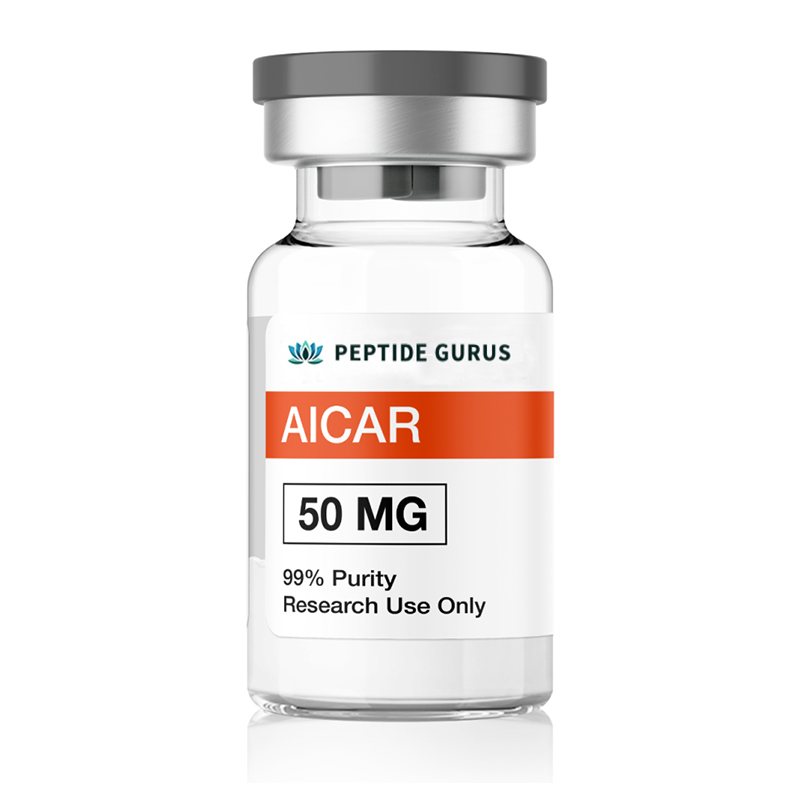
Categorías: Peptides and Their Dosages
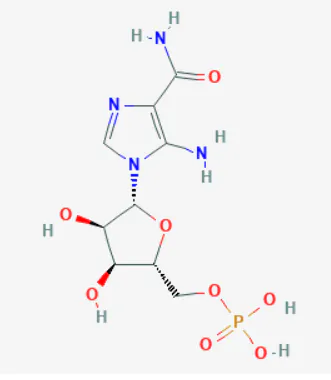 Fuente: PubChem
Secuencia: ribonucleósido de 5-aminoimidazol-4-carboxamida
Fórmula molecular: C9H15N4O8P
Peso molecular: 338,213 g/mol
CID de PubChem: 65110
Número CAS: 3031-94-5
Sinónimos: ribonucleótido AICA, nucleótido Z
Efectos AICAR
AICAR y resistencia a la insulina
La investigación en ratones muestra que AICAR, incluso en dosis bajas, reduce la inflamación en el tejido adiposo. La inflamación de la grasa se asocia con una mayor resistencia a la insulina y la reducción de la inflamación conduce a una mejor homeostasis de la glucosa y una mayor sensibilidad a la insulina incluso sin ningún cambio en el peso corporal. Parece que AICAR tiene varias vías a través de las cuales afecta la inflamación en el tejido adiposo, y al menos una de esas vías involucra SIRT1 y macrófagos [1].
El impacto de AICAR sobre la inflamación adiposa no es inesperado. Se ha descubierto que AMPK atenúa las respuestas inflamatorias en trastornos metabólicos tanto en ratones sanos como diabéticos. En una investigación en ratones, se descubrió que la activación de AMPK, causada por AICAR, mejora la sensibilidad a la insulina, la homeostasis energética, el metabolismo de los lípidos y los marcadores inflamatorios.
El ejercicio aumenta la cantidad de receptores de insulina GLUT-4 que están presentes en la superficie de las células musculares. Es uno de los medios más eficaces para aumentar la absorción de glucosa por las células musculares y reduce eficazmente tanto los niveles de glucosa como la resistencia a la insulina. Resulta que AICAR imita los efectos del ejercicio con mucha precisión y que la administración repetida de AICAR tiene efectos similares a los del ejercicio prolongado[3].
AICAR y la investigación del cáncer
AMPK desempeña un papel complejo en el crecimiento y la metástasis del cáncer, ya que ralentiza y acelera el crecimiento de los tumores en diversas circunstancias. En general, las investigaciones indican que la activación prolongada de la enzima eventualmente conduce a la muerte de las células cancerosas al desacelerar el metabolismo de las células cancerosas y hacer que las células cancerosas sean más susceptibles a las agresiones ambientales. Esto ha sido demostrado tanto en cultivos celulares como en ratas[4, p. 5], [5]. Los científicos están investigando la capacidad de AICAR para trabajar en conjunto con otros agentes quimioterapéuticos para aumentar la eficacia. La idea es que AICAR podría:
reducir los efectos secundarios,
permitir dosis más bajas de fármacos quimioterapéuticos, y
mejorar los resultados en tumores quimiorresistentes[6].
Fuente: PubChem
Secuencia: ribonucleósido de 5-aminoimidazol-4-carboxamida
Fórmula molecular: C9H15N4O8P
Peso molecular: 338,213 g/mol
CID de PubChem: 65110
Número CAS: 3031-94-5
Sinónimos: ribonucleótido AICA, nucleótido Z
Efectos AICAR
AICAR y resistencia a la insulina
La investigación en ratones muestra que AICAR, incluso en dosis bajas, reduce la inflamación en el tejido adiposo. La inflamación de la grasa se asocia con una mayor resistencia a la insulina y la reducción de la inflamación conduce a una mejor homeostasis de la glucosa y una mayor sensibilidad a la insulina incluso sin ningún cambio en el peso corporal. Parece que AICAR tiene varias vías a través de las cuales afecta la inflamación en el tejido adiposo, y al menos una de esas vías involucra SIRT1 y macrófagos [1].
El impacto de AICAR sobre la inflamación adiposa no es inesperado. Se ha descubierto que AMPK atenúa las respuestas inflamatorias en trastornos metabólicos tanto en ratones sanos como diabéticos. En una investigación en ratones, se descubrió que la activación de AMPK, causada por AICAR, mejora la sensibilidad a la insulina, la homeostasis energética, el metabolismo de los lípidos y los marcadores inflamatorios.
El ejercicio aumenta la cantidad de receptores de insulina GLUT-4 que están presentes en la superficie de las células musculares. Es uno de los medios más eficaces para aumentar la absorción de glucosa por las células musculares y reduce eficazmente tanto los niveles de glucosa como la resistencia a la insulina. Resulta que AICAR imita los efectos del ejercicio con mucha precisión y que la administración repetida de AICAR tiene efectos similares a los del ejercicio prolongado[3].
AICAR y la investigación del cáncer
AMPK desempeña un papel complejo en el crecimiento y la metástasis del cáncer, ya que ralentiza y acelera el crecimiento de los tumores en diversas circunstancias. En general, las investigaciones indican que la activación prolongada de la enzima eventualmente conduce a la muerte de las células cancerosas al desacelerar el metabolismo de las células cancerosas y hacer que las células cancerosas sean más susceptibles a las agresiones ambientales. Esto ha sido demostrado tanto en cultivos celulares como en ratas[4, p. 5], [5]. Los científicos están investigando la capacidad de AICAR para trabajar en conjunto con otros agentes quimioterapéuticos para aumentar la eficacia. La idea es que AICAR podría:
reducir los efectos secundarios,
permitir dosis más bajas de fármacos quimioterapéuticos, y
mejorar los resultados en tumores quimiorresistentes[6].
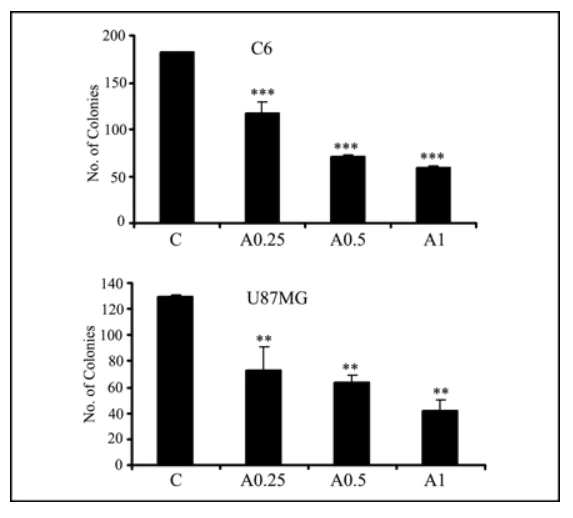 AICAR inhibe el crecimiento clonal de glioma (C6) y células de próstata.
Fuente: Revista de Química Biológica
La investigación en células de cáncer de tiroides indica que AICAR también puede funcionar provocando apoptosis (muerte celular programada). Parece que esta actividad está mediada por la inducción de la acumulación de p21 y la eventual activación de la caspasa 3. El efecto general es la inhibición de la proliferación y supervivencia de las células cancerosas [7].
AICAR inhibe el crecimiento clonal de glioma (C6) y células de próstata.
Fuente: Revista de Química Biológica
La investigación en células de cáncer de tiroides indica que AICAR también puede funcionar provocando apoptosis (muerte celular programada). Parece que esta actividad está mediada por la inducción de la acumulación de p21 y la eventual activación de la caspasa 3. El efecto general es la inhibición de la proliferación y supervivencia de las células cancerosas [7].
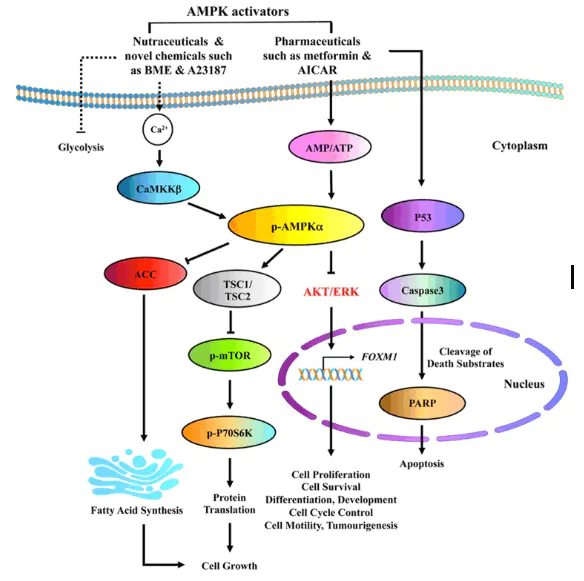 Los activadores de AMPK, como AICAR, influyen en una serie de vías que pueden afectar el crecimiento del cáncer.
Fuente: PubMed
Propiedades antiinflamatorias de AICAR
Se ha demostrado que los activadores de AMPK desempeñan un papel importante en la inflamación a nivel celular. La investigación sobre la metformina, un medicamento común y de uso prolongado para la diabetes, indica que al menos parte de la razón por la que el fármaco es eficaz es que reduce la inflamación y mejora la función del páncreas. AICAR tiene efectos similares y desempeña un papel protector en afecciones inflamatorias como lesión pulmonar aguda, asma, colitis, aterosclerosis y hepatitis [8].
Se están realizando investigaciones sobre el uso de AICAR para mediar los efectos de las enfermedades autoinmunes y otras afecciones inflamatorias. Por ejemplo, los estudios en ratones indican que ACIAR puede ser eficaz para reducir la inflamación en la colitis. Parece que AICAR actúa como un inhibidor central de las respuestas inmunes en este entorno al reducir la activación de NF-kappaB en macrófagos, así como las citocinas de tipo TH1 y TH17 [9].
La Investigación AICAR y el Corazón
Gran parte de las enfermedades cardíacas están relacionadas con la inflamación. La capacidad de controlar la inflamación podría reducir la progresión de la enfermedad vascular, incluida la aterosclerosis. La investigación en modelos de aterosclerosis en conejos indicó que AICAR suprime la proliferación del músculo liso vascular. Este no es sólo un componente importante de la enfermedad cardiovascular, sino también una de las razones por las que los stents cardíacos fallan con el tiempo. Controlar la inflamación vascular podría reducir las complicaciones tanto a corto como a largo plazo de la colocación de un stent sin necesidad de fármacos que aumenten el riesgo de hemorragia[10].
La investigación también sugiere que la activación de AMPK puede suprimir ciertas respuestas inmunes que conducen a la aterosclerosis. La acumulación de LDL, a menudo denominado "colesterol malo", conduce a la proliferación de macrófagos. Este proceso es fundamental para la formación de placas que eventualmente pueden provocar un ataque cardíaco[11]. Cualquier cosa que pueda mitigar esta proliferación tiene el potencial de reducir las enfermedades cardíacas e incluso la prevalencia de ataques cardíacos.
AICAR Investigación y Fertilidad
Gran parte de la investigación de AICAR ha girado en torno a la capacidad del péptido para mejorar la motilidad de los espermatozoides, el metabolismo energético y la capacidad de fertilización. La investigación tanto en gatos, cabras y pollos indica que los activadores de AMPK como AICAR pueden mejorar la motilidad de los espermatozoides al mejorar el metabolismo energético [12]. Parece que AICAR regula la actividad de las enzimas energéticas en los espermatozoides y, por lo tanto, afecta la capacidad de fertilización general [13].
AICAR presenta efectos secundarios mínimos, baja biodisponibilidad oral y subcutánea excelente en ratones. La dosis por kg en ratones no se ajusta a la de los humanos. AICAR a la venta en PEPTIDE GURUS se limita únicamente a la investigación científica y educativa, no para el consumo humano. Compra AICAR únicamente si eres un investigador autorizado.
Autor del artículo
La literatura anterior fue investigada, editada y organizada por el Dr. Logan, M.D. El Dr. Logan tiene un doctorado de la Facultad de Medicina de la Universidad Case Western Reserve y una licenciatura en Ciencias. en biología molecular.
Autor de revista científica
Spencer Gaskin, M.D., Ph.D. es un cardiólogo y médico certificado por la Junta Estadounidense de Medicina Interna. Su experiencia en medicina interna y cardiología proviene de UT Southwestern Cardiology, Washington University Interventional Cardiology y Mid America Heart Institute. El Dr. Gaskin dirigió un estudio que examinó la prevención de la adherencia y el rodamiento de leucocitos postisquémicos mediante el preacondicionamiento con AICAR.
Spencer Gaskin, M.D., Ph.D. Está siendo referenciado como uno de los principales científicos involucrados en la investigación y el desarrollo de AICAR. De ninguna manera este médico/científico respalda o defiende la compra, venta o uso de este producto por ningún motivo. No existe afiliación o relación, implícita o de otro tipo, entre PEPTIDE GURUS y este médico. El propósito de la cita del doctor es reconocer, reconocer y acreditar el exhaustivo esfuerzo de investigación y desarrollo realizado por los científicos que estudian este péptido. El Dr. Gaskin figura en [14] bajo las citas mencionadas.
Citas referenciadas
Z. Yang et al., “La capacidad total de AICAR para reducir la inflamación inducida por la obesidad y la resistencia a la insulina requiere SIRT1 mieloide”, PloS One, vol. 7, núm. 11, pág. e49935, 2012.
K. Pan et al., “La activación de AMPK atenúa la respuesta inflamatoria para reducir los trastornos metabólicos inducidos por PM2.5 ambiental en ratones sanos y diabéticos”, Ecotoxicol. Reinar. Saf., vol. 179, págs. 290–300, septiembre de 2019.
N. Jessen, R. Pold, E. S. Buhl, L. S. Jensen, O. Schmitz y S. Lund, “Efectos de AICAR y el ejercicio sobre la captación de glucosa estimulada por insulina, la señalización y el contenido de GLUT-4 en músculos de rata”, J. Aplica. Fisiol. Bethesda Maryland 1985, vol. 94, núm. 4, págs. 1373-1379, abril de 2003.
J. Zhuge, “La sobreexpresión de CYP2E1 induce la muerte de las células HepG2 mediante el activador de la AMP quinasa 5'-aminoimidazol-4-carboxamida-1-beta-D-ribofuranósido (AICAR)”, Cell Biol. Toxicol., vol. 25, núm. 3, págs. 253–263, junio de 2009.
R. Rattan, S. Giri, A. K. Singh e I. Singh, “5-aminoimidazol-4-carboxamida-1-beta-D-ribofuranósido inhibe la proliferación de células cancerosas in vitro e in vivo mediante la proteína quinasa activada por AMP”, J Biol. Química, vol. 280, núm. 47, págs. 39582–39593, noviembre de 2005.
M. M. H. Yung, H. Y. S. Ngan y D. W. Chan, “Dirigirse a la señalización de AMPK en la lucha contra los cánceres de ovario: oportunidades y desafíos”, Acta Biochim. Biofísica. Pecado, vol. 48, núm. 4, págs. 301–317, abril de 2016.
WG Kim, H.-J. Choi, T. Y. Kim, Y. K. Shong y W. B. Kim, “El efecto del 5-aminoimidazol-4-carboxamida-ribonucleósido fue mediado por la vía de señalización de la proteína quinasa activada por mitógeno p38 en células de cáncer de tiroides FRO”, Korean J. Intern. Medicina, vol. 29, núm. 4, págs. 474–481, julio de 2014.
X.-W. Peng, H.-H. Zhou, J. Dai y L. Zhang, “[Avances sobre el efecto antiinflamatorio y protector de los activadores de AMPK]”, Sheng Li Xue Bao, vol. 71, núm. 2, págs. 319–326, abril de 2019.
A. Bai et al., “Nueva acción antiinflamatoria del ribonucleósido de 5-aminoimidazol-4-carboxamida con efecto protector en la colitis aguda y crónica inducida por sulfato de dextrano sódico”, J. Pharmacol. Exp. Allí, vol. 333, núm. 3, págs. 717–725, junio de 2010.
M. Igata et al., “La proteína quinasa activada por monofosfato de adenosina suprime la proliferación de células del músculo liso vascular mediante la inhibición de la progresión del ciclo celular”, Circ. Res., vol. 97, núm. 8, págs. 837–844, octubre de 2005.
M. Sakai, S. Kobori, A. Miyazaki y S. Horiuchi, “Proliferación de macrófagos en la aterosclerosis”, Curr. Opinión. Lipidol., vol. 11, núm. 5, págs. 503–509, octubre de 2000.
P. Thuwanut, P. Comizzoli, K. Pruksananonda, K. Chatdarong y N. Songsasen, “La activación de la proteína quinasa activada por monofosfato de adenosina (AMPK) mejora el metabolismo energético, la motilidad y la capacidad de fertilización de los espermatozoides criopreservados en un modelo de gato doméstico. ” J. Asistencia. Reproducción. Genet., mayo de 2019.
Z. Zhu et al., “La proteína quinasa activada por 5'-AMP regula las funciones de los espermatozoides de cabra a través del metabolismo energético in vitro”, Cell. Fisiol. Bioquímica. Int. J. Exp. Celúla. Fisiol. Bioquímica. Farmacol., vol. 47, núm. 6, págs. 2420–2431, 2018.
F. Spencer Gaskin, Kazuhiro Kamada, Mozow Yusof, William Durante, Garrett Gross y Ronald J. Korthuis (2009) El preacondicionamiento AICAR previene la adherencia y el rodamiento de leucocitos postisquémicos: función de los canales KATP y la hemooxigenasa, microcirculación, 16:2, 167-176 , DOI: 10.1080/10739680802355897
TODOS LOS ARTÍCULOS E INFORMACIÓN DE PRODUCTOS PROPORCIONADOS EN ESTE SITIO WEB SON SOLO PARA FINES INFORMATIVOS Y EDUCATIVOS.
Los productos ofrecidos en este sitio web se proporcionan únicamente para estudios in vitro. Los estudios in vitro (del latín: en vidrio) se realizan fuera del cuerpo. Estos productos no son medicamentos ni fármacos y no han sido aprobados por la FDA para prevenir, tratar o curar ninguna afección médica, dolencia o enfermedad. La introducción corporal de cualquier tipo en personas o animales está estrictamente prohibida por la ley.
Los activadores de AMPK, como AICAR, influyen en una serie de vías que pueden afectar el crecimiento del cáncer.
Fuente: PubMed
Propiedades antiinflamatorias de AICAR
Se ha demostrado que los activadores de AMPK desempeñan un papel importante en la inflamación a nivel celular. La investigación sobre la metformina, un medicamento común y de uso prolongado para la diabetes, indica que al menos parte de la razón por la que el fármaco es eficaz es que reduce la inflamación y mejora la función del páncreas. AICAR tiene efectos similares y desempeña un papel protector en afecciones inflamatorias como lesión pulmonar aguda, asma, colitis, aterosclerosis y hepatitis [8].
Se están realizando investigaciones sobre el uso de AICAR para mediar los efectos de las enfermedades autoinmunes y otras afecciones inflamatorias. Por ejemplo, los estudios en ratones indican que ACIAR puede ser eficaz para reducir la inflamación en la colitis. Parece que AICAR actúa como un inhibidor central de las respuestas inmunes en este entorno al reducir la activación de NF-kappaB en macrófagos, así como las citocinas de tipo TH1 y TH17 [9].
La Investigación AICAR y el Corazón
Gran parte de las enfermedades cardíacas están relacionadas con la inflamación. La capacidad de controlar la inflamación podría reducir la progresión de la enfermedad vascular, incluida la aterosclerosis. La investigación en modelos de aterosclerosis en conejos indicó que AICAR suprime la proliferación del músculo liso vascular. Este no es sólo un componente importante de la enfermedad cardiovascular, sino también una de las razones por las que los stents cardíacos fallan con el tiempo. Controlar la inflamación vascular podría reducir las complicaciones tanto a corto como a largo plazo de la colocación de un stent sin necesidad de fármacos que aumenten el riesgo de hemorragia[10].
La investigación también sugiere que la activación de AMPK puede suprimir ciertas respuestas inmunes que conducen a la aterosclerosis. La acumulación de LDL, a menudo denominado "colesterol malo", conduce a la proliferación de macrófagos. Este proceso es fundamental para la formación de placas que eventualmente pueden provocar un ataque cardíaco[11]. Cualquier cosa que pueda mitigar esta proliferación tiene el potencial de reducir las enfermedades cardíacas e incluso la prevalencia de ataques cardíacos.
AICAR Investigación y Fertilidad
Gran parte de la investigación de AICAR ha girado en torno a la capacidad del péptido para mejorar la motilidad de los espermatozoides, el metabolismo energético y la capacidad de fertilización. La investigación tanto en gatos, cabras y pollos indica que los activadores de AMPK como AICAR pueden mejorar la motilidad de los espermatozoides al mejorar el metabolismo energético [12]. Parece que AICAR regula la actividad de las enzimas energéticas en los espermatozoides y, por lo tanto, afecta la capacidad de fertilización general [13].
AICAR presenta efectos secundarios mínimos, baja biodisponibilidad oral y subcutánea excelente en ratones. La dosis por kg en ratones no se ajusta a la de los humanos. AICAR a la venta en PEPTIDE GURUS se limita únicamente a la investigación científica y educativa, no para el consumo humano. Compra AICAR únicamente si eres un investigador autorizado.
Autor del artículo
La literatura anterior fue investigada, editada y organizada por el Dr. Logan, M.D. El Dr. Logan tiene un doctorado de la Facultad de Medicina de la Universidad Case Western Reserve y una licenciatura en Ciencias. en biología molecular.
Autor de revista científica
Spencer Gaskin, M.D., Ph.D. es un cardiólogo y médico certificado por la Junta Estadounidense de Medicina Interna. Su experiencia en medicina interna y cardiología proviene de UT Southwestern Cardiology, Washington University Interventional Cardiology y Mid America Heart Institute. El Dr. Gaskin dirigió un estudio que examinó la prevención de la adherencia y el rodamiento de leucocitos postisquémicos mediante el preacondicionamiento con AICAR.
Spencer Gaskin, M.D., Ph.D. Está siendo referenciado como uno de los principales científicos involucrados en la investigación y el desarrollo de AICAR. De ninguna manera este médico/científico respalda o defiende la compra, venta o uso de este producto por ningún motivo. No existe afiliación o relación, implícita o de otro tipo, entre PEPTIDE GURUS y este médico. El propósito de la cita del doctor es reconocer, reconocer y acreditar el exhaustivo esfuerzo de investigación y desarrollo realizado por los científicos que estudian este péptido. El Dr. Gaskin figura en [14] bajo las citas mencionadas.
Citas referenciadas
Z. Yang et al., “La capacidad total de AICAR para reducir la inflamación inducida por la obesidad y la resistencia a la insulina requiere SIRT1 mieloide”, PloS One, vol. 7, núm. 11, pág. e49935, 2012.
K. Pan et al., “La activación de AMPK atenúa la respuesta inflamatoria para reducir los trastornos metabólicos inducidos por PM2.5 ambiental en ratones sanos y diabéticos”, Ecotoxicol. Reinar. Saf., vol. 179, págs. 290–300, septiembre de 2019.
N. Jessen, R. Pold, E. S. Buhl, L. S. Jensen, O. Schmitz y S. Lund, “Efectos de AICAR y el ejercicio sobre la captación de glucosa estimulada por insulina, la señalización y el contenido de GLUT-4 en músculos de rata”, J. Aplica. Fisiol. Bethesda Maryland 1985, vol. 94, núm. 4, págs. 1373-1379, abril de 2003.
J. Zhuge, “La sobreexpresión de CYP2E1 induce la muerte de las células HepG2 mediante el activador de la AMP quinasa 5'-aminoimidazol-4-carboxamida-1-beta-D-ribofuranósido (AICAR)”, Cell Biol. Toxicol., vol. 25, núm. 3, págs. 253–263, junio de 2009.
R. Rattan, S. Giri, A. K. Singh e I. Singh, “5-aminoimidazol-4-carboxamida-1-beta-D-ribofuranósido inhibe la proliferación de células cancerosas in vitro e in vivo mediante la proteína quinasa activada por AMP”, J Biol. Química, vol. 280, núm. 47, págs. 39582–39593, noviembre de 2005.
M. M. H. Yung, H. Y. S. Ngan y D. W. Chan, “Dirigirse a la señalización de AMPK en la lucha contra los cánceres de ovario: oportunidades y desafíos”, Acta Biochim. Biofísica. Pecado, vol. 48, núm. 4, págs. 301–317, abril de 2016.
WG Kim, H.-J. Choi, T. Y. Kim, Y. K. Shong y W. B. Kim, “El efecto del 5-aminoimidazol-4-carboxamida-ribonucleósido fue mediado por la vía de señalización de la proteína quinasa activada por mitógeno p38 en células de cáncer de tiroides FRO”, Korean J. Intern. Medicina, vol. 29, núm. 4, págs. 474–481, julio de 2014.
X.-W. Peng, H.-H. Zhou, J. Dai y L. Zhang, “[Avances sobre el efecto antiinflamatorio y protector de los activadores de AMPK]”, Sheng Li Xue Bao, vol. 71, núm. 2, págs. 319–326, abril de 2019.
A. Bai et al., “Nueva acción antiinflamatoria del ribonucleósido de 5-aminoimidazol-4-carboxamida con efecto protector en la colitis aguda y crónica inducida por sulfato de dextrano sódico”, J. Pharmacol. Exp. Allí, vol. 333, núm. 3, págs. 717–725, junio de 2010.
M. Igata et al., “La proteína quinasa activada por monofosfato de adenosina suprime la proliferación de células del músculo liso vascular mediante la inhibición de la progresión del ciclo celular”, Circ. Res., vol. 97, núm. 8, págs. 837–844, octubre de 2005.
M. Sakai, S. Kobori, A. Miyazaki y S. Horiuchi, “Proliferación de macrófagos en la aterosclerosis”, Curr. Opinión. Lipidol., vol. 11, núm. 5, págs. 503–509, octubre de 2000.
P. Thuwanut, P. Comizzoli, K. Pruksananonda, K. Chatdarong y N. Songsasen, “La activación de la proteína quinasa activada por monofosfato de adenosina (AMPK) mejora el metabolismo energético, la motilidad y la capacidad de fertilización de los espermatozoides criopreservados en un modelo de gato doméstico. ” J. Asistencia. Reproducción. Genet., mayo de 2019.
Z. Zhu et al., “La proteína quinasa activada por 5'-AMP regula las funciones de los espermatozoides de cabra a través del metabolismo energético in vitro”, Cell. Fisiol. Bioquímica. Int. J. Exp. Celúla. Fisiol. Bioquímica. Farmacol., vol. 47, núm. 6, págs. 2420–2431, 2018.
F. Spencer Gaskin, Kazuhiro Kamada, Mozow Yusof, William Durante, Garrett Gross y Ronald J. Korthuis (2009) El preacondicionamiento AICAR previene la adherencia y el rodamiento de leucocitos postisquémicos: función de los canales KATP y la hemooxigenasa, microcirculación, 16:2, 167-176 , DOI: 10.1080/10739680802355897
TODOS LOS ARTÍCULOS E INFORMACIÓN DE PRODUCTOS PROPORCIONADOS EN ESTE SITIO WEB SON SOLO PARA FINES INFORMATIVOS Y EDUCATIVOS.
Los productos ofrecidos en este sitio web se proporcionan únicamente para estudios in vitro. Los estudios in vitro (del latín: en vidrio) se realizan fuera del cuerpo. Estos productos no son medicamentos ni fármacos y no han sido aprobados por la FDA para prevenir, tratar o curar ninguna afección médica, dolencia o enfermedad. La introducción corporal de cualquier tipo en personas o animales está estrictamente prohibida por la ley. PeptideGurus es un proveedor líder de péptidos de investigación fabricados en Estados Unidos y ofrece productos de alta calidad a precios competitivos. Con un enfoque en la excelencia y el servicio al cliente, garantizan un proceso de pedido seguro y conveniente con envío global.
© Copyright Peptide Gurus 2024. Todos los derechos reservados.Privacy Policy
All products on this site are for Research, Development use only. Products are Not for Human consumption of any kind. The statements made within this website have not been evaluated by the US Food and Drug Administration or HEALTH CANADA. The statements and the products of this company are not intended to diagnose, treat, cure or prevent any disease.
PeptideGurus is a chemical supplier. PeptideGurus is not a compounding pharmacy or chemical compounding facility as defined under 503A of the Federal Food, Drug, and Cosmetic act. Peptide Sciences is not an outsourcing facility as defined under 503B of the Federal Food, Drug, and Cosmetic act.
CONTACTO


