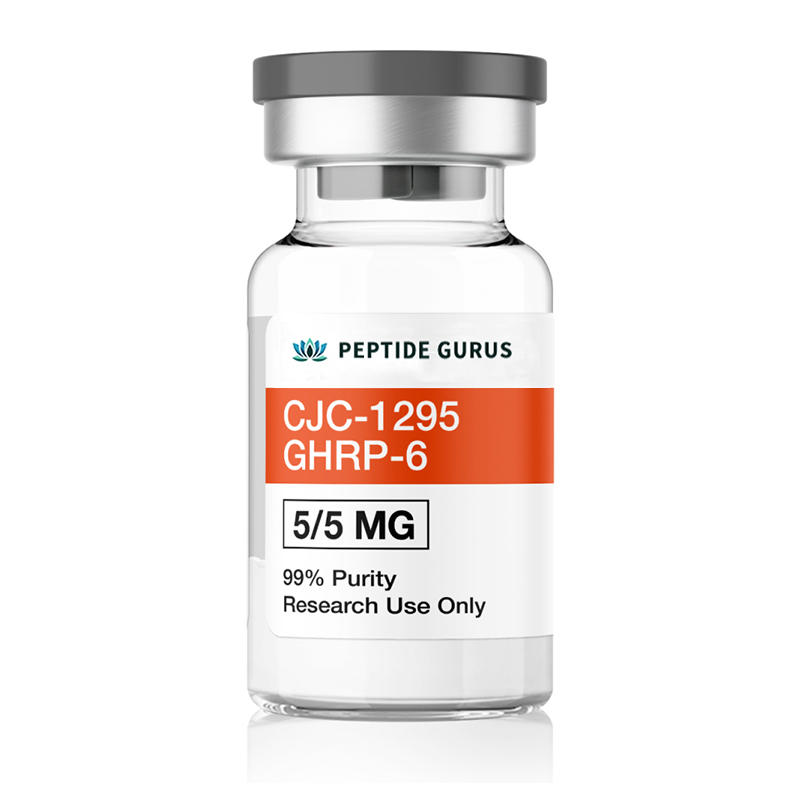
CJC-1295
CJC-1295 es un análogo sintético de la hormona liberadora de la hormona del crecimiento (GHRH) y se une al receptor de GHRH en la glándula pituitaria anterior. es bien conocido por su capacidad para preservar la secreción pulsátil fisiológica de GH al tiempo que aumenta los niveles de GH. GHRP-6 es un análogo sintético de la grelina y se une al receptor secretagogo de la hormona del crecimiento.
Las investigaciones han demostrado que, en combinación, los dos péptidos actúan sinérgicamente para aumentar sustancialmente los niveles de GH. GHRP-6 actúa como un refuerzo de GH de referencia, aumentando el nivel establecido de GH; en otras palabras, GHRP-6 garantiza que el nivel más bajo al que cae la GH sea más alto que en condiciones fisiológicas normales. Luego, CJc-1295 aumentará la liberación de GH de manera pulsátil, utilizando la nueva línea de base más alta establecida por GHRP-6 como valle y creando picos proporcionalmente elevados [1], [2].
Como beneficio adicional, las investigaciones han demostrado que el GHRP-6 estimula el apetito y mejora la calidad del sueño. El aumento del consumo de alimentos permite un mejor uso de los niveles elevados de GH, ya que hay más materia prima a partir de la cual desarrollar músculo, mejorar la densidad ósea y promover el crecimiento. El sueño es el momento durante el cual los animales son más receptivos a los efectos de la G y, por lo tanto, una mejor calidad del sueño ayuda a garantizar que la GH tenga el mayor impacto en funciones como la curación de heridas y la regeneración del sistema inmunológico. Ambos péptidos también se han relacionado con una mejor cicatrización de heridas y la protección del tejido nervioso [3]-[6].
About The Author
La literatura anterior fue investigada, editada y organizada por el Dr. E. Logan, M.D. El Dr. ELogan tiene un doctorado de la Facultad de Medicina de la Universidad Case Western Reserve y una licenciatura en biología molecular.
Scientific JournalAuthor
Márta Korbonits graduated in Medicine in Budapest and undertook her early clinicaltraining at the Internal Medicine Department of the Postgraduate Medical School,Budapest. She joined the Department of Endocrinology at St. Bartholomew’s Hospitalunder the mentorship of Professors Ashley Grossman and Michael Besser. Her MD andlater PhD studies contributed to the understanding of the effects of growth hormone secretagogues on hypothalamic hormone release and the nature and causes of pituitary tumorigenesis. She was awarded an MRC Clinician Scientist Fellowship and commenced studies that produced novel insights into ghrelin physiology and genetics. Her finding srelated to the regulation of the metabolic enzyme AMPK by ghrelin, cannabinoid andglucocorticoid opened a new aspect of hormonal requlation of metabolism. In 2008. MartaKorbonits was promoted to Professor of Endocrinology and Metabolism and since 2012has led the Centre of Endocrinology at Barts and the London School of Medicine. in 2016, Márta Korbonits was appointed a Deputy Head of the William Harvey ResearchInstitute. Professor Korbonits continues to integrate human studies alongside withlaboratory-based research and has pioneered several projects in translational medicine.
Márta Korbonits is being referenced as one of the leading scientists involved in theresearch and development of GHRP-6. In no way is this doctor/scientist endorsing oradvocating the purchase, sale, or use of this product for any reason. There is no affiliationor relationship, implied or otherwise, between PEPTIDE GURUS and this doctor. Thepurpose of citing the doctor is to acknowledge, recoanize, and credit the exhaustiveresearch and development efforts conducted by the scientists studying this peptide. MártaKorbonits is listed ini[7] under the referenced citations.
ReferencedCitations
[1]M. lonescu and L. A. Frohman, “Pulsatile secretion of growth hormone (GH)persists during continuous stimulation by CJC-1295, a long-acting GH-releasinghormone analog,”J.Clin.Endocrinol. Metab., vol.91, no.12,pp.4792-4797, Dec2006.[PubMed]
[2]S.L.Teichman, A. Neale, B.Lawrence, C.Gagnon, J.-P. Castaigne, and L. AFrohman, “Prolonged stimulation of growth hormone (GH) and insulin-like growthfactor l secretion by CJC-1295, a long-acting analog of GH-releasing hormone, inhealthy adults,”J.Clin.Endocrinol. Metab., vol. 91,no.3, pp.799-805, Mar. 2006[PubMed]
[3] Y. Mendoza Marí et al., “Growth Hormone-Releasing Peptide 6 Enhances theHealing Process and lmproves the Esthetic Outcome of the Wounds,” PlasticSurgery International, 2016.[Online]. Available:https://www.hindawi.com/journals/psi/2016/4361702/.[Accessed: 23-May-2019]
[4]M. Fernández-Mayola et al., “Growth hormone-releasing peptide 6 preventscutaneous hypertrophic scarring: early mechanistic data from a proteome study.Int. Wound J., vol.15,no.4, pp.538-546,Aug.2018.[PubMed]
[5]H.-J. Huang et al., “The protective effects of Ghrelin/GHSR on hippocampal neurogenesis in CUMS mice,” Neuropharmacology, May 2019.[PubMed]
[6]N. Subirós et al..“Assessment of dose-effect and therapeutic time window inpreclinical studies of rhEGF and GHRP-6 coadministration for stroke therapy,Neurol. Res., vol.38, no.3, pp.187-195, Mar. 2016.[PubMed]
7]Korbonits, Marta, and Ashley B.Grossman.“Growth Hormone-ReleasingPeptide and lts Analogues.” Trends in Endocrinology& Metabolism, vol. 6, no. 2,Mar.1995, pp.43-49 [PubMed]
ALL ARTICLES AND PRODUCT INFORMATION PROVIDED ON THIS WEBSITE AREFOR INFORMATIONAL AND EDUCATIONAL PURPOSES ONLY.
The products offered on this website are furnished for in-vitro studies only. In-vitro studies(Latin: in glass) are performed outside of the body. These products are not medicines ordrugs and have not been approved by the FDA to prevent, treat or cure any medicalcondition, ailment or disease. Bodily introduction of any kind into humans or animals isstrictly forbidden by law.