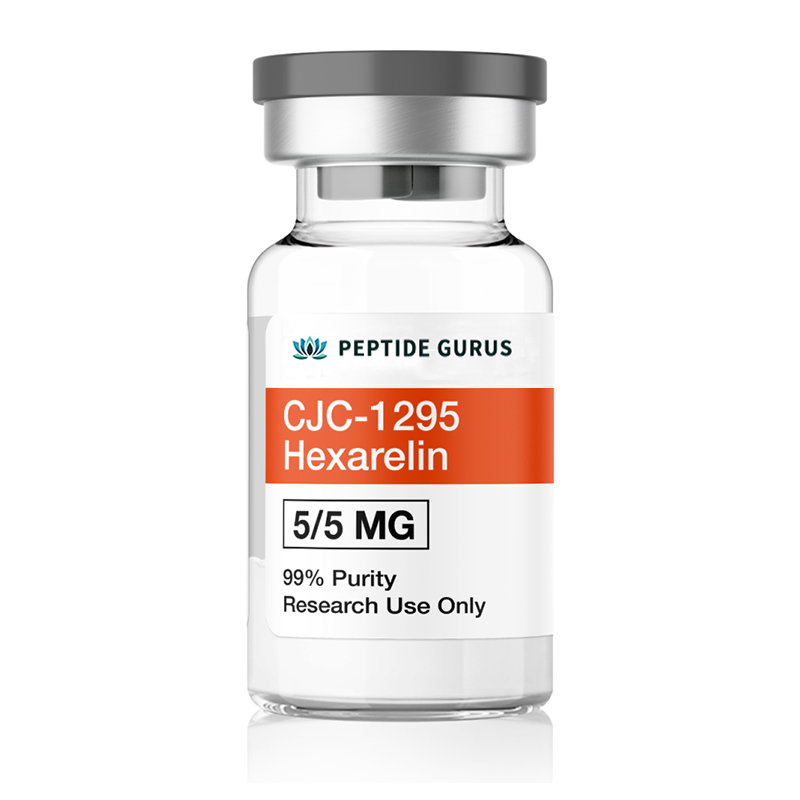
Hexarelina, que es un potente estimulador del receptor secetagogo de la hormona del crecimiento. Cuando se combina con CJC-1295, un crecimiento aumenta los niveles iniciales y máximos de GH en modelos animales, agonistas del receptor de la hormona liberadora de hormonas, los dos estímulos de GH.
Ambos péptidos tienen efectos positivos sobre el músculo cardíaco (corazón). Hexarelin, en particular, ha sido intensamente investigado por su capacidad de ataque). Hay buenas razones para creer que una combinación de ambos protege las células cardíacas del daño durante una lesión isquémica (por ejemplo, los péptidos cardíacos podrían mejorar los resultados durante eventos coronarios agudos, ayudar a la recuperación después de una lesión miocárdica e incluso prevenir una lesión cardíaca en el primer p[1]-[3] .
Hexarelin y CJC-1295 potencian el metabolismo de las grasas y se han relacionado con medidas mejoradas de resistencia a la insulina. La reducción y las mejoras en todo, desde la diabetes tipo 2 hasta el riesgo de la masa de tejido adiposo, están relacionadas con una disminución de la inflamación sistémica del desarrollo de cáncer [4]. Ambos péptidos también están siendo investigados por su capacidad para proteger el músculo de los efectos de la quimioterapia[5][6].
About The Author
La literatura anterior fue investigada, editada y organizada por el Dr. E. Logan, M.D. El Dr. ELogan tiene un doctorado de la Facultad de Medicina de la Universidad Case Western Reserve y una licenciatura en biología molecular.
Scientific JournalAuthor
Aline Moulin’s research while affiliated with French National Centre for Scientificler places are extensive. She is well versed in pharmaceutical Research and otdevelopment, management, external manufacturing operations, quality control, regulatorycontrol, drug deli/ery, and drug discovery research. She has used Hexarelin in multiplestudies to monitoif certain pharmaceuticals were capable of inhibiting many of its effects.
Aline Moulin’s iseing referenced as one of the leading scientists involved in theresearch and deelopment of Hexarelin. In no way is this doctor/scientist endorsing oradvocating the pirchase, sale, or use of this product for any reason. There is no affiliationor relationship, iriplied or otherwise, between PEPTIDE GURUS and this doctor. Thepurpose of citingthe doctor is to acknowledge, recognize, and credit the exhaustiveelopment efforts conducted by the scientists studying this peptide. Alineresearch and deMoulin is listed ir[8]under the referenced citations.
Resources
1.X.Zhang, L. Qu, L. Chen, and C.Chen,“|mprovement of cardiomyocyte functionby in vivo hexarelin treatment in streptozotocin-induced diabetic rats,” Physiol.Rep., vol.6, no.4,2018.[PubMed]
2.J. Huang, Y. Li, J.Zhang, Y. Liu, and O. Lu, “The Growth Hormone SecretagogueHexarelin Protects Rat Cardiomyocytes From in vivo lschemia/Reperfusion InjuryThrough Interleukin-1 Signaling Pathway,” Int. Heart. J., vol. 58, no.2, pp.257-263, Apr. 2017.[PubMed]
3.Y. Ma, L. Zhang, J.N.Edwards, B.S. Launikonis, and C. Chen, “Growth hormonesecretagogues protect mouse cardiomyocytes from in vitro ischemia/reperfusioninjury through requlation of intracellular calcium,” PloS One, vol. 7, no. 4, p.e35265.2012
4.R. Mosa et al.“Hexarelin,a Growth Hormone Secretagoaue, lmproves LipidMetabolic Aberrations in Nonobese Insulin-Resistant Male MKR Mice,Endocrinology,vol.158,no.10,pp.3174-3187,01 2017.[PubMed]
5.E. Conte et al.. “Growth hormone secretagoaues prevent dvsreaulation of skeletalmuscle calcium homeostasis in a rat model of cisplatin-induced cachexia,” J.Cachexia Sarcopenia Muscle, vol. 8, no.3, pp.386-404, Jun.2017.[PubMed]
6.G. Sirago et al., “Growth hormone secretagogues hexarelin and JMV2894 protectskeletal muscle from mitochondrial damages in a rat model of cisplatin-inducedcachexia,”Sci. Rep., vol.7, Oct. 2017.[Nature]
7.X. Zhang, L. Qu, L. Chen, and C.Chen,“lmprovement of cardiomyocyte functionby in vivo hexarelin treatment in streptozotocin-induced diabetic rats,” Physiol.Rep., vol.6, no.4,2018.[PubMed]
8.Torsello, Antonio & Bresciani, Elena & Tamiazzo, Laura & Bulgarelli, llaria &Caporali, Simona & Moulin, Aline & Fehrentz, jean-alain & Martinez, Jean &Perissoud, Daniel & Locatelli, Vittorio.(2008).Novel potent and selective non-peptide ligands of ghrelin receptor : characterization of endocrine andextraendocrine actions.Research Gate.
ALL ARTICLES AND PRODUCT INFORMATION PROVIDED ON THIS WEBSITE AREFOR INFORMATIONAL AND EDUCATIONAL PURPOSES ONLY.
The products offered on this website are furnished for in-vitro studies only. in-vitro studies(Latin: in glass) are performed outside of the body. These products are not medicines ordrugs and have not been approved by the FDA to prevent, treat or cure any medicalcondition, ailment or disease, Bodilv introduction of any kind into humans or animals isstrictly forbidden by law.