




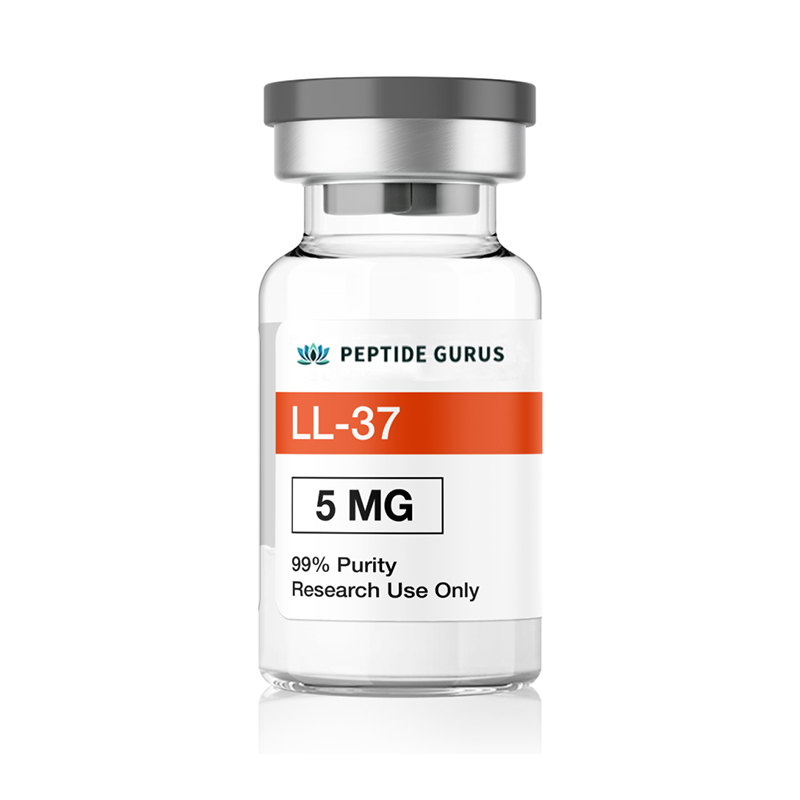
Gratis (1) 30 ml Bacteriostatisch Water
with qualified orders over $500 USD.
(excludes capsule products, cosmetic peptides, promo codes and shipping)
LL-37 heeft, net als alle cathelicidines, antimicrobieel, antibacterieel, antiviraal, anti-schimmel en is aangetoond dat het ontstekingen vermindert. Onderzoek heeft ook aangetoond dat het effect ervan tegen bepaalde kankers en de groei van bloedvaten in specifieke omgevingen aanmoedigt.
Product Usage: This PRODUCT IS INTENDED AS A RESEARCH CHEMICAL ONLY. This designation allows the use of research chemicals strictly for in vitro testing and laboratory experimentation only. All product information available on this website is for educational purposes only. Bodily introduction of any kind into humans or animals is strictly forbidden by law. This product should only be handled by licensed, qualified professionals. This product is not a drug, food, or cosmetic and may not be misbranded, misused or mislabled as a drug, food or cosmetic.
Wat is LL-37 (CAP-18)?
LL-37 is de enige bekende menselijke cathelicidine, een grote eiwitfamilie met een diverse functie. Deze peptiden, die voornamelijk worden gevonden in macrofagen en polymorfonucleaire leukocyten (beide soorten witte bloedcellen), zijn belangrijk voor het doden van bacteriën, maar bleken ook andere dramatische effecten te hebben. De hele klasse wordt vaak antimicrobiële peptiden (AMP's) genoemd. LL-37 is gebleken een belangrijke rol te spelen bij auto-immuunziekten, kanker en wondgenezing.
LL-37 structuur

LL-37 onderzoek
LL-37 en ontstekingsziekten
LL-37, hoewel voornamelijk gefactureerd als een antimicrobieel peptide, speelt eigenlijk een rol bij een aantal inflammatoire ziekten zoals psoriasis, lupus, reumatoïde artritis en atherosclerose. Afhankelijk van de lokale ontstekingsomgeving en de specifieke cellen, heeft LL-37 verschillende modulerend gedrag van het immuunsysteem. Het is gevonden om:- decrease keratinocyte apoptosis,
- increase IFN-alpha production,
- alter chemotaxis of neutrophils and eosinophils,
- down-regulate signaling through toll-like receptor 4 (TLR4),
- verhoog de productie van IL-18, en
- Verlaag niveaus van atherosclerotische plaques[1].

LL-37 is een krachtige antimicrobiële
LL-37 maakt deel uit van het aangeboren immuunsysteem en is als zodanig een van de eerste stukken van het immuunsysteem dat tijdens infectie wordt geactiveerd. Onderzoek bij huidinfecties suggereert dat de normale huid zeer lage niveaus van LL-37 heeft, maar dat het peptide zich snel ophoopt in aanwezigheid van binnenvallende pathogenen. Het is aangetoond dat het peptide samenwerkt met andere eiwitten, zoals menselijke bèta-defensine 2 om infectie te bestrijden[3]. LL-37 primarily works by binding to bacterial lipopolysaccharide (LPS), a major component of the outer membrane of gram-negative bacteria. LPS is a critical component of membrane integrity in these bacteria. The ability of LL-37 to bind to and interfere with LPS means it is exceptionally deadly to certain bacteria. There is interest in using the peptide exogenously to treat serious bacterial infections in people[4]. Despite the fact that LL-37 acts on the cell membrane components of gram-negative bacteria, it still has potent gram-positive effects as well. This could make it a beneficial treatment for staph infections and other serious bacteria. In vitro research indicates that LL-37 enhances the effects of lysozyme, an enzyme responsible for the destruction of gram positive bacteria like Staph aureus[5].LL-37 en longziekte
LPS, zoals hierboven vermeld, is niet uniek voor bacteriële celwanden. Het wordt gevonden in een aantal verschillende organismen en wordt in sommige gevallen in de lucht wanneer een omgeving is besmet door schimmel of andere schimmels. Wanneer LPS wordt ingeademd, reageert het normale longweefsel door te produceren. Helaas is de reactie vaak onvoldoende om het toxische stofsyndroom te voorkomen en de pathogenese van luchtwegaandoeningen zoals astma, COPD en meer. Onderzoek naar het gebruik van LL-37 als een ingeademde behandeling voor het toxische stofsyndroom is momenteel aan de gang[6]. One of the interesting findings of research into the effects of LL-37 on lung disease is that the peptide promotes epithelial cell proliferation and wound closure. It appears that one of the primary properties of LL-37, at least in the lungs, is to attract airway epithelial cells to the site of injury and promote both wound healing and the growth of blood vessels necessary for providing nutrients to the new tissue. It seems that LL-37 is an important homeostatic regulator in the airways just as it has been found to be a homeostatic regulator of immune function[7].Inzicht in LL-37 bij artritis
Onderzoek bij ratten geeft aan dat LL-37 wordt gevonden in hoge concentraties in gewrichten die worden beïnvloed door reumatoïde artritis. In het bijzonder lijkt het peptide geassocieerd te zijn met de pathologische gebeurtenissen van artritis. Het is echter niet duidelijk als het peptide oorzakelijk is of de opregulatie ervan in deze gewrichten is een onderdeel van de poging van het lichaam om het pathologische proces te beheersen[8]. Several things, however, suggest that LL-37 is beneficial in inflammation and not causative. First, there is no evidence that LL-37 or any other cathelicidin is involved in the pathogenesis of inflammatory disease. This does not rule the peptide out as being causative, the but evidence weighs pretty heavily against that being the case. In particular, LL-37 deficiency does not affect outcomes in animal models of arthritis or lupus. In other words, animals without LL-37 experience the same pathological progression as animals who have the peptide. Based on these findings, scientists have suggested that reactivity against cathelicidins in arthritis is likely an epiphenomenon that results from extensive over-expression of the peptide in inflamed tissues[9]. In other words, it is incidental. Research in mouse models of arthritis indicate that peptides derived from LL-37 confer protection against collagen damage that often occurs in inflammatory arthritis. Administration of these peptides directly to affected joints decreases the severity of disease as well as serum levels of antibody against type II collagens[10]. Op basis van deze studie is het redelijk om te speculeren dat LL-37 waarschijnlijk beschermende activiteit heeft bij artritis, wat de hoge concentraties in weefsels met aanzienlijke ontsteking zou kunnen verklaren. Deze speculatie wordt ondersteund door het feit dat is aangetoond dat LL-37 en zijn derivaten ontstekingen reguleren veroorzaakt door interleukine-32, een molecuul dat direct is geassocieerd met de ernst van inflammatoire artritis[11]. Arthritis has also been associated with an up-regulation of toll-like receptor 3 in the fibroblasts of synovial fluid, a factor that likely aggravates arthritis by increasing inflammatory cytokine levels[12]. Het is aangetoond dat LL-37 bindt aan TLR4 en ofwel pro-inflammatoire of ontstekingsremmende effecten bevorderen. Wat het doet in de setting van TLR3-opregulatie is niet duidelijk, maar onderzoek is aan de gang. Het idee dat het selectief ontstekingen kan verminderen, is niet onredelijk, aangezien LL-37 is gevonden om selectief pro-inflammatoire macrofaagreacties in het verleden te verminderen[13].LL-37 en de darm
Onderzoek in celculturen geeft aan dat LL-37 verschillende effecten heeft in de darm. Ten eerste verhoogt het peptide de migratie van cellen die nodig zijn voor het handhaven van de epitheliale barrière van de darm. Ten tweede vermindert LL-37 apoptose in de setting van darmontsteking, waardoor de pathogenese van een aantal inflammatoire aandoeningen wordt vertragen. Over het algemeen geeft het onderzoek aan dat LL-37 een nuttige adjuvante behandeling kan zijn in inflammatoire darmaandoeningen, na darmchirurgie of in de setting van acute darminfecties. Het kan zelfs nuttig blijken te zijn als adjuvans voor antibioticatherapie, waardoor de GI -bijwerkingen worden voorkomen die vaak het oraal antibioticagebruik beperken[14]. LL-37 does not work alone in the intestine, pairing once again with human beta defensin 2 to promote wound healing. Research in cell culture indicates that the peptides work in tandem to both repair and maintain intestinal epithelium while reducing TNF-related cell death[15]. Momenteel zijn TNF-alfa-remmers een steunpilaar van de behandeling voor inflammatoire darmaandoeningen. Ze zijn effectieve medicijnen, maar hebben een aantal ernstige bijwerkingen, waaronder het veroorzaken van een drastische toename van het risico op ernstige infectie, zoals tuberculose. De ontwikkeling van op LL-37 gebaseerde behandelingen van inflammatoire darmaandoeningen zou kunnen helpen de afhankelijkheid van TNF-alfa-remmers te verminderen en de morbiditeit en mortaliteit bij deze patiëntenpopulatie te verbeteren.LL-37 en darmkanker
Onderzoek met betrekking tot LL-37 en kanker heeft gemengde resultaten opgeleverd, maar het peptide lijkt gunstig te zijn in de setting van darm- en maagkankers, waaronder orale plaveiselcelcarcinoom geassocieerd met roken en tabaksgebruik. Interessant is dat deze effecten lijken te worden gemedieerd door een vitamine-D-afhankelijke route, wat kan verklaren waarom het nemen van de vitamine eerder is geassocieerd met een verminderd risico op GI-kanker. Het lijkt erop dat vitamine D de anti-kankeractiviteit van tumor-geassocieerde macrofagen induceert via LL-37[16].LL-37 en de groei van het bloedvat
LL-37 lijkt de synthese van prostaglandine E2 (PGE2) in endotheelcellen te activeren. PGE2 wordt geassocieerd met zowel inflammatoire pijn als met de groei van bloedvaten, maar deze effecten verschillen op basis van waar het molecuul wordt uitgedrukt. In endotheelcellen activeert PGE2 de ontwikkeling van bloedvaten in een proces dat angiogenese wordt genoemd[17]. Dit kan zowel goed als slecht zijn, afhankelijk van de specifieke instelling. Het vermogen om angiogenese te reguleren is de focus geweest van veel onderzoek in de afgelopen decennia omdat het van invloed is op de ontwikkeling van kanker, hartaandoeningen, uitkomsten van beroertes, wondgenezing en meer. LL-37-activiteit biedt een nuttig middel om de angiogenese-route te onderzoeken, evenals een model voor potentiële toekomstige interventies om zowel de groei van het bloedvat te bevorderen wanneer dat nodig is (bijvoorbeeld hartaandoeningen) en het ontmoedigen wanneer het schadelijk is (bijvoorbeeld kanker).Lopend LL-37 onderzoek
Een van de interessante dingen van LL-37 is dat het een andere structuur bij mensen heeft dan bij andere zoogdieren[18]. These alternative structures result in different functions for the same basic peptide and provide insight into how three-dimensional configuration can impact receptor binding. This feature makes LL-37 of intense interest because it allows scientists to study the impacts of simple amino acid sequence changes on structure and ultimately function. This could inform an entire branch of biochemistry and make it easier for scientists to manipulate protein production to achieve very specific results.
LL-37 exhibits minimal to moderate side effects, low oral and excellent subcutaneous bioavailability in mice. Per kg dosage in mice does not scale to humans. LL-37 for sale at
Peptidegoeroes is alleen beperkt tot educatief en wetenschappelijk onderzoek, niet voor menselijke consumptie. Koop alleen LL-37 als u een erkende onderzoeker bent.
Artikelauteur
The above literature was researched, edited and organized by Dr. Logan, M.D. Dr. Logan holds a doctorate degree from Case Western Reserve University School of Medicine and a B.S. in molecular biology.
Wetenschappelijke tijdschrift Auteur
Daniela Jindoli, PhD. operates from the University of Trieste, UNITS · Department of Life Sciences. Her focus surrounds gram-negative bacteria, the biological activities of LL-37 on simultaneously modulating pro-inflammatory and anti-inflationary pathways, and the antibacterial and antimicrobial effects of LL-37.
Daniela Jindoli, PhD. wordt waarnaar wordt verwezen als een van de toonaangevende wetenschappers die betrokken zijn bij het onderzoek en de ontwikkeling van LL-37. Op geen enkele manier is deze arts/wetenschapper de aankoop, verkoop of het gebruik van dit product om welke reden dan ook goed te goedkeuren of te bepleiten. Er is geen aansluiting of relatie, geïmpliceerd of anderszins, tussen
Peptidegoeroes and this doctor. The purpose of citing the doctor is to acknowledge, recognize, and credit the exhaustive research and development efforts conducted by the scientists studying this peptide. Daniela Xhindoli, PhD. is listed in [18] under the referenced citations.
Vermeld citaten
- J. M. Kahlenberg en M. J. Kaplan, “Little peptide, big effects: the role of LL-37 in inflammation and autoimmune disease, ”J. Immunol. Baltim. MD 1950, deel 191, nr. 10, november 2013.
- D. S. Alexandre-Ramos et al., “LL-37 treatment on human peripheral blood mononuclear cells modulates immune response and promotes regulatory T-cells generation, ”Biomed. Pharmacother. Biomedecine Pharmacother., Vol. 108, pp. 1584-1590, december 2018.
- P. Y. Ong et al., “Endogenous antimicrobial peptides and skin infections in atopic dermatitis, ”N. Engl. J. Med., Vol. 347, nr. 15, pp. 1151–1160, oktober 2002.
- C. D. Cirori, T. Sigurdardóttir, A. Schmidtchen en M. Bodelsson, "Antimicrobial and chemoattractant activity, lipopolysaccharide neutralization, cytotoxicity, and inhibition by serum of analogs of human cathelicidin LL-37, ”Antimicrob. Agenten Chemother., Vol. 49, no. 7, pp. 2845–2850, juli 2005.
- X. Chen et al., “Synergistic effect of antibacterial agents human β-defensins, cathelicidin LL-37 and lysozyme against Staphylococcus aureus and Escherichia coli, ”J. Dermatol. Sci., Vol. 40, nr. 2, pp. 123–132, november 2005.
- M. Golec, "Cathelicidin LL-37: LPS-neutralizing, pleiotropic peptide, ”Ann. Agric. Environ. Med. AAM, Vol. 14, nr. 1, pp. 1–4, 2007.
- R. Shaykhiev et al., “Human endogenous antibiotic LL-37 stimulates airway epithelial cell proliferation and wound closure, ”Am. J. Physiol. Lung Cell. Mol. Physiol., Vol. 789, no. 5, pp. L842-848, november 2005.
- M. H. H. Hoffmann et al., “The cathelicidins LL-37 and rCRAMP are associated with pathogenic events of arthritis in humans and rats, ”Ann. Rheum. Dis., Vol. 72, nr. 7, pp. 1239–1248, juli 2013.
- D. Kienhöfer et al., “No evidence of pathogenic involvement of cathelicidins in patient cohorts and mouse models of lupus and arthritis, ”PLOS ONE, deel 9, nr. 12, p. E115474, 2014.
- L. N. Y. Chow et al., “Human cathelicidin LL-37-derived peptide IG-19 confers protection in a murine model of collagen-induced arthritis, ”Mol. Immunol., Vol. 57, no. 2, pp. 86–92, februari 2014.
- K.-Y. G. Choi, S. Napper en N. Mookherjee, “Human cathelicidin LL-37 and its derivative IG-19 regulate interleukin-32-induced inflammation, ”Immunology, Vol. 143, nr. 1, pp. 68–80, september 2014.
- W. Zhu et al., “Arthritis is associated with T-cell-induced upregulation of Toll-like receptor 3 on synovial fibroblasts, ”Artritis Res. Ther., Vol. 13, nr. 3, p. R103, juni 2011.
- K. L. Brown et al., "Host Defensie Peptide LL-37 vermindert selectief pro-inflammatoire macrofaagreacties," J. Immunol. Baltim. MD 1950, Vol. 186, nee. 9, pp. 5497–5505, mei 2011.
- J.-M. Otte et al., "Effects of the cathelicidin LL-37 on intestinal epithelial barrier integrity, ”Regul. Pept., Vol. 156, nr. 1–3, pp. 104–117, augustus 2009.
- J.-M. Otte et al., "Human beta defensin 2 promotes intestinal wound healing in vitro, ”J. Cell. Biochem., Vol. 104, nr. 6, pp. 2286–2297, augustus 2008.
- X. Chen et al., “Roles and Mechanisms of Human Cathelicidin LL-37 in Cancer, ”Cell. Physiol. Biochem. Int. J. Exp. Cell. Physiol. Biochem. Pharmacol., Vol. 47, no. 3, pp. 1060-1073, 2018.
- M. Dolors, Birth Antony, Lennart Lindbo, Lennart, Birget en Nieuws.Cathelicidin LL-37 Induces Angiogenesis via PGE2–EP3 Signaling in Endothelial Cells, In Vivo Inhibition by Aspirin, ”Arterioscler. Thromb. Vasc. Biol., Vol. 33, no. 8, pp. 1965–1972, augustus 2013.
- D. Xhindoli, S. Pacor, M. Benincasa, M. Scocchi, R. Gennaro en A. Tossi, “The human cathelicidin LL-37 — A pore-forming antibacterial peptide and host-cell modulator, ”Biochim. Biophys. Acta BBA - Biomembr., Vol. 1858, nr. 3, pp. 546–566, maart 2016.


