

Kategorie:Bioregulatory peptydów, Produkt peptydowy, Peptydy i ich dawki

Wolna (1) 30 ml wody bakteriostatycznej
z rozkazami kwalifikowanymi po zakończeniu500 USD.
(z wyłączeniem produktów kapsułkowych, peptydów kosmetycznych, kodów promocyjnych i wysyłki)
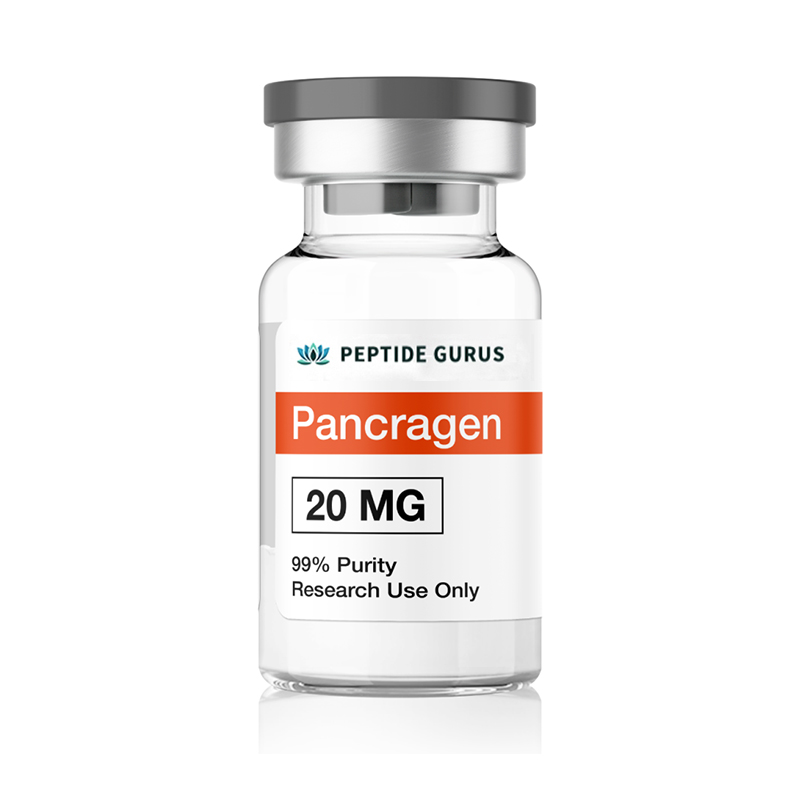
Pancragen is a naturally occurring tetrapeptide bioregulator that has primary effects on the pancreas. Pancragen research has shown it to help control blood sugar, improve endocrine function of the pancreas, regulate melatonin expression, and reduce the incidence and magnitude of metabolic syndrome. It has been researched and is of interest in the treatment of both diabetes and the metabolic effects of aging. Pancragen can be thought of as an anti-aging peptide for the pancreas.
Wykorzystanie produktu:Ten produkt PRZEZNACZONY JEST WYŁĄCZNIE JAKO SUBSTANCJA CHEMICZNA BADAWCZA.To oznaczenie pozwala na stosowanie chemikaliów badawczych wyłącznie do testów in vitro i eksperymentów laboratoryjnych. Wszystkie informacje o produktach dostępne na tej stronie mają charakter wyłącznie edukacyjny. Wprowadzenie ciała jakiegokolwiek rodzaju do ludzi lub zwierząt jest surowo zabronione przez prawo. Tym produktem powinni zajmować się wyłącznie licencjonowani, wykwalifikowani profesjonaliści. Ten produkt nie jest lekiem, żywnością ani kosmetykiem i nie może być błędnie oznakowany, niewłaściwie używany ani błędnie określany jako lek, żywność czy kosmetyk.
Pancragen is a naturally occurring tetrapeptide bioregulator that, as the name implies, has primary effects on the pancreas. Not to be confused with the DNA-based PancraGEN test, Pancragen has been shown to help control blood sugar, improve endocrine function of the pancreas, regulate melatonin expression, and reduce the incidence and magnitude of metabolic syndrome. It has been investigated and is of interest in the treatment of both diabetes and the metabolic effects of aging. To some extent, Pancragen can be thought of as an anti-aging peptide for the pancreas.
Sekwencja aminokwasów:Lys-Glu-Asp-Trp (KEDW)
Wzór molekularny:C26H36N6Lub9Masa cząsteczkowa:576.25 g/mol
PubChem CID: 68452887
Synonimy:SCHEMBL5491754

Research on pancreatic cells shows that Pancragen stimulates the expression of a number of differentiation factors that control the growth of acinar and islet of Langerhans cells. The latter are responsible for insulin and glucagon[1]. Though this may not seem like an anti-aging effect, it should b clear that restoration of improved growth and differentiation is a feature of young, healthy tissues. Improving these parameters, particularly in older tissues, is fundamentally an anti-aging effect. Throughout the rest of the sections of Pancragen, additional reasons for its classification as an anti-aging peptide will be manifest. In particular, its ability to change the epigenetic regulation of DNA to improve gene expression is one of the clearest indications that Pancragen can turn back the clock on DNA to promote function more in keeping with youth.
Further supporting the idea that Pancragen is an anti-aging peptide are its effects on metabolic disorders. Research shows that metabolic dysregulation in older people is at least partially caused by changes in melatonin secretion during sleep. This melatonin deficiency appears to be caused by changes in insulin levels, suggesting that loss of insulin function, both in disease and as a result of old age, may be responsible for changes in melatonin secretion, which is then responsible for some of the other symptoms of metabolic syndrome[2].
Based on the above line of thought, it stands to reason that administration of Pancragen, which helps to normalize insulin secretion, could further reduce symptoms of metabolic syndrome by normalizing melatonin secretion. In fact, this is precisely what research reveals. Administration of Pancragen decreases glucose levels but also reduces plasma concentrations of insulin as well as the insulin resistance index which are strong indications that Pancragen is having a direct effect on melatonin signaling[2].
Both exogenous and endogenous melatonin inhibit the pathophysiological mechanisms of metabolic syndrome and normalize metabolism[3]. Research shows that melatonin receptors exist in the pancrease where they serve to modulate insulin and glucagon signaling in a diurnal (daylight-sensitive) fashion[4]. There is a lot of new research focusing on how disruptions in melatonin signaling are linked to the development of type 2 diabetes and metabolic syndrome.
If melatonin affects the pancreas, then is stands to reason that there is likely a feedback mechanism by which glucagon and insulin signal to the pineal gland whether to increase or decrease melatonin release. In fact, this feedback loop exists and, in type 2 diabetes, appears to be responsible for the additional metabolic effects that arise in this version of the disease that are less common in type 1 diabetes. This would explain why Pancragen’s ability to regulate insulin secretion of the pancreas also has beneficial effects on other symptoms of metabolic syndrome.

Of course, the most obvious use for Pancragen is in the treatment of diabetes, hyperinsulinemia, and elevated blood glucose levels. Research in rhesus monkeys comparing Pancragen to glimepiride (a widely used drug for lowering blood sugar) reveals that while both compounds can reduce blood sugar levels to normal baselines, only Pancragen normalizes insulin levels and C-peptide levels[5], [6]. This would suggest that Pancragen is having a more physiologic effect, striking at the very heart of what causes elevated blood sugar and correcting the problem at a more fundamental level.
Research in old monkeys shows that Pancragen normalizes plasma insulin, C-peptide, and glucose levels within 10 days and that the effect lasts, at least partially, for as long as 3 weeks[7], [8]. This suggests that Pancragen might be useful in restoring pancreatic function in elderly individuals or maintaining it as we age. This can help to normalize the metabolic system and reduce the impact of everything from osteoporosis to dementia.
Additional research in cell cultures shows that Pancragen increases the expression of matrix metalloproteinases MMP2 and MMP9. It also increases the expression of serotonin, glycoprotein CD79alpha, and the anti-apoptotic protein MCl1 while decreasing levels of the pro-apoptotic protein p53. Additionally, levels of proliferation markers PCNA and Ki67 are increased. Vasili Ashapkin, author of the textbookDNA Methylation in Plantsand collaborator with Vladimir Khavinson, points out that these findings collectively indicate that Pancragen activates the expression of signaling molecules associated with increased differentiation and functionality of pancreatic islet cells[9], [10]. These effects can only be accounted for by a broad functional mechanism such as direct alteration of DNA expression and condensation patterns. In other words, Pancragen is likely working at a very fundamental level within the DNA to alter the expression of multiple genes.
One of the most serious consequences of diabetes is on the function of small blood vessels called capillaries. Elevated glucose levels cause these capillaries to first become leak and then to die off as the cells that make them up, called endothelial cells, become dysfunctional and then die. Many of the long-term consequences of diabetes like heart disease, kidney disease, erectile dysfunction, and loss of limb result from damage to and loss of capillaries.
Research on Pancragen shows that it helps to normalize the adhesion of mesenteric capillary endothelium[11]. These findings suggest that Pancragen could protect the endothelium from some of the effects of diabetes, thus helping to stave off long-term consequences of the disease.
One of the most serious consequences of diabetes is on the function of small blood vessels called capillaries. Elevated glucose levels cause these capillaries to first become leak and then to die off as the cells that make them up, called endothelial cells, become dysfunctional and then die. Many of the long-term consequences of diabetes like heart disease, kidney disease, erectile dysfunction, and loss of limb result from damage to and loss of capillaries.
Powyższa literatura została zbadana, zredagowana i zorganizowana przez dr E. Logana, M.D. Dr E. Logan posiada tytuł doktoraWydział Medyczny Case Western Reserve Universityoraz licencjat z biologii molekularnej.

Prof. Vladimir Khavinson is being referenced as one of the leading scientists involved in the research and development of Pancragen. In no way is this doctor/scientist endorsing or advocating the purchase, sale, or use of this product for any reason. There is no affiliation or relationship, implied or otherwise, between
WSZYSTKIE ARTYKUŁY I INFORMACJE O PRODUKTACH ZAMIESZCZONE NA TEJ STRONIE MAJĄ CHARAKTER WYŁĄCZNIE INFORMACYJNY I EDUKACYJNY.
Produkty oferowane na tej stronie są przeznaczone wyłącznie do badań in vitro. Badania in vitro (łac. w szkle) przeprowadza się poza ciałem. Te produkty nie są lekami ani lekami i nie zostały zatwierdzone przez FDA do zapobiegania, leczenia lub leczenia jakichkolwiek schorzeń, dolegliwości czy chorób. Wprowadzenie ciała jakiegokolwiek rodzaju do ludzi lub zwierząt jest surowo zabronione przez prawo.
PeptideGurus jest wiodącym dostawcą amerykańskich peptydów badawczych, oferującym produkty najwyższej jakości w konkurencyjnych cenach. Stawiając na doskonałą jakość i obsługę klienta, zapewniają bezpieczny i wygodny proces zamawiania z globalną wysyłką.
KONTAKT


