Envoyez-nous un e-mail dès maintenant pour passer votre commande avec un support individuel. Stock limité ! Nous acceptons Zelle, CashApp, Venmo, virements bancaires et cryptomonnaies.
Eau bactériostatique libre (1) 30 ml with qualified orders over $500 USD.
(excludes capsule products, cosmetic peptides, promo codes and shipping)
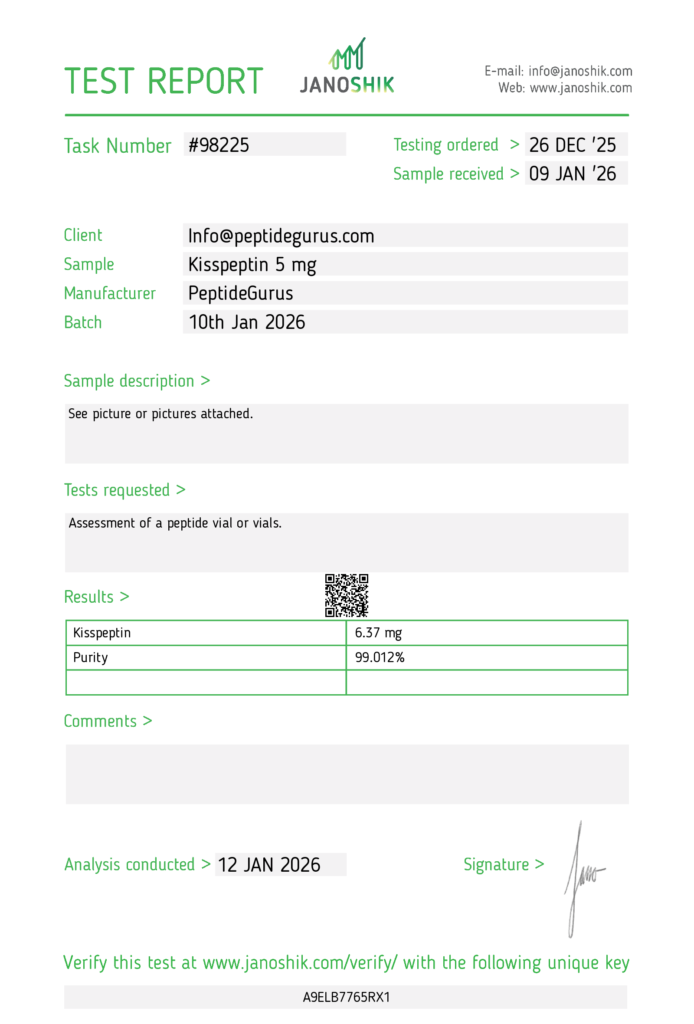
La kisspeptine agit pour contrôler la sécrétion d'hormones en ce qui concerne la reproduction. La kisspeptine peut influencer les niveaux de testostérone et les comportements liés au sexe comme la conduite et la motivation. La recherche suggère également que cela peut aider à inverser certains des effets du vieillissement.
Product Usage: This PRODUCT IS INTENDED AS A RESEARCH CHEMICAL ONLY. This designation allows the use of research chemicals strictly for in vitro testing and laboratory experimentation only. All product information available on this website is for educational purposes only. Bodily introduction of any kind into humans or animals is strictly forbidden by law. This product should only be handled by licensed, qualified professionals. This product is not a drug, food, or cosmetic and may not be misbranded, misused or mislabled as a drug, food or cosmetic.
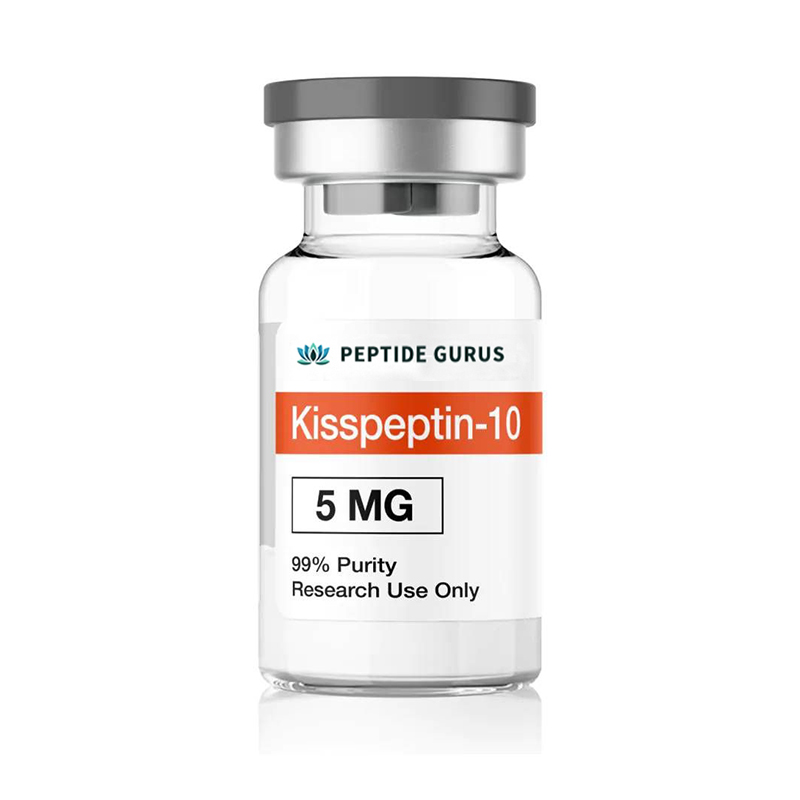
Qu'est-ce que Kisspeptine-10?
La kisspeptine (A.K.A. Metastine) est une protéine naturelle chez l'homme qui joue un rôle important dans la signalisation hormonale pendant la puberté et la reproduction. On pense également qu'il modifie l'humeur et le comportement, favorise l'angiogenèse et régule la fonction rénale. Le peptide a également été trouvé dans le cerveau et est connu pour supprimer la croissance tumorale et les métastases (propagation). Le peptide présente le plus grand intérêt scientifique pour sa capacité à influencer l'hormone libérée de la gonadotrophine (GnRH).
L'hormone de libération de la gonadotrophine (GnRH) est synthétisée et libérée des neurones de la GnRH dans l'hypothalamus. Il s'agit de la première hormone libérée dans l'axe hypothalamique-gonadique et contrôle la libération d'hormone stimulante des follicules (FSH) et de l'hormone lutéinisante (LH) de l'hypophyse antérieure. La GnRH est le principal moteur de la puberté et contrôle la maturation des gamètes dans les parties génitales. Il est utilisé sur le plan thérapeutique pour contrôler les menstruations dans certains contextes, comme traitement de la puberté précoce, et comme une perfusion continue dans certains types de cancer.
Augmentation de la testostérone
By affecting circulating levels of LH and FSH, kisspeptin can alter testosterone levels. This alteration, however, appears to be sex specific. In men, kisspeptin increases testosterone levels while in women it has no discernible impact on testosterone. In one study, 6 men were administered a derivative of kisspeptin via IV. They showed a significant increase in plasma testosterone levels (nearly 3-fold) after just 90 minutes[1]. A different analog of kisspeptin has been found to alter the pulse frequency of LH in men, suggesting that kisspeptin helps to fine tune the normal pulsatile release of sex hormones. A study of healthy men given kisspeptin-10 revealed a rapid and dose-dependent increase in serum LH levels and a concomitant increase in testosterone levels. Kisspeptin-10 appears to achieve this feat by increasing the pulsatile release of LH. If given at high enough doses, kisspeptin-10 causes such rapid pulsation as to obscure individual pulses entirely, resulting in continuous LH release[2]. This finding opens the door for potential uses of kisspeptin and its analogues in a variety of settings from pregnancy to low testosterone levels and more.
Bilan énergétique
Kisspeptin neurons have long been known to be sensitive to the energy status of an individual. Both under-nutrition and severe over-nutrition can blunt the action of kisspeptin neurons in stimulating GnRH release. In fact, drastic changes in energy balance can lead to infertility in both men and women, a process that appears to be mediated by kisspeptin.
So it is well understood that kisspeptin production and release is sensitive to energy balance. What is becoming clearer, however, is that kisspeptin may itself regulate energy balance. This finding arose through the observation of mice in which the kisspeptin receptor (Kiss1r) was removed via genetic manipulation. These mice showed increased adiposity and reduced energy expenditure. It turns out that the kisspeptin receptor is found in adipose (fat) tissue and brown adipose tissue[3]. It should not come as a surprise that kisspeptin plays a role in energy balance as energy status and reproductive fitness have always been tightly linked. It seems that kisspeptin may be one link that helps to explain the neurochemical control that leads to energy modulating behavior in relation to reproduction.
Recherche sur le cancer
Il y a vingt ans, il a été découvert que la kisspeptine est capable de supprimer les métastases du mélanome (cancer malin de la peau) jusqu'à 95%. Il semble que le peptide produit cet effet en réduisant la migration des cellules cancéreuses. Il y a aussi une question de savoir si la kisspeptine peut réduire l'adhésion cellulaire et empêcher ainsi les cellules cancéreuses de s'en tenir à d'autres tissus et de les envahir. Le dépistage d'une variété de types de cancer métastatiques révèle que les cancers du sein, de la vessie, du gi, de la prostate, du pancréatique, de l'ovaire, de la peau et de la thyroïde montrent tous des changements (diminuent généralement) dans les niveaux de kisspeptine, confirmant que le peptide joue un rôle dans la propagation du cancer [4].
Source: ScienceDirect
The interest in kisspeptin for the treatment of cancer has waxed and waned as a result of the incredible complexity of this peptide. Research is ongoing to understand exactly how the peptide can be manipulated, cut, recombined, and altered to produce effects in various cancer types. It is not so much that the peptide doesn’t work but rather than kisspeptin has so many effects that teasing out its precise impact on various cancer cells is difficult[5]. Dr. Floriana Morgillo implores researchers to take on the complexities of kisspeptin to realize the tremendous potential of this peptide to treat cancer. As she points out, kisspeptin could block metastasis in multiple organs and drastically reduce disease burden, adding years to lifespan of cancer patients and making it easier for current treatments to induce remission.
An interesting connection between kisspeptin, melatonin, and cancer was discovered only in the early months of 2020 when an experiment linked levels of the peptides to exposure to daylight. In the experiment, mice exposed to daylight and darkness showed drastically different levels of melatonin and kisspeptin. Those exposed to daylight had high kisspeptin levels and low melatonin levels. The opposite was true of those kept in the dark. To add to the experiment’s value, the mice were injected with melanoma cells. It turns out that the daylight mice had high tumor growth rates and tumor volume. No measure was made of metastasis. It appears that melatonin and kisspeptin are both involved in tumor suppression such that one influences the other, but the exact connection remains unknown[6]. This is just one example of the complex ways in which kisspeptin interacts with the body to alter tumor growth.
Amélioration de la mémoire étudiée
Il apparaît que certains analogues de l'esclpeptine sont importants dans les zones du cerveau responsables de la consolidation de la mémoire et de l'orientation dans l'espace 3D. La recherche sur des souris suggère que l'administration de ces peptides peut aider à inverser l'apprentissage et les troubles de la navigation souvent observés dans l'intoxication à l'éthanol [7]. Cela suggère que la kisspeptine et ses analogues jouent un rôle dans la capacité des neurones à coder des informations et peuvent rendre ces peptides d'intérêt potentiel pour compenser les déficits d'apprentissage observés dans certaines situations de maladies génétiques et chroniques. Bien que cette recherche soit à ses débuts, elle aide à élargir notre compréhension de l'apprentissage et à nous pousser vers le développement de nootropiques qui peuvent aider à stimuler la santé et le cerveau endommagé pour améliorer la fonction.
Impact sur l'humeur
Tout comme la reproduction et l'état de l'énergie sont interconnectés, la reproduction et l'émotion sont également interconnectées. Compte tenu du rôle de la kisspeptine dans la reproduction et l'homéostasie énergétique, les chercheurs ont demandé comment le peptide pourrait influencer l'émotion et le comportement. Pour tester cette connexion, ils ont comparé la kisspeptine à l'administration du placebo chez 29 hommes hétérosexuels sains. Les individus ayant une kisspeptine ont montré une activité cérébrale limbique accrue. En particulier, les individus ont montré une augmentation du comportement de recherche de récompense, une augmentation de l'entraînement et une amélioration de l'humeur globale [8]. Il semblerait que Kisspeptine joue un rôle dans l'intégration du traitement du cerveau sexuel et émotionnel au processus global de reproduction. Ces résultats aident à approfondir notre compréhension de l'humeur, de la motivation et de la conduite non seulement en ce qui concerne le sexe, mais en ce qui concerne le comportement humain en général.
Rein et cœur
Much is made of the role of kisspeptin in reproduction and reproductive hormone control. It comes as a bit of surprise then to learn that kisspeptin is also important in the kidney. Kisspeptin and its receptor are found in several locations throughout the kidney and are thought to play a role in signaling kidney function. Research in mice lacking the Kiss1 receptor reveals that the peptide is important in ensuring glomerular development during development though the exact nature of this action, whether direct or indirect, remains to be elucidated[9].
Though the exact role of kisspeptin in the kidney is not understood, it appears that it may relate to the protein’s larger overall role in controlling vascular development and vascular response to injury. Research in cardiovascular disease in mice suggests that kisspeptin may play an important role certain vascular beds and not others, acting to control vasoconstriction and even cardiac output in specific settings[9]. The impact of kisspeptin in both the kidney and cardiovascular system appears to be related to the effects the peptide has on angiogenesis and vascular function. This same trait may explain the role that kisspeptin plays in reducing metastasis of tumors. Understanding the finer points of how kisspeptin functions in blood vessels will help to move the peptide further into the therapeutic sphere.
Résumé de Kisspeptine-10
Kisspeptin is a peptide that acts primarily, but not exclusively, in the brain to control hormone secretion as it relates to human reproduction. There is a great deal of interest in understanding how kisspeptin influences everything from testosterone levels to sex-related behaviors like drive and motivation.
For years it has also been understood that kisspeptin has the potential to influence the growth and metastasis of cancerous cells. Studies have been somewhat contradictory, however, leading to periods of waxing and waning interest in using kisspeptin as a treatment in chemotherapy regimens. The ability o the peptide to influence metastasis may be linked to its role in vascular growth and functioning. Right now, kisspeptin is the subject of a number of intensive trials aimed at deepening our understanding of this versatile and potentially life-saving peptide.
Kisspeptin-10 exhibits minimal to moderate side effects, moderate oral and excellent subcutaneous bioavailability in mice. Per kg dosage in mice does not scale to humans. Kisspeptin-10 for sale at
Gourous peptidiques se limite à la recherche éducative et scientifique uniquement, et non à la consommation humaine. N'achetez que Kisspeptine-10 si vous êtes un chercheur agréé.
Article auteur
The above literature was researched, edited and organized by Dr. E. Logan, M.D. Dr. E. Logan holds a doctorate degree from Case Western Reserve University School of Medicine and a B.S. in molecular biology.
Auteur de journal scientifique
Florence Morgillo, M.D. is an Associate Professor of Medical Oncology at the University of Campania “Luigi Vanvitelli”. She received her Medical Degree, cum laude, in 2000 and in 2004 she completed her specialisation in Medical Oncology with Professor Fortunato Ciardiello at the Second University of Naples. In February 2008 she completed the PhD course in Medical Oncology at the same University. From February 2004 to February 2006, she worked at the MD Anderson Cancer Center in the Thoracic Head and Neck Medical Department. During this time she was deeply involved in the studies of acquired resistance to anti-EGFR targeted drugs in non-small cell lung cancer. In June 2009 she received a Translational Research fellowship from ESMO. She is the Principal Investigator and covers the role of Sub-Investigator in several clinical trials and has been a co-author in various publications in important international journals, including one study on the effects of Kisspeptin-10 antitumor efficacy. Floriana Morgillo, M.D. is listed in [10] under the referenced citations.
Floriana Morgillo, M.D. is being referenced as one of the leading scientists involved in the research and development of Kisspeptin. In no way is this doctor/scientist endorsing or advocating the purchase, sale, or use of this product for any reason. There is no affiliation or relationship, implied or otherwise, between
Gourous peptidiques Et ce médecin. Le but de citer le médecin est de reconnaître, de reconnaître et de créditer les efforts exhaustifs de recherche et de développement menés par les scientifiques qui étudient ce peptide. Le Dr Floriana Morgillo est répertorié dans [10] sous les citations référencées.
Citations référencées
W. S. Dhillo et al., “Kisspeptin-54 stimulates the hypothalamic-pituitary gonadal axis in human males,” J. Clin. Endocrinol. Metab., vol. 90, no. 12, pp. 6609–6615, décembre 2005, doi: 10.1210 / jc.2005-1468.
J. T. George et al., “Kisspeptin-10 is a potent stimulator of LH and increases pulse frequency in men,” J. Clin. Endocrinol. Metab., vol. 96, no. 8, pp. E1228-1236, août 2011, doi: 10.1210 / jc.2011-0089.
C. J. L. Harter, G. S. Kavanagh, and J. T. Smith, “The role of kisspeptin neurons in reproduction and metabolism,” J. Endocrinol., vol. 238, no. 3, pp. R173 - R183, 2018, doi: 10.1530 / Joe-18-0108.
E. J. Mead, J. J. Maguire, R. E. Kuc, and A. P. Davenport, “Kisspeptins: a multifunctional peptide system with a role in reproduction, cancer and the cardiovascular system,” Br. J. Pharmacol., vol. 151, no. 8, pp. 1143–1153, août 2007, doi: 10.1038 / sj.bjp.0707295.
T. Ly, S. Harihar, and D. R. Welch, “KISS1 in metastatic cancer research and treatment: potential and paradoxes,” Cancer Metastasis Rev., Mars 2020, doi: 10.1007 / s10555-020-09868-9.
P. Pazarci et al., “The effects of daylight exposure on melatonin levels, Kiss1 expression, and melanoma formation in mice,” Croat. Med. J., vol. 61, no. 1, pp. 55–61, février 2020.
E. Gibula-Tarlowska and J. H. Kotlinska, “Kissorphin improves spatial memory and cognitive flexibility impairment induced by ethanol treatment in the Barnes maze task in rats,” Behav. Pharmacol., vol. 31, no. 2 & 3, pp. 272–282, avril 2020, doi: 10.1097 / fbp.000000000000057.
A. N. Comninos et al., “Kisspeptin modulates sexual and emotional brain processing in humans,” J. Clin. Invest., vol. 127, no. 2, pp. 709–719, doi: 10.1172 / jci89519.
M. Bhattacharya and A. V. Babwah, “Kisspeptin: Beyond the Brain,” Endocrinology, vol. 156, no. 4, pp. 1218–1227, avr. 2015, doi: 10.1210 / en.2014-1915.
ALL ARTICLES AND PRODUCT INFORMATION PROVIDED ON THIS WEBSITE ARE FOR INFORMATONAL AND EDUCATIONAL PURPOSES ONLY.
Les produits proposés sur ce site Web sont fournis uniquement pour des études in vitro. Des études in vitro (latin: en verre) sont réalisées en dehors du corps. Ces produits ne sont pas des médicaments ou des médicaments et n'ont pas été approuvés par la FDA pour prévenir, traiter ou guérir une condition médicale, une maladie ou une maladie. L'introduction corporelle de toute nature dans l'homme ou les animaux est strictement interdite par la loi.
Peptidegurus est l'un des principaux fournisseurs de peptides de recherche de fabrication américaine, offrant des produits de qualité supérieure à des prix compétitifs. En mettant l'accent sur l'excellence et le service à la clientèle, ils garantissent un processus de commande sécurisé et pratique avec l'expédition mondiale.