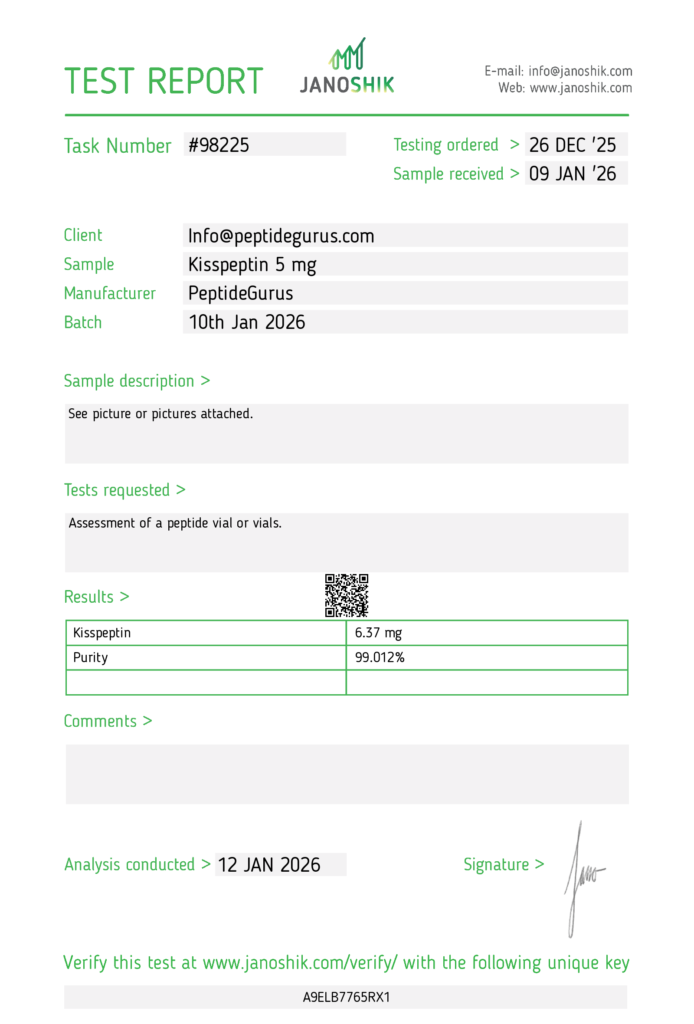
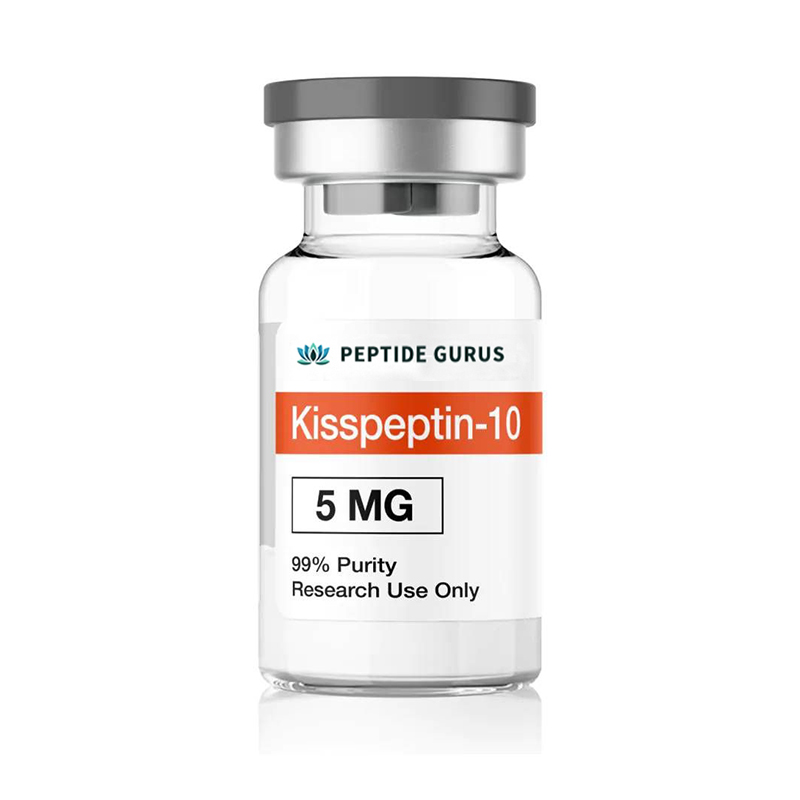
Envie um e-mail para nós agora para fazer seu pedido com suporte individual. Estoque limitado! Aceitamos Zelle, CashApp, Venmo, transferência bancária e cripto.
Grátis (1) 30 ml de água bacteriostática with qualified orders over $500 USD.
(excludes capsule products, cosmetic peptides, promo codes and shipping)
Kisspeptina atua para controlar a secreção hormonal no que se refere à reprodução. O Kisspeptina pode influenciar os níveis de testosterona e comportamentos relacionados ao sexo, como motivação e motivação. A pesquisa também sugere que pode ajudar a reverter alguns dos efeitos do envelhecimento.
Product Usage: This PRODUCT IS INTENDED AS A RESEARCH CHEMICAL ONLY. This designation allows the use of research chemicals strictly for in vitro testing and laboratory experimentation only. All product information available on this website is for educational purposes only. Bodily introduction of any kind into humans or animals is strictly forbidden by law. This product should only be handled by licensed, qualified professionals. This product is not a drug, food, or cosmetic and may not be misbranded, misused or mislabled as a drug, food or cosmetic.
O que é Kisspeptina-10?
Kisspeptina (também conhecida como metastina) é uma proteína que ocorre naturalmente em humanos que desempenha papéis importantes na sinalização hormonal durante a puberdade e reprodução. Também se pensa alterar o humor e o comportamento, promover a angiogênese e regular a função renal. O peptídeo também foi encontrado no cérebro e é conhecido por suprimir o crescimento e a metástase do tumor (disseminação). O peptídeo é de maior interesse científico por sua capacidade de influenciar a gonadotrofina que libera hormônio (GnRH).
O hormônio liberador de gonadotrofina (GnRH) é sintetizado e liberado dos neurônios GnRH no hipotálamo. É o primeiro hormônio liberado no eixo hipotalâmico-hipófise-gonadal e controla a liberação do hormônio folículo-estimulante (FSH) e do hormônio luteinizante (LH) da glândula pituitária anterior. O GNRH é o principal fator da puberdade e controla a maturação dos gametas nos órgãos genitais. É usado terapeuticamente para controlar a menstruação em configurações de seleção, como um tratamento para a puberdade precoce e como uma infusão contínua em certos tipos de câncer.
Aumento da testosterona
By affecting circulating levels of LH and FSH, kisspeptin can alter testosterone levels. This alteration, however, appears to be sex specific. In men, kisspeptin increases testosterone levels while in women it has no discernible impact on testosterone. In one study, 6 men were administered a derivative of kisspeptin via IV. They showed a significant increase in plasma testosterone levels (nearly 3-fold) after just 90 minutes[1]. A different analog of kisspeptin has been found to alter the pulse frequency of LH in men, suggesting that kisspeptin helps to fine tune the normal pulsatile release of sex hormones. A study of healthy men given kisspeptin-10 revealed a rapid and dose-dependent increase in serum LH levels and a concomitant increase in testosterone levels. Kisspeptin-10 appears to achieve this feat by increasing the pulsatile release of LH. If given at high enough doses, kisspeptin-10 causes such rapid pulsation as to obscure individual pulses entirely, resulting in continuous LH release[2]. This finding opens the door for potential uses of kisspeptin and its analogues in a variety of settings from pregnancy to low testosterone levels and more.
Balanço energético
Kisspeptin neurons have long been known to be sensitive to the energy status of an individual. Both under-nutrition and severe over-nutrition can blunt the action of kisspeptin neurons in stimulating GnRH release. In fact, drastic changes in energy balance can lead to infertility in both men and women, a process that appears to be mediated by kisspeptin.
So it is well understood that kisspeptin production and release is sensitive to energy balance. What is becoming clearer, however, is that kisspeptin may itself regulate energy balance. This finding arose through the observation of mice in which the kisspeptin receptor (Kiss1r) was removed via genetic manipulation. These mice showed increased adiposity and reduced energy expenditure. It turns out that the kisspeptin receptor is found in adipose (fat) tissue and brown adipose tissue[3]. It should not come as a surprise that kisspeptin plays a role in energy balance as energy status and reproductive fitness have always been tightly linked. It seems that kisspeptin may be one link that helps to explain the neurochemical control that leads to energy modulating behavior in relation to reproduction.
Pesquisa sobre câncer
Vinte anos atrás, descobriu -se que a Kisspeptina é capaz de suprimir a metástase do melanoma (câncer de pele maligna) em até 95%. Parece que o peptídeo produz esse efeito reduzindo a migração de células cancerígenas. Há também alguma dúvida sobre se a Kisspeptina pode reduzir a adesão celular e, assim, impedir que as células cancerígenas se apeguem a outros tecidos e os invadissem. A triagem de uma variedade de tipos de câncer metastático revela que os cânceres de mama, bexiga, GI, próstata, pancreática, ovariana, pele e tireoidiana mostram mudanças (geralmente diminuem) nos níveis de beijo, confirmando que o peptídeo desempenha um papel na propagação do câncer [4].
Source: ScienceDirect
The interest in kisspeptin for the treatment of cancer has waxed and waned as a result of the incredible complexity of this peptide. Research is ongoing to understand exactly how the peptide can be manipulated, cut, recombined, and altered to produce effects in various cancer types. It is not so much that the peptide doesn’t work but rather than kisspeptin has so many effects that teasing out its precise impact on various cancer cells is difficult[5]. Dr. Floriana Morgillo implores researchers to take on the complexities of kisspeptin to realize the tremendous potential of this peptide to treat cancer. As she points out, kisspeptin could block metastasis in multiple organs and drastically reduce disease burden, adding years to lifespan of cancer patients and making it easier for current treatments to induce remission.
An interesting connection between kisspeptin, melatonin, and cancer was discovered only in the early months of 2020 when an experiment linked levels of the peptides to exposure to daylight. In the experiment, mice exposed to daylight and darkness showed drastically different levels of melatonin and kisspeptin. Those exposed to daylight had high kisspeptin levels and low melatonin levels. The opposite was true of those kept in the dark. To add to the experiment’s value, the mice were injected with melanoma cells. It turns out that the daylight mice had high tumor growth rates and tumor volume. No measure was made of metastasis. It appears that melatonin and kisspeptin are both involved in tumor suppression such that one influences the other, but the exact connection remains unknown[6]. This is just one example of the complex ways in which kisspeptin interacts with the body to alter tumor growth.
Melhoria de memória estudou
Parece que certos análogos da Kisspeptina são importantes nas áreas do cérebro responsáveis pela consolidação e orientação da memória no espaço 3D. Pesquisas em ratos sugerem que a administração desses peptídeos pode ajudar a reverter o comprometimento da aprendizagem e da navegação frequentemente visto em intoxicação por etanol [7]. Isso sugere que a Kisspeptina e seus análogos desempenham um papel na capacidade dos neurônios de codificar informações e podem tornar esses peptídeos de potencial interesse em compensar os déficits de aprendizado observados em certas situações genéticas e crônicas. Embora esta pesquisa esteja em seus estágios iniciais, ajuda a ampliar nossa compreensão da aprendizagem e nos empurrar ainda mais para o desenvolvimento de nootrópicos que podem ajudar a estimular a saúde e os cérebros danificados para melhorar a função.
Impacto no humor
Assim como a reprodução e o status de energia estão interconectados, o mesmo acontece com a reprodução e a emoção interconectadas. Dado o papel da Kisspeptina na reprodução e na homeostase energética, os pesquisadores questionaram como o peptídeo poderia influenciar a emoção e o comportamento. Para testar essa conexão, eles compararam a Kisspeptina à administração de placebo em 29 homens heterossexuais saudáveis. Indivíduos que receberam Kisspeptina mostraram atividade cerebral límbica aprimorada. Em particular, os indivíduos mostraram maior comportamento de busca de recompensa, aumento do impulso e melhorar o humor geral [8]. Parece que a Kisspeptina desempenha um papel na integração do processamento cerebral sexual e emocional com o processo geral de reprodução. Essas descobertas ajudam a promover nossa compreensão do humor, motivação e impulsionar não apenas como se relacionam com o sexo, mas também se relacionam com o comportamento humano em geral.
Rim e coração
Much is made of the role of kisspeptin in reproduction and reproductive hormone control. It comes as a bit of surprise then to learn that kisspeptin is also important in the kidney. Kisspeptin and its receptor are found in several locations throughout the kidney and are thought to play a role in signaling kidney function. Research in mice lacking the Kiss1 receptor reveals that the peptide is important in ensuring glomerular development during development though the exact nature of this action, whether direct or indirect, remains to be elucidated[9].
Though the exact role of kisspeptin in the kidney is not understood, it appears that it may relate to the protein’s larger overall role in controlling vascular development and vascular response to injury. Research in cardiovascular disease in mice suggests that kisspeptin may play an important role certain vascular beds and not others, acting to control vasoconstriction and even cardiac output in specific settings[9]. The impact of kisspeptin in both the kidney and cardiovascular system appears to be related to the effects the peptide has on angiogenesis and vascular function. This same trait may explain the role that kisspeptin plays in reducing metastasis of tumors. Understanding the finer points of how kisspeptin functions in blood vessels will help to move the peptide further into the therapeutic sphere.
Resumo da Kisspeptina-10
Kisspeptin is a peptide that acts primarily, but not exclusively, in the brain to control hormone secretion as it relates to human reproduction. There is a great deal of interest in understanding how kisspeptin influences everything from testosterone levels to sex-related behaviors like drive and motivation.
For years it has also been understood that kisspeptin has the potential to influence the growth and metastasis of cancerous cells. Studies have been somewhat contradictory, however, leading to periods of waxing and waning interest in using kisspeptin as a treatment in chemotherapy regimens. The ability o the peptide to influence metastasis may be linked to its role in vascular growth and functioning. Right now, kisspeptin is the subject of a number of intensive trials aimed at deepening our understanding of this versatile and potentially life-saving peptide.
Kisspeptin-10 exhibits minimal to moderate side effects, moderate oral and excellent subcutaneous bioavailability in mice. Per kg dosage in mice does not scale to humans. Kisspeptin-10 for sale at
Gurus peptídico é limitado apenas a pesquisas educacionais e científicas, não para consumo humano. Compre apenas Kisspeptina-10 se você é um pesquisador licenciado.
Autor do artigo
The above literature was researched, edited and organized by Dr. E. Logan, M.D. Dr. E. Logan holds a doctorate degree from Case Western Reserve University School of Medicine and a B.S. in molecular biology.
Autor da revista científica
FLORENCE MORGILLO, M.D. is an Associate Professor of Medical Oncology at the University of Campania “Luigi Vanvitelli”. She received her Medical Degree, cum laude, in 2000 and in 2004 she completed her specialisation in Medical Oncology with Professor Fortunato Ciardiello at the Second University of Naples. In February 2008 she completed the PhD course in Medical Oncology at the same University. From February 2004 to February 2006, she worked at the MD Anderson Cancer Center in the Thoracic Head and Neck Medical Department. During this time she was deeply involved in the studies of acquired resistance to anti-EGFR targeted drugs in non-small cell lung cancer. In June 2009 she received a Translational Research fellowship from ESMO. She is the Principal Investigator and covers the role of Sub-Investigator in several clinical trials and has been a co-author in various publications in important international journals, including one study on the effects of Kisspeptin-10 antitumor efficacy. Floriana Morgillo, M.D. is listed in [10] under the referenced citations.
Floriana Morgillo, M.D. is being referenced as one of the leading scientists involved in the research and development of Kisspeptin. In no way is this doctor/scientist endorsing or advocating the purchase, sale, or use of this product for any reason. There is no affiliation or relationship, implied or otherwise, between
Gurus peptídico e este médico. O objetivo de citar o médico é reconhecer, reconhecer e creditar os esforços exaustivos de pesquisa e desenvolvimento conduzidos pelos cientistas que estudam esse peptídeo. A Dra. Floriana Morgillo está listada em [10] sob as citações referenciadas.
Citações referenciadas
W. S. Dhillo et al., “Kisspeptin-54 stimulates the hypothalamic-pituitary gonadal axis in human males,” J. Clin. Endocrinol. Metab., vol. 90, não. 12, pp. 6609-6615, dezembro de 2005, doi: 10.1210/jc.2005-1468.
J. T. George et al., “Kisspeptin-10 is a potent stimulator of LH and increases pulse frequency in men,” J. Clin. Endocrinol. Metab., vol. 96, não. 8, pp. E1228-1236, agosto de 2011, doi: 10.1210/jc.2011-0089.
C. J. L. Harter, G. S. Kavanagh, and J. T. Smith, “The role of kisspeptin neurons in reproduction and metabolism,” J. Endocrinol., vol. 238, não. 3, pp. R173-R183, 2018, doi: 10.1530/Joe-18-0108.
E. J. Mead, J. J. Maguire, R. E. Kuc, and A. P. Davenport, “Kisspeptins: a multifunctional peptide system with a role in reproduction, cancer and the cardiovascular system,” Br. J. Pharmacol., vol. 151, não. 8, pp. 1143-1153, agosto de 2007, doi: 10.1038/sj.bjp.0707295.
T. Ly, S. Harihar, and D. R. Welch, “KISS1 in metastatic cancer research and treatment: potential and paradoxes,” Cancer Metastasis Rev., Março de 2020, doi: 10.1007/s10555-020-09868-9.
P. Pazarci et al., “The effects of daylight exposure on melatonin levels, Kiss1 expression, and melanoma formation in mice,” Croat. Med. J., vol. 61, não. 1, pp. 55–61, fevereiro de 2020.
E. Gibula-Tarlowska and J. H. Kotlinska, “Kissorphin improves spatial memory and cognitive flexibility impairment induced by ethanol treatment in the Barnes maze task in rats,” Behav. Pharmacol., vol. 31, não. 2 e 3, pp. 272–282, abril de 2020, doi: 10.1097/fbp.000000000005557.
A. N. Comninos et al., “Kisspeptin modulates sexual and emotional brain processing in humans,” J. Clin. Invest., vol. 127, não. 2, pp. 709-719, doi: 10.1172/jci89519.
M. Bhattacharya and A. V. Babwah, “Kisspeptin: Beyond the Brain,” Endocrinology, vol. 156, não. 4, pp. 1218-1227, abril. 2015, doi: 10.1210/en.2014-1915.
ALL ARTICLES AND PRODUCT INFORMATION PROVIDED ON THIS WEBSITE ARE FOR INFORMATONAL AND EDUCATIONAL PURPOSES ONLY.
Os produtos oferecidos neste site são fornecidos apenas para estudos in vitro. Estudos in vitro (latim: em vidro) são realizados fora do corpo. Esses produtos não são medicamentos ou medicamentos e não foram aprovados pelo FDA para prevenir, tratar ou curar qualquer condição médica, doença ou doença. A introdução corporal de qualquer tipo em seres humanos ou animais é estritamente proibida por lei.
A Peptidegurus é um fornecedor líder de peptídeos de pesquisa fabricados americanos, oferecendo produtos de alta qualidade a preços competitivos. Com foco na excelência e no atendimento ao cliente, eles garantem um processo de pedido seguro e conveniente com o envio global.