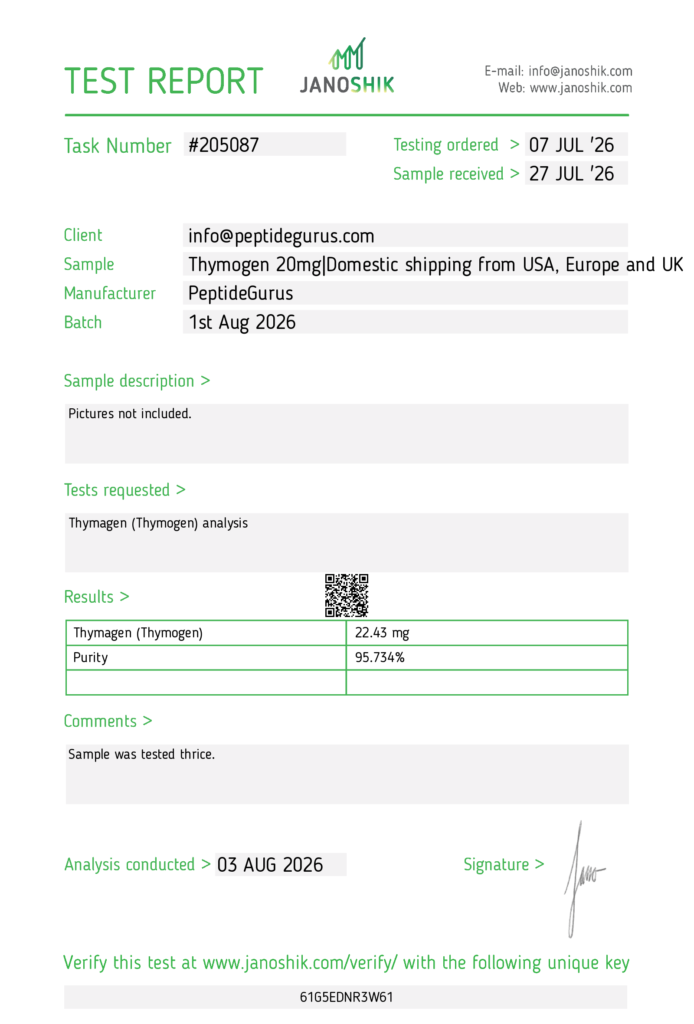
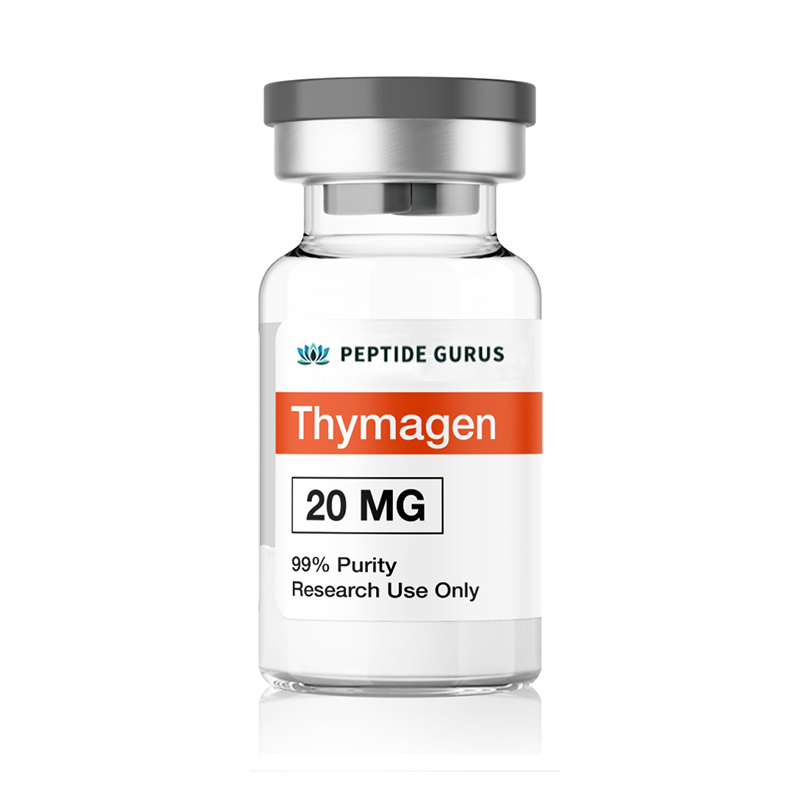
유리 (1) 30 ml 세균성 물 with qualified orders over $500 USD.
(excludes capsule products, cosmetic peptides, promo codes and shipping)
티마 겐 (Thymogen)은 면역계의 세포에 일시적인 영향을 미치는 매우 활성 활성 생물 저하제 펩티드이다. T 세포의 생산 및 분화를 증가시키고, 인터페론의 분비를 자극하고, 주기적 뉴클레오티드의 수준을 높이고, 선천성 면역계의 기능을 촉진하는 것으로 나타났습니다. 타고난 면역계에 미치는 영향의 결과로, 티마겐은 또한 암을 예방하고 질병의 심각성을 줄이는 데 도움이되는 것으로 나타났습니다. 연구에 따르면 티마겐은 감염에 대한 수술 전 예방 조치로 유용합니다. 수술 후 회복 속도를 높이는 것으로 나타 났으며 잠재적으로 심장 보호 적입니다.
Product Usage: This PRODUCT IS INTENDED AS A RESEARCH CHEMICAL ONLY. 이 명칭은 시험 관내 시험 및 실험실 실험에만 연구 화학 물질을 엄격하게 사용할 수있게한다. 이 웹 사이트에서 제공되는 모든 제품 정보는 교육 목적으로 만 사용됩니다. 인간이나 동물에 어떤 종류의 신체적으로 소개되는 것은 법에 의해 엄격히 금지되어 있습니다. 이 제품은 라이센스가 부여 된 자격을 갖춘 전문가 만 처리해야합니다. 이 제품은 약물, 음식 또는 화장품이 아니며 약물, 음식 또는 화장품으로 잘못 브랜드화되거나 잘못 사용되거나 오해가되지 않을 수 있습니다.
THYMAGEN 25MG – Research Grade Peptide
Thymagen is a peptide researched for its role in immune system and thymus-related cellular studies. It has been widely used in immunology research, aging-related studies, and investigations involving immune regulation at the cellular level.
우리의 Thymagen 25mg is manufactured to research-grade standards, ensuring high purity, strong stability, and consistent quality. The lyophilized form protects the peptide structure and allows for extended storage without degradation.
This product is well-suited for laboratories, biotech companies, and distributors focusing on immune system and longevity-related peptide research.
티마겐 (티모겐)
Thymagen (Thymogen) is a dipeptide bioregulator with primary effects on the thymus and immune system. Originally isolated from calf thymus, Thymagen is now produced via recombinant DNA techniques. In Russia, Thymagen has been studied for its ability to treat cancer by regulating the body’s innate immune response. It has also shown promise in heart disease, diabetes, and as a post-operative treatment for improving surgical outcomes. Research shows that it can stimulate the immune response to a number of viruses and a variety of bacterial infections. It has shown success in the treatment of Hepatitis B and C.
Cyclic nucleotides are single-phosphate nucleotides with a cyclic bond arrangement between the sugar and phosphate groups. They are integral components of communication within cells, usually acting as second messengers within the cell after a protein on the cell surface has bound to something. In other words, cyclic nucleotides act as messengers within cells for substances that cannot enter the cells themselves.
Research on Thymagen shows that it down regulates cyclic nucleotide catabolism. In other words, Thymagen slows the breakdown of cyclic nucleotides and thereby raises their levels within the cell[1]. This results in enhanced ability of cells, particularly those of the immune system, to respond to messages from other parts of the body. For example, increased levels of cyclic nucleotides could make cells of the immune system more responsive to invading pathogens by improving signaling between these cells.
Summary of nucleoside signaling (nucleotides indicated as NTPs being converted to NMPs). Thymagen has been shown to increase the pool of NTPs and potentiate down-stream effects:
Source: Pubch
The effects of Thymagen on the immune system begin, but don’t end at cyclic nucleotides though. Research in rat spleen and thymus has shown that Thymagen promotes the maturation of T-lymphoctye precursors into immunocompetent T-cells capable of fending off disease. This process of maturation is driven by the changes that Thymagen induces in cyclic GMP (cGMP) levels[2]. By optimizing cyclic nucleotide ratios, Thymagen helps to ensure that T-lymphocyte precursors are getting the signals that tell them they need to mature into full-flow cells of the immune system.
Thymagen, along with other immunomodulatory molecules like Immunitor and Milife, has also been shown to induce interferon secretion[3]. Interferons are signaling proteins made by host cells in response to viral infection. They serve to modulate and coordinate immune defenses against viruses, but have also been shown to ward off cancer and are generally known as immune regulators. Interferons are used currently in the treatment of autoimmune diseases, such as multiple sclerosis, and in combination with chemotherapy and radiation in the treatment of certain cancers. They are also used in the treatment of both hepatitis B and C.
티마겐 및 염증
염증은 면역계에 의해 주로 제어되는 과정입니다. 따라서 면역계에 영향을 줄 수있는 물질이 염증에도 영향을 미칠 수 있다고 생각합니다. 이것은 티마겐이 우려되는 확실한 추론으로 밝혀졌습니다. 연구에 따르면 티마겐은 림프구 수를 정상화하고 T- 세포 기능 활성을 증가시키는 데 도움이된다고합니다. 이것은 전 염증성 사이토 카인 수준을 감소시킴으로써 염증을 하향 조절하는 탈감작 효과를 초래한다.
티마겐 및 감염
Speaking specifically of the ability of Thymagen to affect the immune response to invading pathogens was a study carried out in guinea pigs infected with Yersiniaenterocolithic (a bacteria related to the bacteria that causes the Plague). The guinea pigs treated with Thymagen in this study showed increased nonspecific resistance to the bacteria as well as an increased specific humoral (antibody) response. Thymagen appeared to help regulate the immune response by focusing it on natural killer cell immunity and by helping to prevent autoimmune reactions. The overall result was to decrease the dissemination of Y. enterocoliticia 그리고 궁극적으로 신체로부터의 제거를 돕기 위해 [4].
티마겐과 당뇨병
Research shows that patients with type 1 diabetes are suffering from secondary immunodeficiency in many cases. Thymagen, by promoting T-Cell differentiation, removes signs of this immunodeficiency and helps to correct the deficit. In fact, a clinical effect was seen in nearly 95% of patients in the study[5].
Diabetes actually leads to immunocompromise if left untreated. One of the primary results of this is infection with candida (yeast) species. These types of infection are notoriously difficult to treat and can lead to serious morbidity in people with diabetes. Research with Thymagen indicates that it can slow candidiasis in the setting of secondary immunodeficiency and give existing treatments and edge in eradicating the fungus[6].
티마겐 및 수술
수술 후 감염은 드문 일이 아니며, 특히 복부 수술 및 면역 결핍 환자의 경우. 노인은 면역 결핍으로 간주되지 않지만 면역 기능 감소의 결과로 수술 후 감염에 더 취약합니다. Thymagen을 이용한 연구에 따르면 수술 전 일주일 동안 펩티드를 투여하면 수술 후 합병증의 품종이 모두 줄어 듭니다. 펩티드는 또한 회복을 서두르고 정상적인 활성으로의 복귀함으로써 수술 후 기간을 감소시키는 것으로 보인다 [7].
티마겐과 심장
Thymagen has been studied as a possible treatment for several different heart conditions. The earliest research looked at the ability of Thymagen to reduce arrhythmia using 6 different models of the disease condition. Research showed a beneficial effect, including a solid dose-response curve that indicated that the observed changes were in fact legitimate[8].
Thymagen has also been studied in isolated heart models where it has been found to have superior protective properties compared to commonly used drugs like verapamil[9]. In the setting of cardiac ischemia, protecting heart muscle from further damage is one of the primary goals of treatment prior to restoration of blood flow via catheterization, bypass grafting, or clot dissolution. Treatment with cardioprotective drugs can help to prevent long-term consequences like heart failure or the need for transplant. Thus, Thymagen may be a useful adjuvant in treating ischemic cardiac injury.
티마겐과 암
Research in rats shows that radiation-induced carcinogenesis can be inhibited by Thymagen. In fact, all carcinogenesis is inhibited by Thymagen, with rats exposed to radiation living roughly average lifespans while rats with no radiation exposure live above average lifespans[10]. This suggests that Thymagen may be a useful cancer preventative, helping to ward off the disease even in the setting of unknown exposures.
According to Dr. Vladimir Anisimov, a collaborator of Dr. Vladimir Khavinson and an expert in cancer development, rats treated with Thymagen have been shown to have a decreased incidence of GI cancer. In fact, regardless of immune status in the study, the rats treated with Thymagen had a 12% reduction in tumor incidence as well as a 1.7-fold reduction in the number of tumors if they did develop cancer[11]. In other words, Thymagen appears to boost immune function against cancer. This suggests that Thymagen works to boost the body’s natural killer cell defenses, which are the front line against cancer, along with other aspects of the innate immune system. This helps to not only prevent cancer from developing, but reduces the rate and severity of spread in rats that do develop cancer.
티마겐 요약
Thymagen is a highly active peptide with primary effects on cells of the immune system. It has been shown to increase production and differentiation of T cells, stimulate the secretion of interferons, boost levels of cyclic nucleotides, and promote the functionality of the innate immune system. As a result of its effects on the innate immune system, Thymagen has also been shown to both help prevent cancer and reduce the severity of the disease.
There is good evidence that Thymagen is useful as a peri-operative preventative measures against infection. It has been shown to increase rate of recovery following surgery and is potentially cardioprotective as well.
기사 저자
The above literature was researched, edited and organized by Dr. E. Logan, M.D. Dr. E. Logan holds a doctorate degree from Case Western Reserve University School of Medicine and a B.S. in molecular biology.
과학 저널 저자
블라디미르 카빈슨 is a Professor, President of the European region of the International Association of Gerontology and Geriatrics; Member of the 러시아 및 우크라이나 의학 아카데미; Main gerontologist of the Health Committee of the Government of Saint Petersburg, Russia; Director of the Saint Petersburg Institute of Bioregulation and Gerontology; Vice-president of Gerontological Society of the 러시아 과학 아카데미; Head of the Chair of Gerontology and Geriatrics of the North-Western State Medical University, St-Petersburg; Colonel of medical service (USSR, Russia), retired. Vladimir Khavinson is known for the discovery, experimental and clinical studies of new classes of 펩티드 bioregulators as well as for the development of bioregulating peptide therapy. He is engaged in studying of the role of peptides in regulation of the mechanisms of ageing. His main field of actions is design, pre-clinical and clinical studies of new peptide Geroprotectors. A 40-year-long investigation resulted in a multitude of methods of application of peptide bioregulators to slow down the process of ageing and increase human life span. Six peptide-based pharmaceuticals and 64 peptide food supplements have been introduced into clinical practice by V. Khavinson. He is an author of 196 patents (Russian and international) as well as of 775 scientific publications. His major achievements are presented in two books: “Peptides and Ageing” (NEL, 2002) and “Gerontological aspects of genome peptide regulation” (Karger AG, 2005). Vladimir Khavinson introduced scientific specialty “Gerontology and Geriatrics” in the Russian Federation on the governmental level. Academic Council headed by V. Khavinson has oversighted over 200 Ph.D. and Doctorate theses from many different countries.
Prof. Vladimir Khavinson is being referenced as one of the leading scientists involved in the research and development of Thymagen. In no way is this doctor/scientist endorsing or advocating the purchase, sale, or use of this product for any reason. There is no affiliation or relationship, implied or otherwise, between
펩티드 전문가 그리고이 의사. 의사를 인용하는 목적은이 펩티드를 연구하는 과학자들이 수행 한 철저한 연구 개발 노력을 인정, 인식 및 인정하는 것입니다.
ALL ARTICLES AND PRODUCT INFORMATION PROVIDED ON THIS WEBSITE ARE FOR INFORMATONAL AND EDUCATIONAL PURPOSES ONLY.
이 웹 사이트에서 제공되는 제품은 투명한 연구를 위해 제공됩니다. 내역 연구 (라틴어 : 유리)는 신체 외부에서 수행됩니다. 이 제품은 의약품이나 약물이 아니며 FDA에 의해 의학적 상태, 질병 또는 질병을 예방, 치료 또는 치료하기 위해 승인되지 않았습니다. 인간이나 동물에 어떤 종류의 신체적으로 소개되는 것은 법에 의해 엄격히 금지되어 있습니다.