




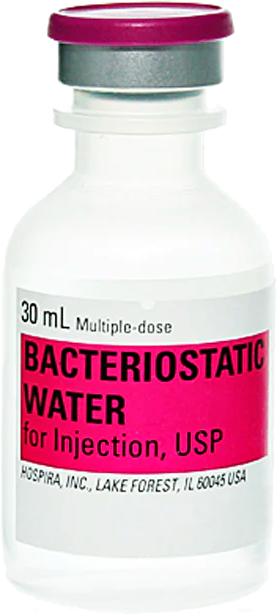
유리 (1) 30 ml 세균성 물
with qualified orders over $500 USD.
(excludes capsule products, cosmetic peptides, promo codes and shipping)
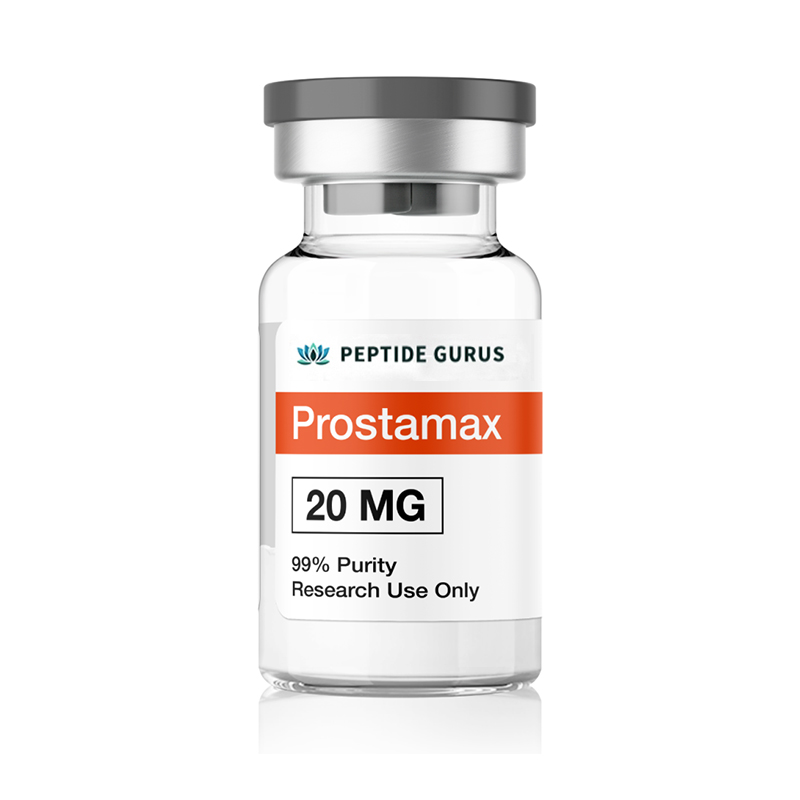
PROSTAMAX 20MG – Research Grade Peptide
Prostamax is a bioregulatory peptide primarily studied in prostate and urogenital system research. It has been widely used in studies related to cellular regulation, tissue differentiation, and age-related functional changes within prostate tissues.
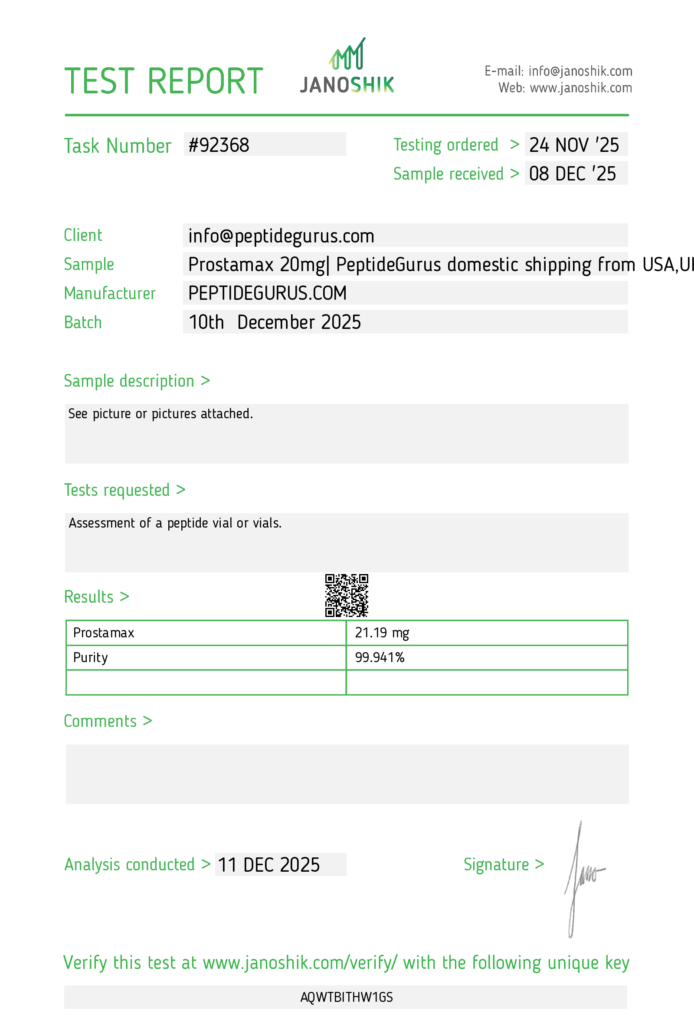
우리의 Prostamax 20mg is manufactured under strict quality control standards to ensure high purity, structural stability, and consistent batch performance. The lyophilized presentation allows for easy handling, extended shelf life, and reliable storage conditions.
This peptide is suitable for research facilities, pharmaceutical development teams, and peptide distributors specializing in urogenital and endocrine-related research.
프로스타 맥스
Prostamax 구조

Prostamax와 전립선
프로스 타 맥스 및 면역계
Though Prostamax is considered to be tissue-specific, there is ample evidence that the bioreulator acts on cells outside of the prostate. The most consequential effects are on the ribosomes and densely packed chromatin found in lymphocytes. In these cells, Prostamax, like Epithalon and Vilon, serves to increase expression of ribosomes which are responsible for the translation of mRNA into proteins. It also opens up densely packed chromatin to make genes more accessible for transcription into mRNA. Thus, Prostamax sets the stage for increased gene expression at every level, allowing for a functional change in the health of lymphocytes[4], [5]. The impact of Prostamax on the immune system is not just theoretical either. Research shows that the peptide helps to reduce signs of chronic prostate inflammation including swelling, hyperemia, and lymphocyte infiltration.[3] This results both from the influence Prostamax has on lymphocytes and their control over the immune response as well as the role the peptide plays in normalizing growth and differentiation of prostate cells.프로스 타 맥스 및 노화
The effects that Prostamax has on lymphocytes and cells of the prostate are part of a larger effect it has one many different types of cells. Research in cell cultures taken from older individuals shows that Prostamax alters DNA structure by decondensing heterochromatin. This, in turn, allows for greater expression of DNA that was inactivated via dense packaging of DNA[6]. What makes this remarkable in terms of aging is that condensation of DNA is a normal, if undesirable, consequence of aging. DNA condensation is a primary driver of both senescence and apoptosis, making it one of the most important mechanisms of aging. By unpacking DNA, Prostamax is literally giving the cells a more youthful genetic profile. The results are increased proliferation of cells, decreased apoptosis (programmed cell death), and improved protein expression and cell function. Interestingly, Prostamax and similar epigenetically active peptides are found naturally in long-lived rodent species like the African mole rat. These same peptides are ~ 아니다 found in short-lived species[7]. This indicates that the epigenetic effects that have been observed with peptides like Prostamax are, in fact, directly related to aging and longevity.프로스 타 맥스 요약
Prostamax는 다수의 세포에서 DNA 축합에 심오한 영향을 미치는 합성 카빈슨 펩티드이다. 전립선에 대한 노화 방지 및 항 염증 효과에 주로 관심이 있지만, Prostamax는 또한 DNA에 대한 후성 유전 학적 대조군을 변화시킴으로써 신체 내의 여러 세포 (예를 들어 림프구)의 기능을 최적화하는 것으로 나타났다.기사 저자
과학 저널 저자

참조 인용
- A. N. Zakutskiĭ, N. I. Chalisova, G. A. Ryzhak, A. I. Aniskina, S. V. Filippov, and P. N. Zeziulin, “[The tissue-specific effect of synthetic peptides-biologic regulators in organotypic tissues culture in young and old rats],” Adv. Gerontol. Uspekhi Gerontol., vol. 19, pp. 93–96, 2006.
- “Treating chronic prostatitis,” Harvard Health, 2017 년 12 월 21 일. https://www.health.harvard.edu/mens-health/treating-chronic-prostatitis (2022 년 2 월 22 일 접근).
- T. G. Borovskaya et al., “Experimental studying of the drug efficiency Prostamax in the therapy of chronic aseptic prostatitis and its complications,” Mod. Res. Inflamm., vol. 2013 년 7 월, 2013 년 7 월, 2 : 10.4236/MRI.2013.23007.
- V. K. Khavinson, T. A. Lezhava, and V. V. Malinin, “Effects of short peptides on lymphocyte chromatin in senile subjects,” Bull. Exp. Biol. Med., vol. 137, 아니요. 1, pp. 78–81, 2004 년 1 월, doi : 10.1023/b : babm.0000024393.40560.05.
- T. Meskhi et al., “[The influence of the peptide bioregulator prostamax on heterochromatin of human lymphocytes in situ],” Biofizika, vol. 49, 아니요. 6, pp. 1091–1093, 2004 년 12 월.
- T. A. Dzhokhadze, T. Z. Buadze, M. N. Gaĭozishvili, N. A. Baratashvili, and T. A. Lezhava, “[Deheterochromatinization of the chromatin in old age induced by oligopeptide bioregulator (Lys-Glu-Asp-Pro)],” Georgian Med. News, 닫다. 212, pp. 2012 년 11 월 76-82 일.
- V. K. Khavinson, D. Y. Kormilets, and A. T. Mar’yanovich, “Peptides (Epigenetic Regulators) in the Structure of Rodents with a Long and Short Lifespan,” Bull. Exp. Biol. Med., vol. 163, 아니요. 5, pp. 671–676, 2017 년 9 월, doi : 10.1007/s10517-017-3876-X.


