유리 (1) 30 ml 세균성 물 with qualified orders over $500 USD.
(excludes capsule products, cosmetic peptides, promo codes and shipping)
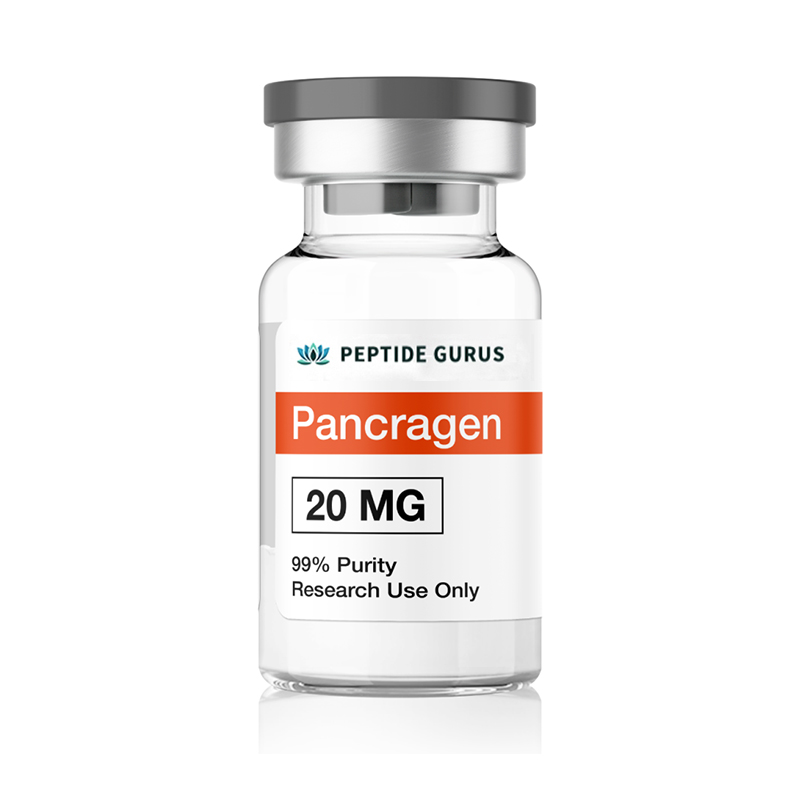
팡 크라겐은 췌장에 주요 영향을 미치는 자연적으로 발생하는 테트라 펩티드 바이오 레게 게이터입니다. 췌장 연구에 따르면 혈당을 조절하고 췌장의 내분비 기능을 개선하며 멜라토닌 발현을 조절하며 대사 증후군의 발생률과 크기를 줄이는 데 도움이됩니다. 그것은 연구되었으며 당뇨병의 치료 및 노화의 대사 효과에 관심이 있습니다. 췌장은 췌장의 노화 방지 펩티드로 생각할 수 있습니다.
Product Usage: This PRODUCT IS INTENDED AS A RESEARCH CHEMICAL ONLY. This designation allows the use of research chemicals strictly for in vitro testing and laboratory experimentation only. All product information available on this website is for educational purposes only. Bodily introduction of any kind into humans or animals is strictly forbidden by law. This product should only be handled by licensed, qualified professionals. This product is not a drug, food, or cosmetic and may not be misbranded, misused or mislabled as a drug, food or cosmetic.
팡 크라겐
췌장은 자연적으로 발생하는 테트라 펩티드 바이오 레게 게이터로, 이름에서 알 수 있듯이 췌장에 주요 영향을 미칩니다. DNA- 기반 판크라겐 검사와 혼동하지 않기 위해, 팡 크라겐은 혈당을 조절하고, 췌장의 내분비 기능을 개선하며, 멜라토닌 발현을 조절하며, 대사 증후군의 발생률과 크기를 감소시키는 것으로 나타났습니다. 그것은 조사되었으며 당뇨병의 치료 및 노화의 대사 효과에 관심이 있습니다. 어느 정도까지 췌장은 췌장의 노화 방지 펩티드로 생각할 수 있습니다.
췌장 세포에 대한 연구에 따르면 췌장 척수는 Acinar와 Langerhans 세포의 섬의 성장을 제어하는 다수의 분화 인자의 발현을 자극한다는 것을 보여줍니다. 후자는 인슐린과 글루카곤을 담당한다 [1]. 이것은 노화 방지 효과처럼 보이지 않을 수도 있지만, 개선 된 성장과 분화의 회복은 젊고 건강한 조직의 특징이라는 것이 분명해야합니다. 이러한 파라미터, 특히 오래된 조직에서 이러한 파라미터를 개선하는 것은 기본적으로 노화 방지 효과입니다. 팡 크라겐의 나머지 부분에서, 노화 방지 펩티드로서의 분류에 대한 추가 이유가 나타날 것이다. 특히, 유전자 발현을 향상시키기 위해 DNA의 후성 유전 적 조절을 변화시키는 능력은 췌장이 DNA의 시계를 되돌려 청소년들과 더 많은 기능을 촉진 할 수 있다는 가장 분명한 징후 중 하나이다.
팡 크라겐 및 대사 장애
Further supporting the idea that Pancragen is an anti-aging peptide are its effects on metabolic disorders. Research shows that metabolic dysregulation in older people is at least partially caused by changes in melatonin secretion during sleep. This melatonin deficiency appears to be caused by changes in insulin levels, suggesting that loss of insulin function, both in disease and as a result of old age, may be responsible for changes in melatonin secretion, which is then responsible for some of the other symptoms of metabolic syndrome[2].
Based on the above line of thought, it stands to reason that administration of Pancragen, which helps to normalize insulin secretion, could further reduce symptoms of metabolic syndrome by normalizing melatonin secretion. In fact, this is precisely what research reveals. Administration of Pancragen decreases glucose levels but also reduces plasma concentrations of insulin as well as the insulin resistance index which are strong indications that Pancragen is having a direct effect on melatonin signaling[2].
Both exogenous and endogenous melatonin inhibit the pathophysiological mechanisms of metabolic syndrome and normalize metabolism[3]. Research shows that melatonin receptors exist in the pancrease where they serve to modulate insulin and glucagon signaling in a diurnal (daylight-sensitive) fashion[4]. There is a lot of new research focusing on how disruptions in melatonin signaling are linked to the development of type 2 diabetes and metabolic syndrome.
If melatonin affects the pancreas, then is stands to reason that there is likely a feedback mechanism by which glucagon and insulin signal to the pineal gland whether to increase or decrease melatonin release. In fact, this feedback loop exists and, in type 2 diabetes, appears to be responsible for the additional metabolic effects that arise in this version of the disease that are less common in type 1 diabetes. This would explain why Pancragen’s ability to regulate insulin secretion of the pancreas also has beneficial effects on other symptoms of metabolic syndrome.
Source: Pubch
팡 크라겐과 당뇨병
Of course, the most obvious use for Pancragen is in the treatment of diabetes, hyperinsulinemia, and elevated blood glucose levels. Research in rhesus monkeys comparing Pancragen to glimepiride (a widely used drug for lowering blood sugar) reveals that while both compounds can reduce blood sugar levels to normal baselines, only Pancragen normalizes insulin levels and C-peptide levels[5], [6]. This would suggest that Pancragen is having a more physiologic effect, striking at the very heart of what causes elevated blood sugar and correcting the problem at a more fundamental level.
Research in old monkeys shows that Pancragen normalizes plasma insulin, C-peptide, and glucose levels within 10 days and that the effect lasts, at least partially, for as long as 3 weeks[7], [8]. This suggests that Pancragen might be useful in restoring pancreatic function in elderly individuals or maintaining it as we age. This can help to normalize the metabolic system and reduce the impact of everything from osteoporosis to dementia.
Additional research in cell cultures shows that Pancragen increases the expression of matrix metalloproteinases MMP2 and MMP9. It also increases the expression of serotonin, glycoprotein CD79alpha, and the anti-apoptotic protein MCl1 while decreasing levels of the pro-apoptotic protein p53. Additionally, levels of proliferation markers PCNA and Ki67 are increased. Vasili Ashapkin, author of the textbook 식물의 DNA 메틸화 and collaborator with Vladimir Khavinson, points out that these findings collectively indicate that Pancragen activates the expression of signaling molecules associated with increased differentiation and functionality of pancreatic islet cells[9], [10]. These effects can only be accounted for by a broad functional mechanism such as direct alteration of DNA expression and condensation patterns. In other words, Pancragen is likely working at a very fundamental level within the DNA to alter the expression of multiple genes.
팡 크라겐 및 혈관 시스템
One of the most serious consequences of diabetes is on the function of small blood vessels called capillaries. Elevated glucose levels cause these capillaries to first become leak and then to die off as the cells that make them up, called endothelial cells, become dysfunctional and then die. Many of the long-term consequences of diabetes like heart disease, kidney disease, erectile dysfunction, and loss of limb result from damage to and loss of capillaries.
Research on Pancragen shows that it helps to normalize the adhesion of mesenteric capillary endothelium[11]. These findings suggest that Pancragen could protect the endothelium from some of the effects of diabetes, thus helping to stave off long-term consequences of the disease.
팡 크라겐 및 혈관 시스템
당뇨병의 가장 심각한 결과 중 하나는 모세관이라는 소형 혈관의 기능에 관한 것입니다. 포도당 수준이 높아짐에 따라 이러한 모세관이 먼저 누출되고 내피 세포라고 불리는 세포가 기능 장애가되어 죽게됩니다. 심장병, 신장 질환, 발기 부전 및 사지 상실과 같은 당뇨병의 장기적인 결과는 모세 혈관 손상 및 손실로 인해 발생합니다.
기사 저자
The above literature was researched, edited and organized by Dr. E. Logan, M.D. Dr. E. Logan holds a doctorate degree from Case Western Reserve University School of Medicine and a B.S. in molecular biology.
과학 저널 저자
블라디미르 카빈슨 is a Professor, President of the European region of the International Association of Gerontology and Geriatrics; Member of the 러시아 및 우크라이나 의학 아카데미; Main gerontologist of the Health Committee of the Government of Saint Petersburg, Russia; Director of the Saint Petersburg Institute of Bioregulation and Gerontology; Vice-president of Gerontological Society of the 러시아 과학 아카데미; Head of the Chair of Gerontology and Geriatrics of the North-Western State Medical University, St-Petersburg; Colonel of medical service (USSR, Russia), retired. Vladimir Khavinson is known for the discovery, experimental and clinical studies of new classes of 펩티드 bioregulators as well as for the development of bioregulating peptide therapy. He is engaged in studying of the role of peptides in regulation of the mechanisms of ageing. His main field of actions is design, pre-clinical and clinical studies of new peptide Geroprotectors. A 40-year-long investigation resulted in a multitude of methods of application of peptide bioregulators to slow down the process of ageing and increase human life span. Six peptide-based pharmaceuticals and 64 peptide food supplements have been introduced into clinical practice by V. Khavinson. He is an author of 196 patents (Russian and international) as well as of 775 scientific publications. His major achievements are presented in two books: “Peptides and Ageing” (NEL, 2002) and “Gerontological aspects of genome peptide regulation” (Karger AG, 2005). Vladimir Khavinson introduced scientific specialty “Gerontology and Geriatrics” in the Russian Federation on the governmental level. Academic Council headed by V. Khavinson has oversighted over 200 Ph.D. and Doctorate theses from many different countries.
Prof. Vladimir Khavinson is being referenced as one of the leading scientists involved in the research and development of Pancragen. In no way is this doctor/scientist endorsing or advocating the purchase, sale, or use of this product for any reason. There is no affiliation or relationship, implied or otherwise, between
펩티드 전문가 그리고이 의사. 의사를 인용하는 목적은이 펩티드를 연구하는 과학자들이 수행 한 철저한 연구 개발 노력을 인정, 인식 및 인정하는 것입니다.
ALL ARTICLES AND PRODUCT INFORMATION PROVIDED ON THIS WEBSITE ARE FOR INFORMATONAL AND EDUCATIONAL PURPOSES ONLY.
이 웹 사이트에서 제공되는 제품은 투명한 연구를 위해 제공됩니다. 내역 연구 (라틴어 : 유리)는 신체 외부에서 수행됩니다. 이 제품은 의약품이나 약물이 아니며 FDA에 의해 의학적 상태, 질병 또는 질병을 예방, 치료 또는 치료하기 위해 승인되지 않았습니다. 인간이나 동물에 어떤 종류의 신체적으로 소개되는 것은 법에 의해 엄격히 금지되어 있습니다.