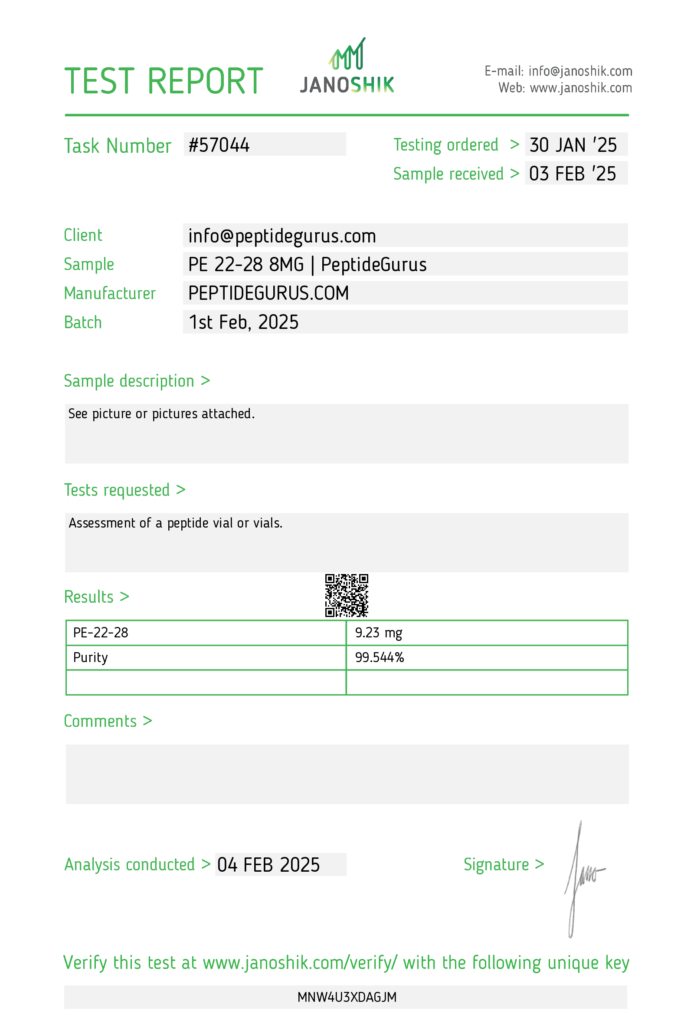
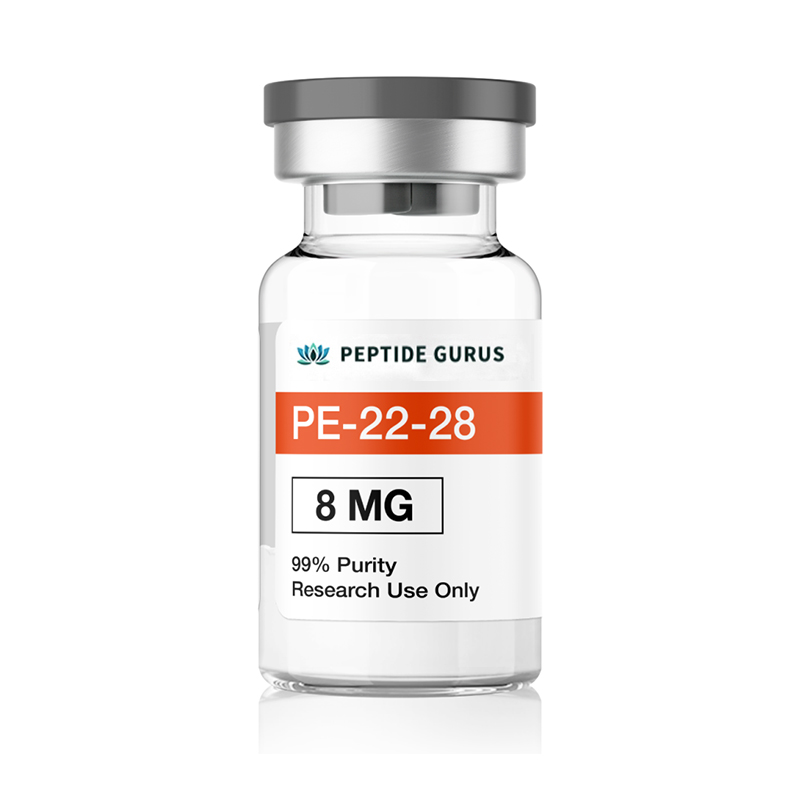
Bel 22-28 8mg is een synthetisch peptide dat is ontworpen om verschillende biologische processen te bevorderen, met name gerelateerd aan immuunsysteemmodulatie en weefselregeneratie. PE 22-28 is een fragment van een groter eiwit genaamd thymosine beta-4, dat van nature betrokken is bij weefselherstel, genezing en immuunfunctie. Van dit specifieke fragment (PE 22-28) is aangetoond dat het sterke regeneratieve en genezende eigenschappen heeft, met name in spier- en bindweefsels.
Belangrijkste eigenschappen en gebruik van PE 22-28 8mg:
-
Tissue Regeneration:
- PE 22-28 speelt een sleutelrol bij weefselregeneratie en -reparatie, met name in spier-, huid- en bindweefsels. Het wordt vaak gebruikt om de genezing van wonden te bevorderen en om het herstel van verwondingen of operaties te versnellen.
-
Anti-inflammatory Effects:
- Dit peptide heeft krachtige ontstekingsremmende eigenschappen, die het nuttig maken bij het verminderen van zwelling en ongemak veroorzaakt door verwondingen of inflammatoire aandoeningen. Door de ontsteking te verlagen, ondersteunt PE 22-28 sneller genezing en herstel.
-
Muscle Repair and Growth:
- PE 22-28 wordt vaak gebruikt door atleten en bodybuilders om spierherstel te versnellen en spierschade na intense lichaamsbeweging te verminderen. Het kan helpen bij het repareren van spiervezels, waardoor de algehele hersteltijd en prestaties van het lichaam worden verbeterd.
-
Cell Migration and Regeneration:
- Een van de belangrijkste functies van PE 22-28 is het vermogen om celmigratie en regeneratie te bevorderen, wat essentieel is voor weefselherstel. Het helpt de productie van nieuwe cellen in beschadigde weefselgebieden te stimuleren en het genezingsproces te versnellen.
-
Wound Healing:
- PE 22-28 wordt vaak gebruikt in klinische omgevingen om de genezing van chronische wonden, chirurgische wonden en brandwonden te ondersteunen. Het moedigt nieuwe weefselvorming aan en helpt wonden sneller en efficiënter te sluiten.
-
Immune System Support:
- Als onderdeel van de familie Thymosin Beta-4 speelt PE 22-28 een rol bij het ondersteunen van de functie van het immuunsysteem. Het kan helpen bij het moduleren van immuunreacties, het verbeteren van het vermogen van het lichaam om infecties te bestrijden en het algehele welzijn te bevorderen.
Administratie en dosering:
-
Administration: PE 22-28 wordt typisch toegediend door subcutane of intramusculaire injectie. Dit zorgt voor directe absorptie in de bloedbaan, gericht op het gebied waar weefselherstel en regeneratie nodig zijn.
-
Dosage: De typische dosering van PE 22-28 is 8 mg per injectie, hoewel de exacte dosering en frequentie van injecties kan variëren op basis van individuele doelen en de specifieke aandoening die wordt behandeld. Behandelingscycli duren over het algemeen van enkele weken tot enkele maanden, afhankelijk van de ernst van het letsel of de aandoening.
Overwegingen en waarschuwingen:
-
Side Effects: PE 22-28 is over het algemeen goed verdragen, maar sommige personen kunnen milde bijwerkingen zoals roodheid of irritatie op de injectieplaats ervaren. Minder vaak kunnen er systemische effecten zijn zoals duizeligheid of misselijkheid, hoewel deze zeldzaam zijn.
-
Medical Supervision: Vanwege de krachtige biologische effecten van PE 22-28, moet het worden gebruikt onder toezicht van een zorgverlener, met name voor personen met onderliggende gezondheidsproblemen of mensen die zwanger zijn of borstvoeding geven.
-
Regulatory Status: PE 22-28 wordt vaak verkocht als een onderzoekspeptide en is mogelijk niet algemeen goedgekeurd voor klinisch gebruik in alle regio's. Zorg voor naleving van de lokale wetgeving en voorschriften met betrekking tot het gebruik van peptiden.
Samenvatting:
PE 22-28 8mg is een krachtig peptide dat wordt gebruikt om weefselregeneratie te bevorderen, ontstekingen te verminderen en spierherstel en herstel te ondersteunen. Het wordt vaak gebruikt in medische, sport- en wellnesscontexten om de genezing te versnellen en de algehele weefselgezondheid te verbeteren. Vanwege de krachtige effecten moet het worden toegediend onder medisch toezicht om veiligheid en effectiviteit te waarborgen.
Gratis (1) 30 ml Bacteriostatisch Water
with qualified orders over
$ 500 USD.
(excludes capsule products, cosmetic peptides, promo codes and shipping)
Product Usage:
Dit product is alleen bedoeld als een onderzoeks chemisch. This designation allows the use of research chemicals strictly for in vitro testing and laboratory experimentation only. All product information available on this website is for educational purposes only. Bodily introduction of any kind into humans or animals is strictly forbidden by law. This product should only be handled by licensed, qualified professionals. This product is not a drug, food, or cosmetic and may not be misbranded, misused or mislabled as a drug, food or cosmetic.
Wat is PE-22-28?
PE-22-28 is a synthetic derivative of the naturally occurring peptide spadin. Spadin is a secreted peptide derived from sortilin. It is an antagonist of the TREK-1 (TWIK-related-potassium channel) receptor, a two-pore potassium channel identified as a potential target in the treatment of depression and as a possible neurogenic regulator. Early studies in mice have shown that a deletion of the TREK-1 receptor makes them resistant to depression. Similarly, treatment with sortilin leads to resistance to depression boosts the growth of both neurons and the synaptic interconnections between neurons[1].
Interestingly, shortened analogs of spadin actually show better TREK-1 inhibition than spadin itself. PE-22-28 is the representative peptide for this group of synthetic spadin analogs. PE-22-28 has been shown to be more stable and have improved antidepressant activity and neurogenic properties over the naturally occurring spadin.
It is important to note that one of the long-term consequences of taking anti-depressant medications (e.g. SSRIs) is neurogenesis. In fact, the growth of new neurons is considered to be one indication that depression is being adequately treated and that antidepressants are working. PE-22-28 has been shown to induce neurogenesis after just 4 days, which is substantially faster than any known antidepressant. This also suggests that PE-22-28 might be useful in other applications such as learning, stroke recovery, and perhaps even the battle against neurodegenerative diseases[2].
TREK-1, which is primarily found in the brain, is also found in the heart, smooth muscle cells, lung tissue, the prostate, and in specific areas of the pancreas. Though it has been primarily studied as a target for antidepressant activity, TREK-1 plays important roles in pain perception, anesthesia, and neuroprotection. These properties have made TREK-1 a major research target in academia and industry.
Structuren
Spadin -reeks: YAPLPRWSGPIGVSWGLR
Moleculaire formule: C
96H
142N
26O
22
Molecuulgewicht: 2012.3492 g/mol
PE-22-28-reeks: GVSWGLR
Moleculaire formule: C
35H
55N
11O
9
Molecuulgewicht: 773.8947 g/mol
PE-22-28 Onderzoek
Wat is Trek-1?
The receptor that spadin and thus PE-22-28 primarily bind to is TREK-1. TREK-1 is a two-pore potassium channel regulated by a number of different molecules. It belongs to a large family of two-pore potassium channels that are important in regulating the excitability of neurons. TREK-1, in particular, is found in regions of the brain controlling mood, memory, and learning. These areas include the prefrontal cortex, the amygdala, and the hippocampus. Stimulating TREK-1 activity reduces excitability of the neuron while reducing TREK-1 function increases excitability and increases the likelihood of a depolarization event[3]. By reducing excitability of the neuron, TREK-1 can help to protect against excitotoxicity.
Depressie
Research in mouse models of depression indicates that PE-22-28 is more effective in reversing the symptoms of depression than any currently used treatment and that it does so with fewer side effects. In fact, PE-22-28 has been shown to relieve depression in just 4 days without producing any side effects on other functions that are controlled by the TREK-1 channel.
There is strong evidence to show that the hippocampus is smaller (of reduced volume) in patients suffering from depressive disorder and other affect disorders. Additionally, research has shown that long-term administration of classic antidepressants (5-HT or norepinephrine selective reuptake inhibitors) boosts neurogenesis in the adult rodent hippocampus and leads to increased hippocampus volume[4]. The ability of PE-22-28 to reverse this loss of volume by stimulating neurogenesis indicates that it is fighting depression at its source and that it may help to uncover some of the underlying physiologic pathways that are deficient in the setting of depression[5].
The lack of side effects caused by spadin and PE-22-28 is just as important as the effects of these peptides. Current treatments for depression have a host of known side effects ranging from suicidality to changes in libido and problems with cognition. In fact, side effects are the number one reason that people stop using their antidepressants and are reluctant to return to them even after their depression worsens. Even ketamine, which has been newly touted as a potential rapid-onset treatment for depression has a host of side effects including delirium, hallucinations, muscle tremors, high blood pressure, and increased heart rate. So, despite its rapid onset of action, doctors have been reluctant to use ketamine in the treatment of depression because of the range and severity of its side effects[6].
There was initial concern that spadin would also cause a host of side effects because the TREK-1 receptor has been implicated in pain sensitivity, seizure activity, and cardiac ischemia. There was also concern that spadin and PE-22-28 may inhibit currents in TREK-2, TRAAK, TASK, and TRESK channels leading additional side effects. Research in mice, however, shows that none of these side effects are observed and, in fact, PE-22-28 has one of the smallest side effect profiles of any existing or experimental treatment for depression[7].
Depressie na het beroerte
De depressie na de beroerte (PSD) is een veel voorkomende aandoening na ischemie van de hersenen en is bijzonder vuurvast voor de standaardbehandeling. Recent onderzoek heeft aangetoond dat Trek-1 overexpressie waarschijnlijk een oorzakelijke rol speelt in deze toestand. In experimentele muismodellen kan deze opregulatie worden onderdrukt of omgekeerd met behulp van zowel SSRI-antidepressiva als Trek-1-blokkers zoals Spadin [3]. Natuurlijk hebben de SSRI's veel langer nodig om te handelen en hebben ze een groot aantal bijwerkingen. Dit suggereert dat PE-22-28 effectief kan blijken te zijn in toekomstige onderzoeken die de behandeling van PSD onderzoeken.
Neurogenese
The ability of antidepressant drugs to upregulate neurogenesis in the hippocampus has been well-established. Research with PE-22-28 shows that this peptide can perform the same function, but in a shorter duration of time. Studies in mice show that PE-22-28 increases both neurogenesis and synaptogenesis after just four days. Preliminary results indicate that PE-22-28 roughly doubles the amount of BrdU (an exogenous marker that is incorporated into DNA and used to detect replication) positive cells in the hippocampus. In the case of synaptogenesis, PE-22-28 appears to double the rate of synapse formation[2], [8].
Another clue that PE-22-28 is boosting cell division in the brain is the increase in CREB seen after its administration. CREB (cAMP response element-binding protein) is a transcription factor associated with neuronal plasticity, memory formation, and the development of spatial memory. CREB appears to be a necessary component in not just the growth of neurons, but in their protection as well. Research in Alzheimer’s disease has shown a down-regulation of CREB and scientists have long sought a drug capable of boosting CREB as a means of treating Alzheimer’s[9], [10]. PE-22-28 is being actively investigated for its ability to both prevent and reverse the symptoms of Alzheimer’s disease.
The hippocampus, while playing an important role in depression, is also a critical structure for learning and memory. It is a very plastic structure that research has revealed to be vulnerable to damage by a variety of insults. The hippocampus has been implicated in diseases ranging from depression to anxiety to Alzheimer’s disease. Improving its ability to regenerate following injury could help to treat a number of diseases. Notably, the role of the hippocampus in learning, memory, and spatial navigation suggests that PE-22-28 or a similar TREK-1 antagonist may prove to be an effective nootropic.
Now, it has generally been demonstrated in animal models that removing the TREK-1 channel is a recipe for disaster. In previous mouse models, knockout of TREK-1 increased significantly the likelihood of seizure activity and reduced the normal ability of this two-pore potassium channel to protect neurons from excitotoxicity. It came as a bit of surprise then that neither spadin nor PE-22-28 enhanced seizure activity. Even more interesting is the fact that mice treated with spadin are more resistant to developing generalized seizures[3]. PE-22-28 has even more profound protective effects than spadin.
Top: Number of cells in the hippocampus of mice treated with saline, fluoxetine (Prozac), and spadin for four days.
Middle: Quantification of CREB activity in the brain of mice treated with saline and spadin.
Bottom: Effect of spadin on the firing rate of 5-HT neurons (neurons implicated in depression) at baseline (WT), in TREK-1 knockout mice (KO), and after administration of spadin and saline. Note that spadin boosts firing in neurons almost as much as removing TREK-1 entirely.
Spierfunctie
Er is enig onderzoek om te suggereren dat Trek-1 een belangrijke rol speelt in het vermogen van spieren om te reageren op mechanische stimulatie. In het bijzonder lijkt Trek-1-blokkade de contractiliteit in spierweefsel te vergroten, terwijl activering van het kanaal spierontspanning lijkt te bevorderen. Hoewel dit specifieke aspect van het Trek-1-kanaal zich nog in de vroege stadia van onderzoek bevindt, wordt het steeds belangrijker. Er is hoop dat het begrijpen van de rol van moleculen zoals PE-22-28 bij spiercontractie en ontspanning misschien niet alleen nieuwe behandelingsmodaliteiten biedt voor aandoeningen zoals myogene blaasdisfunctie, maar kan ook nieuwe routes openen voor het begrijpen van de fysiologie van spierprestaties [11].
Samenvatting
According to Dr. Jean Mazella, one of the lead researchers in the development of PE-22-28, the peptide was specifically designed to move forward the use of spadin analogs in clinics. PE-22-28 appears to be an effective treatment for depression and a potent stimulator of neurogenesis and synaptogenesis in the hippocampus. It has far fewer side effects than existing antidepressant medications and appears to retain much of its ability to antagonize TREK-1 even after modifications that boost half-life or alter the route of administration. In short, PE-22-28 appears to offer a strong target for guiding the development of a new generation of antidepressants and is helping to shed light on the burgeoning field of nootropics. It is also helping to expand the arsenal of drugs used to treat neurodegenerative diseases like Alzheimer’s disease.
The products offered on this website are furnished for in-vitro studies only. In-vitro studies (Latin: in glass) are performed outside of the body. These products are not medicines or drugs and have not been approved by the FDA to prevent, treat or cure any medical condition, ailment or disease. Bodily introduction of any kind into humans or animals is strictly forbidden by law.