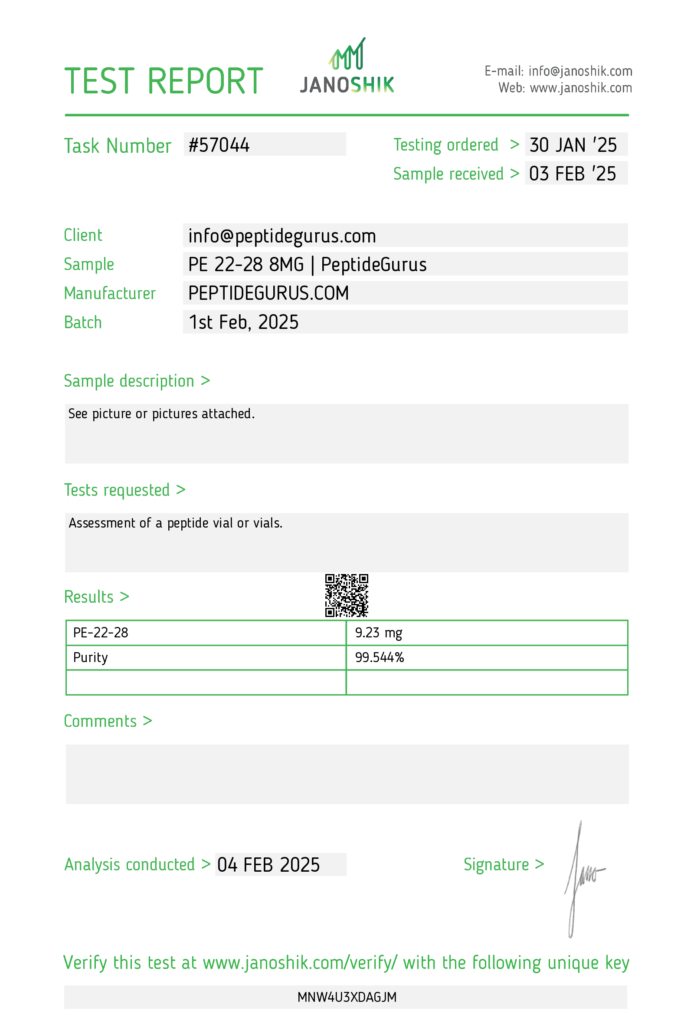
Hubungi 22-28 8mg adalah peptida sintetis yang dirancang untuk mempromosikan berbagai proses biologis, terutama terkait dengan modulasi sistem kekebalan tubuh dan regenerasi jaringan. PE 22-28 adalah fragmen dari protein yang lebih besar yang disebut timosin beta-4, yang secara alami terlibat dalam perbaikan jaringan, penyembuhan, dan fungsi kekebalan tubuh. Fragmen spesifik ini (PE 22-28) telah terbukti memiliki sifat regeneratif dan penyembuhan yang kuat, terutama pada jaringan otot dan ikat.
Properti Kunci dan Penggunaan PE 22-28 8mg:
-
Tissue Regeneration:
- PE 22-28 memainkan peran kunci dalam regenerasi dan perbaikan jaringan, terutama pada otot, kulit, dan jaringan ikat. Ini sering digunakan untuk mempromosikan penyembuhan luka dan mempercepat pemulihan dari cedera atau operasi.
-
Anti-inflammatory Effects:
- Peptida ini memiliki sifat anti-inflamasi yang kuat, yang membuatnya berguna dalam mengurangi pembengkakan dan ketidaknyamanan yang disebabkan oleh cedera atau kondisi peradangan. Dengan menurunkan peradangan, PE 22-28 mendukung penyembuhan dan pemulihan yang lebih cepat.
-
Muscle Repair and Growth:
- PE 22-28 biasanya digunakan oleh atlet dan binaragawan untuk mempercepat pemulihan otot dan mengurangi kerusakan otot setelah berolahraga. Ini dapat membantu dalam memperbaiki serat otot, meningkatkan waktu pemulihan dan kinerja tubuh secara keseluruhan.
-
Cell Migration and Regeneration:
- Salah satu fungsi terpenting dari PE 22-28 adalah kemampuannya untuk mempromosikan migrasi dan regenerasi sel, yang penting untuk perbaikan jaringan. Ini membantu merangsang produksi sel -sel baru di daerah jaringan yang rusak, mempercepat proses penyembuhan.
-
Wound Healing:
- PE 22-28 sering digunakan dalam pengaturan klinis untuk mendukung penyembuhan luka kronis, luka bedah, dan luka bakar. Ini mendorong pembentukan jaringan baru dan membantu menutup luka lebih cepat dan efisien.
-
Immune System Support:
- Sebagai bagian dari keluarga timosin beta-4, PE 22-28 berperan dalam mendukung fungsi sistem kekebalan tubuh. Ini dapat membantu memodulasi respons imun, meningkatkan kemampuan tubuh untuk melawan infeksi dan mempromosikan kesehatan secara keseluruhan.
Administrasi dan dosis:
-
Administration: PE 22-28 biasanya diberikan melalui injeksi subkutan atau intramuskuler. Hal ini memungkinkan penyerapan langsung ke dalam aliran darah, menargetkan area tempat perbaikan dan regenerasi jaringan diperlukan.
-
Dosage: Dosis khas PE 22-28 adalah 8mg per suntikan, meskipun dosis dan frekuensi suntikan yang tepat dapat bervariasi berdasarkan tujuan individu dan kondisi spesifik yang sedang dirawat. Siklus pengobatan umumnya berlangsung dari beberapa minggu hingga beberapa bulan, tergantung pada keparahan cedera atau kondisi.
Pertimbangan dan Peringatan:
-
Side Effects: PE 22-28 umumnya ditoleransi dengan baik, tetapi beberapa orang mungkin mengalami efek samping ringan seperti kemerahan atau iritasi di lokasi injeksi. Lebih jarang, mungkin ada efek sistemik seperti pusing atau mual, meskipun ini jarang terjadi.
-
Medical Supervision: Karena efek biologis yang kuat dari PE 22-28, itu harus digunakan di bawah pengawasan profesional perawatan kesehatan, terutama untuk individu dengan kondisi kesehatan yang mendasarinya atau mereka yang hamil atau menyusui.
-
Regulatory Status: PE 22-28 sering dijual sebagai peptida penelitian dan mungkin tidak disetujui secara luas untuk penggunaan klinis di semua wilayah. Pastikan kepatuhan terhadap hukum dan peraturan setempat mengenai penggunaan peptida.
Ringkasan:
PE 22-28 8mg adalah peptida kuat yang digunakan untuk mempromosikan regenerasi jaringan, mengurangi peradangan, dan mendukung perbaikan dan pemulihan otot. Ini biasanya digunakan dalam konteks medis, olahraga, dan kebugaran untuk mempercepat penyembuhan dan meningkatkan kesehatan jaringan secara keseluruhan. Karena efeknya yang kuat, itu harus diberikan di bawah pengawasan medis untuk memastikan keamanan dan efektivitas.
Bebas (1) 30 mL air bakteriostatik
with qualified orders over
$ 500 USD.
(excludes capsule products, cosmetic peptides, promo codes and shipping)
Product Usage:
Produk ini dimaksudkan sebagai bahan kimia penelitian saja. This designation allows the use of research chemicals strictly for in vitro testing and laboratory experimentation only. All product information available on this website is for educational purposes only. Bodily introduction of any kind into humans or animals is strictly forbidden by law. This product should only be handled by licensed, qualified professionals. This product is not a drug, food, or cosmetic and may not be misbranded, misused or mislabled as a drug, food or cosmetic.
Apa itu PE-22-28?
PE-22-28 is a synthetic derivative of the naturally occurring peptide spadin. Spadin is a secreted peptide derived from sortilin. It is an antagonist of the TREK-1 (TWIK-related-potassium channel) receptor, a two-pore potassium channel identified as a potential target in the treatment of depression and as a possible neurogenic regulator. Early studies in mice have shown that a deletion of the TREK-1 receptor makes them resistant to depression. Similarly, treatment with sortilin leads to resistance to depression boosts the growth of both neurons and the synaptic interconnections between neurons[1].
Interestingly, shortened analogs of spadin actually show better TREK-1 inhibition than spadin itself. PE-22-28 is the representative peptide for this group of synthetic spadin analogs. PE-22-28 has been shown to be more stable and have improved antidepressant activity and neurogenic properties over the naturally occurring spadin.
It is important to note that one of the long-term consequences of taking anti-depressant medications (e.g. SSRIs) is neurogenesis. In fact, the growth of new neurons is considered to be one indication that depression is being adequately treated and that antidepressants are working. PE-22-28 has been shown to induce neurogenesis after just 4 days, which is substantially faster than any known antidepressant. This also suggests that PE-22-28 might be useful in other applications such as learning, stroke recovery, and perhaps even the battle against neurodegenerative diseases[2].
TREK-1, which is primarily found in the brain, is also found in the heart, smooth muscle cells, lung tissue, the prostate, and in specific areas of the pancreas. Though it has been primarily studied as a target for antidepressant activity, TREK-1 plays important roles in pain perception, anesthesia, and neuroprotection. These properties have made TREK-1 a major research target in academia and industry.
Struktur
Urutan Spadin: YAPLPRWSGPIGVSWGLR
Formula Molekul: C
96H
142N
26HAI
22
Berat molekul: 2012.3492 g/mol
Urutan PE-22-28: GVSWGLR
Formula Molekul: C
35H
55N
11HAI
9
Berat molekul: 773.8947 g/mol
Penelitian PE-22-28
Apa itu Trek-1?
The receptor that spadin and thus PE-22-28 primarily bind to is TREK-1. TREK-1 is a two-pore potassium channel regulated by a number of different molecules. It belongs to a large family of two-pore potassium channels that are important in regulating the excitability of neurons. TREK-1, in particular, is found in regions of the brain controlling mood, memory, and learning. These areas include the prefrontal cortex, the amygdala, and the hippocampus. Stimulating TREK-1 activity reduces excitability of the neuron while reducing TREK-1 function increases excitability and increases the likelihood of a depolarization event[3]. By reducing excitability of the neuron, TREK-1 can help to protect against excitotoxicity.
Depresi
Research in mouse models of depression indicates that PE-22-28 is more effective in reversing the symptoms of depression than any currently used treatment and that it does so with fewer side effects. In fact, PE-22-28 has been shown to relieve depression in just 4 days without producing any side effects on other functions that are controlled by the TREK-1 channel.
There is strong evidence to show that the hippocampus is smaller (of reduced volume) in patients suffering from depressive disorder and other affect disorders. Additionally, research has shown that long-term administration of classic antidepressants (5-HT or norepinephrine selective reuptake inhibitors) boosts neurogenesis in the adult rodent hippocampus and leads to increased hippocampus volume[4]. The ability of PE-22-28 to reverse this loss of volume by stimulating neurogenesis indicates that it is fighting depression at its source and that it may help to uncover some of the underlying physiologic pathways that are deficient in the setting of depression[5].
The lack of side effects caused by spadin and PE-22-28 is just as important as the effects of these peptides. Current treatments for depression have a host of known side effects ranging from suicidality to changes in libido and problems with cognition. In fact, side effects are the number one reason that people stop using their antidepressants and are reluctant to return to them even after their depression worsens. Even ketamine, which has been newly touted as a potential rapid-onset treatment for depression has a host of side effects including delirium, hallucinations, muscle tremors, high blood pressure, and increased heart rate. So, despite its rapid onset of action, doctors have been reluctant to use ketamine in the treatment of depression because of the range and severity of its side effects[6].
There was initial concern that spadin would also cause a host of side effects because the TREK-1 receptor has been implicated in pain sensitivity, seizure activity, and cardiac ischemia. There was also concern that spadin and PE-22-28 may inhibit currents in TREK-2, TRAAK, TASK, and TRESK channels leading additional side effects. Research in mice, however, shows that none of these side effects are observed and, in fact, PE-22-28 has one of the smallest side effect profiles of any existing or experimental treatment for depression[7].
Depresi pasca-stroke
Depresi pasca-stroke (PSD) adalah kondisi umum setelah iskemia otak dan sangat refraktori untuk pengobatan standar. Penelitian terbaru menunjukkan bahwa ekspresi berlebihan Trek-1 kemungkinan memainkan peran penyebab dalam kondisi ini. Dalam model tikus eksperimental, upregulasi ini dapat ditekan atau dibalik menggunakan kedua antidepresan SSRI serta trek-1 blocker seperti Spadin [3]. Tentu saja, SSRI membutuhkan waktu lebih lama untuk bertindak dan memiliki sejumlah efek samping. Ini menunjukkan bahwa PE-22-28 mungkin terbukti efektif dalam uji coba di masa depan yang mengeksplorasi pengobatan PSD.
Neurogenesis
The ability of antidepressant drugs to upregulate neurogenesis in the hippocampus has been well-established. Research with PE-22-28 shows that this peptide can perform the same function, but in a shorter duration of time. Studies in mice show that PE-22-28 increases both neurogenesis and synaptogenesis after just four days. Preliminary results indicate that PE-22-28 roughly doubles the amount of BrdU (an exogenous marker that is incorporated into DNA and used to detect replication) positive cells in the hippocampus. In the case of synaptogenesis, PE-22-28 appears to double the rate of synapse formation[2], [8].
Another clue that PE-22-28 is boosting cell division in the brain is the increase in CREB seen after its administration. CREB (cAMP response element-binding protein) is a transcription factor associated with neuronal plasticity, memory formation, and the development of spatial memory. CREB appears to be a necessary component in not just the growth of neurons, but in their protection as well. Research in Alzheimer’s disease has shown a down-regulation of CREB and scientists have long sought a drug capable of boosting CREB as a means of treating Alzheimer’s[9], [10]. PE-22-28 is being actively investigated for its ability to both prevent and reverse the symptoms of Alzheimer’s disease.
The hippocampus, while playing an important role in depression, is also a critical structure for learning and memory. It is a very plastic structure that research has revealed to be vulnerable to damage by a variety of insults. The hippocampus has been implicated in diseases ranging from depression to anxiety to Alzheimer’s disease. Improving its ability to regenerate following injury could help to treat a number of diseases. Notably, the role of the hippocampus in learning, memory, and spatial navigation suggests that PE-22-28 or a similar TREK-1 antagonist may prove to be an effective nootropic.
Now, it has generally been demonstrated in animal models that removing the TREK-1 channel is a recipe for disaster. In previous mouse models, knockout of TREK-1 increased significantly the likelihood of seizure activity and reduced the normal ability of this two-pore potassium channel to protect neurons from excitotoxicity. It came as a bit of surprise then that neither spadin nor PE-22-28 enhanced seizure activity. Even more interesting is the fact that mice treated with spadin are more resistant to developing generalized seizures[3]. PE-22-28 has even more profound protective effects than spadin.
Top: Number of cells in the hippocampus of mice treated with saline, fluoxetine (Prozac), and spadin for four days.
Middle: Quantification of CREB activity in the brain of mice treated with saline and spadin.
Bottom: Effect of spadin on the firing rate of 5-HT neurons (neurons implicated in depression) at baseline (WT), in TREK-1 knockout mice (KO), and after administration of spadin and saline. Note that spadin boosts firing in neurons almost as much as removing TREK-1 entirely.
Fungsi otot
Ada beberapa penelitian yang menunjukkan bahwa Trek-1 memainkan peran penting dalam kemampuan otot untuk merespons stimulasi mekanik. Secara khusus, blokade Trek-1 tampaknya meningkatkan kontraktilitas dalam jaringan otot sementara aktivasi saluran tampaknya mempromosikan relaksasi otot. Sementara aspek khusus dari saluran Trek-1 ini masih dalam tahap awal investigasi, itu menjadi semakin penting. Ada harapan bahwa memahami peran molekul seperti PE-22-28 dalam kontraksi otot dan relaksasi mungkin tidak hanya memberikan modalitas pengobatan baru untuk kondisi seperti disfungsi kandung kemih miogenik, tetapi juga dapat membuka jalur baru untuk memahami fisiologi kinerja otot [11].
Ringkasan
According to Dr. Jean Mazella, one of the lead researchers in the development of PE-22-28, the peptide was specifically designed to move forward the use of spadin analogs in clinics. PE-22-28 appears to be an effective treatment for depression and a potent stimulator of neurogenesis and synaptogenesis in the hippocampus. It has far fewer side effects than existing antidepressant medications and appears to retain much of its ability to antagonize TREK-1 even after modifications that boost half-life or alter the route of administration. In short, PE-22-28 appears to offer a strong target for guiding the development of a new generation of antidepressants and is helping to shed light on the burgeoning field of nootropics. It is also helping to expand the arsenal of drugs used to treat neurodegenerative diseases like Alzheimer’s disease.
The products offered on this website are furnished for in-vitro studies only. In-vitro studies (Latin: in glass) are performed outside of the body. These products are not medicines or drugs and have not been approved by the FDA to prevent, treat or cure any medical condition, ailment or disease. Bodily introduction of any kind into humans or animals is strictly forbidden by law.