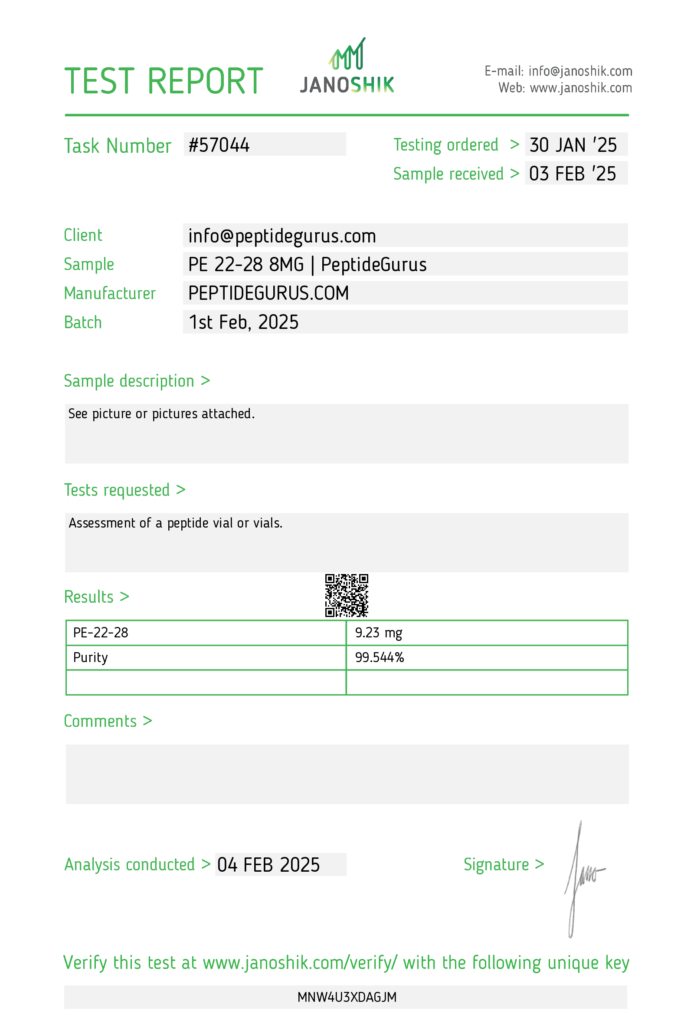
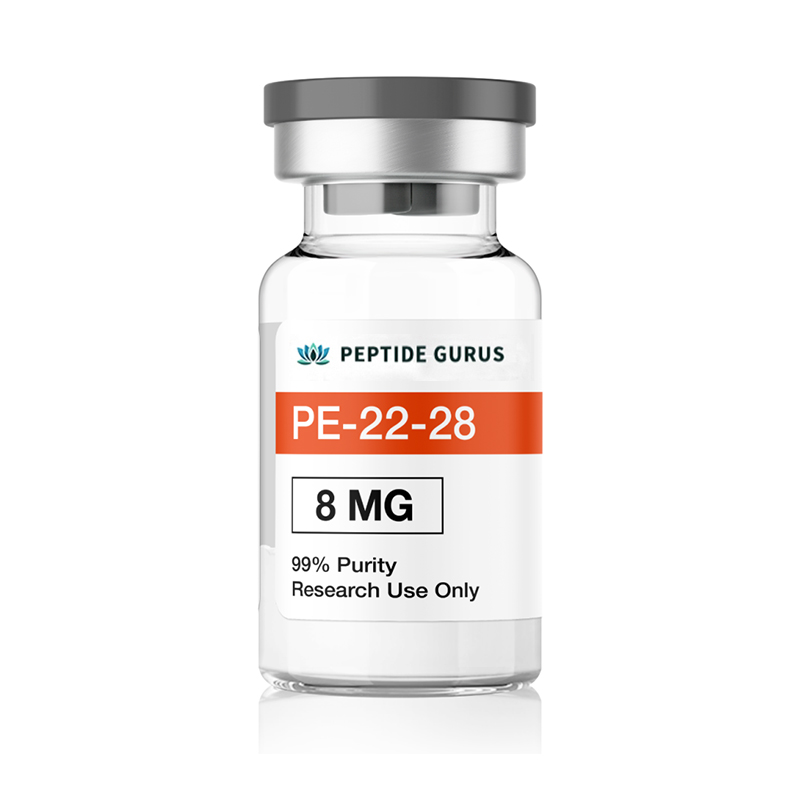
Ligue para 22-28 8mg é um peptídeo sintético projetado para promover vários processos biológicos, particularmente relacionados à modulação do sistema imunológico e à regeneração tecidual. O PE 22-28 é um fragmento de uma proteína maior chamada timasina beta-4, que está naturalmente envolvida no reparo de tecidos, cura e função imunológica. Foi demonstrado que este fragmento específico (PE 22-28) possui fortes propriedades regenerativas e curativas, particularmente nos tecidos musculares e conjuntivos.
Propriedades-chave e usos do PE 22-28 8mg:
-
Tissue Regeneration:
- O PE 22-28 desempenha um papel fundamental na regeneração e reparo dos tecidos, particularmente nos tecidos musculares, pele e conjuntivos. É frequentemente usado para promover a cicatrização de feridas e acelerar a recuperação de lesões ou cirurgias.
-
Anti-inflammatory Effects:
- Esse peptídeo possui potentes propriedades anti-inflamatórias, o que o torna útil na redução do inchaço e desconforto causados por lesões ou condições inflamatórias. Ao diminuir a inflamação, o PE 22-28 suporta cicatrização e recuperação mais rápidas.
-
Muscle Repair and Growth:
- O PE 22-28 é comumente usado por atletas e fisiculturistas para acelerar a recuperação muscular e reduzir os danos musculares após exercícios intensos. Pode ajudar a reparar fibras musculares, melhorando o tempo e o desempenho de recuperação do corpo.
-
Cell Migration and Regeneration:
- Uma das funções mais importantes do PE 22-28 é sua capacidade de promover a migração e a regeneração celular, essencial para o reparo de tecidos. Ajuda a estimular a produção de novas células em áreas de tecido danificado, acelerando o processo de cicatrização.
-
Wound Healing:
- O PE 22-28 é frequentemente usado em ambientes clínicos para apoiar a cicatrização de feridas crônicas, feridas cirúrgicas e queimaduras. Incentiva a formação de novos tecidos e ajuda a fechar feridas com mais rapidez e eficiência.
-
Immune System Support:
- Como parte da família beta-4 da timasina, o PE 22-28 desempenha um papel no suporte à função do sistema imunológico. Pode ajudar a modular as respostas imunes, melhorando a capacidade do corpo de combater infecções e promover o bem -estar geral.
Administração e dosagem:
-
Administration: O PE 22-28 é normalmente administrado por injeção subcutânea ou intramuscular. Isso permite a absorção direta na corrente sanguínea, visando a área onde são necessários reparos e regeneração teciduais.
-
Dosage: A dosagem típica do PE 22-28 é de 8mg por injeção, embora a dose exata e a frequência das injeções possam variar com base em objetivos individuais e na condição específica que está sendo tratada. Os ciclos de tratamento geralmente duram de algumas semanas a vários meses, dependendo da gravidade da lesão ou condição.
Considerações e avisos:
-
Side Effects: O PE 22-28 é geralmente bem tolerado, mas alguns indivíduos podem sofrer efeitos colaterais leves, como vermelhidão ou irritação, no local da injeção. Menos comumente, pode haver efeitos sistêmicos, como tontura ou náusea, embora sejam raros.
-
Medical Supervision: Devido aos potentes efeitos biológicos do PE 22-28, ele deve ser usado sob a supervisão de um profissional de saúde, principalmente para indivíduos com condições de saúde subjacentes ou para aqueles que estão grávidas ou amamentando.
-
Regulatory Status: O PE 22-28 é frequentemente vendido como um peptídeo de pesquisa e pode não ser amplamente aprovado para uso clínico em todas as regiões. Garanta a conformidade com as leis e regulamentos locais sobre o uso de peptídeos.
Resumo:
O PE 22-28 8mg é um peptídeo poderoso usado para promover a regeneração tecidual, reduzir a inflamação e apoiar o reparo e a recuperação muscular. É comumente usado em contextos médicos, de esportes e bem -estar para acelerar a cura e melhorar a saúde geral dos tecidos. Devido aos seus efeitos potentes, ele deve ser administrado sob supervisão médica para garantir a segurança e a eficácia.
Grátis (1) 30 ml de água bacteriostática
with qualified orders over
US $ 500 USD.
(excludes capsule products, cosmetic peptides, promo codes and shipping)
Product Usage:
Este produto é destinado apenas a um produto químico de pesquisa. This designation allows the use of research chemicals strictly for in vitro testing and laboratory experimentation only. All product information available on this website is for educational purposes only. Bodily introduction of any kind into humans or animals is strictly forbidden by law. This product should only be handled by licensed, qualified professionals. This product is not a drug, food, or cosmetic and may not be misbranded, misused or mislabled as a drug, food or cosmetic.
O que é PE-22-28?
PE-22-28 is a synthetic derivative of the naturally occurring peptide spadin. Spadin is a secreted peptide derived from sortilin. It is an antagonist of the TREK-1 (TWIK-related-potassium channel) receptor, a two-pore potassium channel identified as a potential target in the treatment of depression and as a possible neurogenic regulator. Early studies in mice have shown that a deletion of the TREK-1 receptor makes them resistant to depression. Similarly, treatment with sortilin leads to resistance to depression boosts the growth of both neurons and the synaptic interconnections between neurons[1].
Interestingly, shortened analogs of spadin actually show better TREK-1 inhibition than spadin itself. PE-22-28 is the representative peptide for this group of synthetic spadin analogs. PE-22-28 has been shown to be more stable and have improved antidepressant activity and neurogenic properties over the naturally occurring spadin.
It is important to note that one of the long-term consequences of taking anti-depressant medications (e.g. SSRIs) is neurogenesis. In fact, the growth of new neurons is considered to be one indication that depression is being adequately treated and that antidepressants are working. PE-22-28 has been shown to induce neurogenesis after just 4 days, which is substantially faster than any known antidepressant. This also suggests that PE-22-28 might be useful in other applications such as learning, stroke recovery, and perhaps even the battle against neurodegenerative diseases[2].
TREK-1, which is primarily found in the brain, is also found in the heart, smooth muscle cells, lung tissue, the prostate, and in specific areas of the pancreas. Though it has been primarily studied as a target for antidepressant activity, TREK-1 plays important roles in pain perception, anesthesia, and neuroprotection. These properties have made TREK-1 a major research target in academia and industry.
Estruturas
Sequência de Spadin: YAPLPRWSGPIGVSWGLR
Fórmula Molecular: C
96H
142N
26O
22
Peso molecular: 2012.3492 g/mol
Sequência PE-22-28: GVSWGLR
Fórmula Molecular: C
35H
55N
11O
9
Peso molecular: 773.8947 g/mol
Pesquisa PE-22-28
O que é Trek-1?
The receptor that spadin and thus PE-22-28 primarily bind to is TREK-1. TREK-1 is a two-pore potassium channel regulated by a number of different molecules. It belongs to a large family of two-pore potassium channels that are important in regulating the excitability of neurons. TREK-1, in particular, is found in regions of the brain controlling mood, memory, and learning. These areas include the prefrontal cortex, the amygdala, and the hippocampus. Stimulating TREK-1 activity reduces excitability of the neuron while reducing TREK-1 function increases excitability and increases the likelihood of a depolarization event[3]. By reducing excitability of the neuron, TREK-1 can help to protect against excitotoxicity.
Depressão
Research in mouse models of depression indicates that PE-22-28 is more effective in reversing the symptoms of depression than any currently used treatment and that it does so with fewer side effects. In fact, PE-22-28 has been shown to relieve depression in just 4 days without producing any side effects on other functions that are controlled by the TREK-1 channel.
There is strong evidence to show that the hippocampus is smaller (of reduced volume) in patients suffering from depressive disorder and other affect disorders. Additionally, research has shown that long-term administration of classic antidepressants (5-HT or norepinephrine selective reuptake inhibitors) boosts neurogenesis in the adult rodent hippocampus and leads to increased hippocampus volume[4]. The ability of PE-22-28 to reverse this loss of volume by stimulating neurogenesis indicates that it is fighting depression at its source and that it may help to uncover some of the underlying physiologic pathways that are deficient in the setting of depression[5].
The lack of side effects caused by spadin and PE-22-28 is just as important as the effects of these peptides. Current treatments for depression have a host of known side effects ranging from suicidality to changes in libido and problems with cognition. In fact, side effects are the number one reason that people stop using their antidepressants and are reluctant to return to them even after their depression worsens. Even ketamine, which has been newly touted as a potential rapid-onset treatment for depression has a host of side effects including delirium, hallucinations, muscle tremors, high blood pressure, and increased heart rate. So, despite its rapid onset of action, doctors have been reluctant to use ketamine in the treatment of depression because of the range and severity of its side effects[6].
There was initial concern that spadin would also cause a host of side effects because the TREK-1 receptor has been implicated in pain sensitivity, seizure activity, and cardiac ischemia. There was also concern that spadin and PE-22-28 may inhibit currents in TREK-2, TRAAK, TASK, and TRESK channels leading additional side effects. Research in mice, however, shows that none of these side effects are observed and, in fact, PE-22-28 has one of the smallest side effect profiles of any existing or experimental treatment for depression[7].
Depressão pós-AVC
A depressão pós-AVC (PSD) é uma condição comum após a isquemia cerebral e é particularmente refratária ao tratamento padrão. Pesquisas recentes mostraram que a super expressão do Trek-1 provavelmente desempenha um papel causador nessa condição. Nos modelos experimentais de camundongos, essa regulação positiva pode ser suprimida ou revertida usando antidepressivos SSRI, bem como bloqueadores de Trek-1 como Spadin [3]. Obviamente, os SSRIs demoram muito mais para agir e têm uma série de efeitos colaterais. Isso sugere que o PE-22-28 pode ser eficaz em futuros ensaios que exploram o tratamento do PSD.
Neurogênese
The ability of antidepressant drugs to upregulate neurogenesis in the hippocampus has been well-established. Research with PE-22-28 shows that this peptide can perform the same function, but in a shorter duration of time. Studies in mice show that PE-22-28 increases both neurogenesis and synaptogenesis after just four days. Preliminary results indicate that PE-22-28 roughly doubles the amount of BrdU (an exogenous marker that is incorporated into DNA and used to detect replication) positive cells in the hippocampus. In the case of synaptogenesis, PE-22-28 appears to double the rate of synapse formation[2], [8].
Another clue that PE-22-28 is boosting cell division in the brain is the increase in CREB seen after its administration. CREB (cAMP response element-binding protein) is a transcription factor associated with neuronal plasticity, memory formation, and the development of spatial memory. CREB appears to be a necessary component in not just the growth of neurons, but in their protection as well. Research in Alzheimer’s disease has shown a down-regulation of CREB and scientists have long sought a drug capable of boosting CREB as a means of treating Alzheimer’s[9], [10]. PE-22-28 is being actively investigated for its ability to both prevent and reverse the symptoms of Alzheimer’s disease.
The hippocampus, while playing an important role in depression, is also a critical structure for learning and memory. It is a very plastic structure that research has revealed to be vulnerable to damage by a variety of insults. The hippocampus has been implicated in diseases ranging from depression to anxiety to Alzheimer’s disease. Improving its ability to regenerate following injury could help to treat a number of diseases. Notably, the role of the hippocampus in learning, memory, and spatial navigation suggests that PE-22-28 or a similar TREK-1 antagonist may prove to be an effective nootropic.
Now, it has generally been demonstrated in animal models that removing the TREK-1 channel is a recipe for disaster. In previous mouse models, knockout of TREK-1 increased significantly the likelihood of seizure activity and reduced the normal ability of this two-pore potassium channel to protect neurons from excitotoxicity. It came as a bit of surprise then that neither spadin nor PE-22-28 enhanced seizure activity. Even more interesting is the fact that mice treated with spadin are more resistant to developing generalized seizures[3]. PE-22-28 has even more profound protective effects than spadin.
Top: Number of cells in the hippocampus of mice treated with saline, fluoxetine (Prozac), and spadin for four days.
Middle: Quantification of CREB activity in the brain of mice treated with saline and spadin.
Bottom: Effect of spadin on the firing rate of 5-HT neurons (neurons implicated in depression) at baseline (WT), in TREK-1 knockout mice (KO), and after administration of spadin and saline. Note that spadin boosts firing in neurons almost as much as removing TREK-1 entirely.
Função muscular
Há algumas pesquisas que sugerem que o Trek-1 desempenha um papel importante na capacidade do músculo de responder à estimulação mecânica. Em particular, o bloqueio do Trek-1 parece aumentar a contratilidade no tecido muscular, enquanto a ativação do canal parece promover o relaxamento muscular. Embora esse aspecto específico do canal Trek-1 ainda esteja nos estágios iniciais da investigação, está se tornando cada vez mais importante. Há esperança de que entender o papel das moléculas como PE-22-28 na contração e relaxamento muscular possa não apenas fornecer novas modalidades de tratamento para condições como a disfunção da bexiga miogênica, mas também pode abrir novos caminhos para entender a fisiologia do desempenho muscular [11].
Resumo
According to Dr. Jean Mazella, one of the lead researchers in the development of PE-22-28, the peptide was specifically designed to move forward the use of spadin analogs in clinics. PE-22-28 appears to be an effective treatment for depression and a potent stimulator of neurogenesis and synaptogenesis in the hippocampus. It has far fewer side effects than existing antidepressant medications and appears to retain much of its ability to antagonize TREK-1 even after modifications that boost half-life or alter the route of administration. In short, PE-22-28 appears to offer a strong target for guiding the development of a new generation of antidepressants and is helping to shed light on the burgeoning field of nootropics. It is also helping to expand the arsenal of drugs used to treat neurodegenerative diseases like Alzheimer’s disease.
The products offered on this website are furnished for in-vitro studies only. In-vitro studies (Latin: in glass) are performed outside of the body. These products are not medicines or drugs and have not been approved by the FDA to prevent, treat or cure any medical condition, ailment or disease. Bodily introduction of any kind into humans or animals is strictly forbidden by law.