




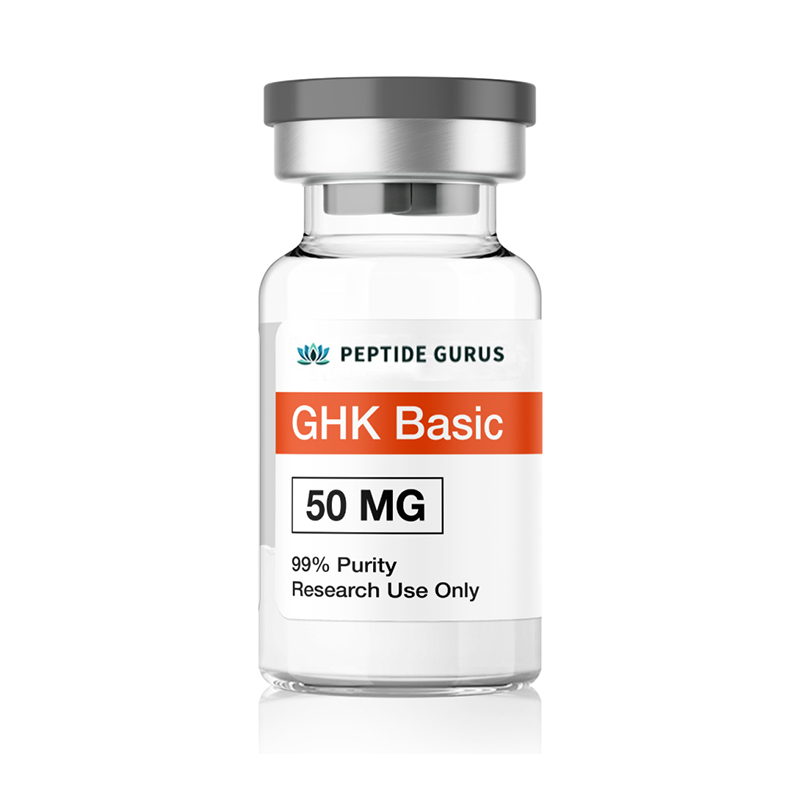
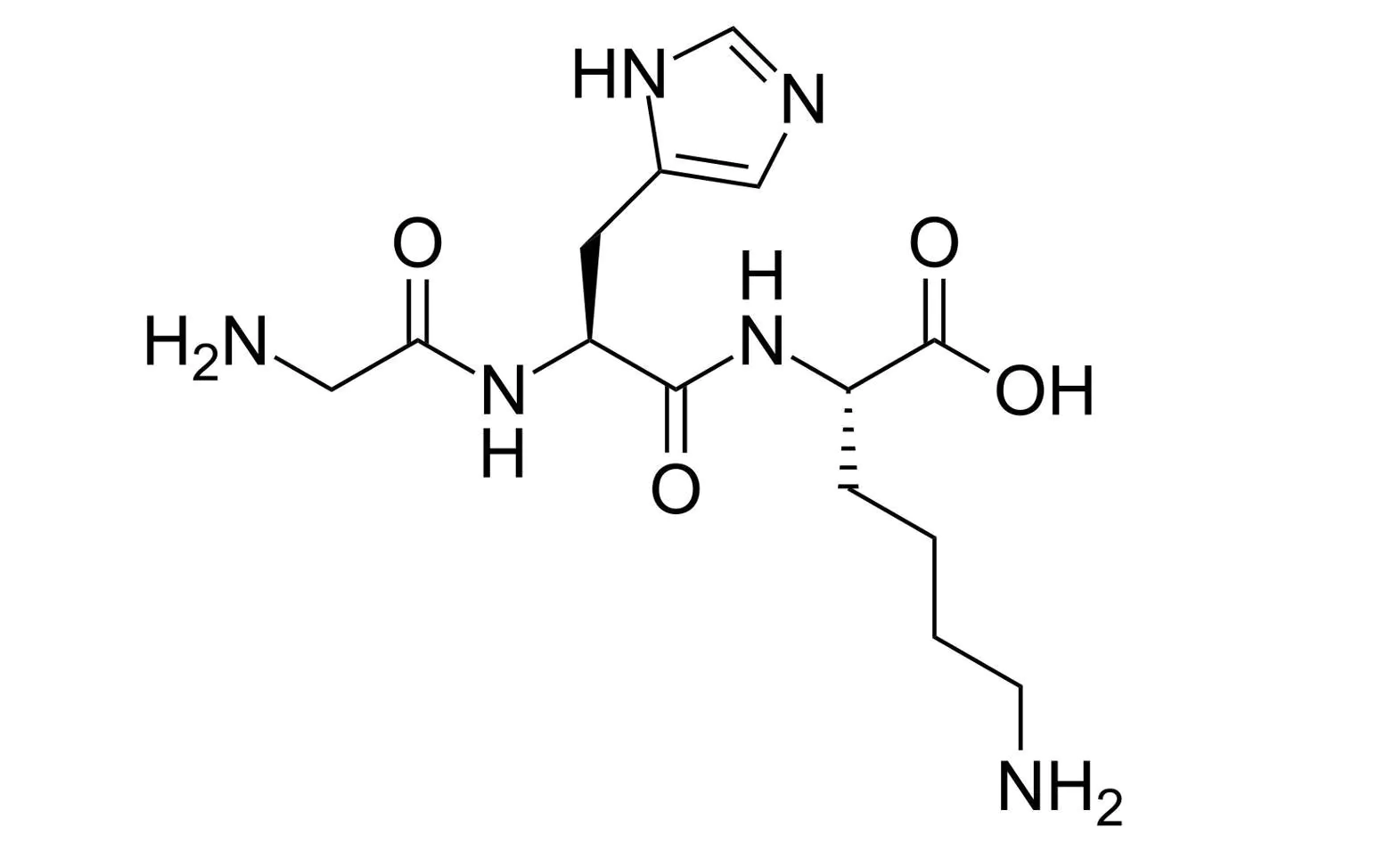
GHK with and without copper affects a large number of genes related to an organism’s response to stress and injury (tissue remodeling, anti-oxidant, anti-inflammatory, anti-pain, anti-anxiety, blood vessel growth, nerve outgrowth, anti-cancer action). GHK sequence is included in the collagen molecule, and SPARC protein and GHK is naturally released after an injury due to protein breakdown.
Copper is a transitional metal that is vital for all eukaryotic organisms from microbes to humans. Since it can be converted from oxidized Cu(II) to reduced Cu(I) form, it functions as an essential cofactor in a multitude of biochemical reactions involving electron transfer. A dozen enzymes use changes in copper oxidation states to catalyze important biochemical reactions, including cellular respiration, antioxidant defense, detoxification, blood clotting, and the connective tissue formation. Copper is required for iron metabolism, oxygenation, neurotransmission, embryonic development and many other essential biological processes.
GHK -Forschung
1. GHK unterdrückt die Fibrinogensynthese
Fibrinogen consists of three polypeptide chains; alpha, beta, and gamma. GHK strongly suppresses the gene for the beta chain of fibrinogen. A lack of adequate FGB will effectively stop fibrinogen synthesis since equal amounts of all three polypeptide chains are needed to produce fibrinogen. GHK also suppresses the production of the inflammatory cytokine interleukin-6 (IL-6) which is a main positive regulator of fibrinogen synthesis, through its interaction with fibrinogen genes. In cell culture systems, GHK suppresses IL-6 secretion in skin fibroblasts and IL-6 gene expression in SZ95 sebocytes. In summary, the effects of GHK on the FGB gene plus its effects on IL-6 production imply a suppression of overall fibrinogen production.2. GHK aktiviert das Ubiquitin/Proteasom -System (UPS)
Die UPS entfernt beschädigte Proteine. Höhere Aktivitäten der UPS scheinen die Alterungseffekte zu verzögern. GHK stimulierte die Genexpression in 41 UPS -Genen und unterdrückte nur 1 UPS -Gen.3. GHK aktiviert DNA -Reparaturgene
DNA -Schäden werden in jungen und gesunden Zellen sofort repariert, wenn wir mit zunehmendem Alter von DNA -Schäden ansammeln. Das Zurücksetzen der Aktivität von DNA -Reparaturgenen kann schädliche Auswirkungen des Alterns verringern. GHK war in erster Linie stimulierend für DNA -Reparaturgene (47 nach oben, 5 unten).4. GHK fungiert als Antioxidans
Freie Radikale und toxische Endprodukte der Lipidperoxidation sind mit Atheriosklerose, Krebs, Katarakten, Diabetes, Nephropathie, Alzheimer -Krankheit und anderen schweren pathologischen Erkrankungen des Alterns verbunden. GHK stimuliert 14 antioxidative Gene und unterdrückt zwei prooxidative Gene.5. GHK unterdrückt Insulin- und Insulin-ähnliche Gene
The insulin family has been proposed as a negative controller of longevity; higher levels of insulin and insulin-like proteins reduce lifespan. GHK stimulates 3 genes in this system and suppresses 6 genes. The insulin/IGF-1- like receptor pathway is a contributor to the biological aging process in many organisms. The gene expression data suggests that GHK suppresses this system as 6 of 9 of the affected insulin/IGF-1 genes are suppressed. Insulin/IGF-1-like signaling is conserved from worms to humans. In vitro experiments show that mutations that reduce insulin/IGF-1 signaling have been shown to decelerate the degenerative aging process and extend lifespan in many organisms, including mice and possibly humans. Reduced IGF-1 signaling is also thought to contribute to the “antiaging” effects of calorie restriction.6. GHK repariert das Gewebe durch TGF -Superfamilie
The most explored of GHK’s actions is the repair of damaged tissues (skin, hair follicles, stomach and intestinal linings, and boney tissue) either by the use of copper-peptide-containing creams or by induction of systemic healing. Campbell et al. found that GHK’s resetting of gene expression of fibroblasts from COPD patients fits into this category of tissue repair via the TGF beta superfamily. Campbell et al. also found that GHK directly increases TGF beta and other family members which activate the repair process.7. Krebskontrollierende Gene
Caspase, growth regulatory, and DNA repair genes are important in cancer suppression. In 2010, Hong et al. identified 54 genes associated with aggressive, metastatic, human colon cancer. The Broad Institute’s Connectivity Map was used to find compounds that reverse the differential expressions of these genes. The results indicated that two wound healing and skin remodeling molecules, GHK at 1 micromolar and securinine at 18 micromolar, could significantly reverse the differential expression of these genes and suggested that they may have a therapeutic effect on the metastasis-prone patients.Fazit
The tripeptide GHK possesses many positive effects but declines with age. It improves wound healing and tissue regeneration (skin, hair follicles, stomach and intestinal linings, and boney tissue), increases collagen and glycosaminoglycans, stimulates synthesis of decorin, increases angiogenesis, and nerve outgrowth, possesses antioxidant and anti-inflammatory effects, and increases cellular stemness and the secretion of trophic factors by mesenchymal stem cells. Recently, GHK has even been found to reset genes of diseased cells from patients with cancer or COPD to a healthier state. GHK exhibits minimal side effects, low oral and excellent subcutaneous bioavailability in mice. Per kg dosage in mice does not scale to humans. GHK for sale at
Peptid-Gurus ist nur auf Bildungs- und wissenschaftliche Forschung beschränkt, nicht auf den menschlichen Konsum. Kaufen Sie nur GHK, wenn Sie ein lizenzierter Forscher sind.
Artikelautor
The above literature was researched, edited and organized by Dr. Logan, M.D. Dr. Logan holds a doctorate degree from Case Western Reserve University School of Medicine and a B.S. in molecular biology.
Autor wissenschaftlicher Zeitschriften
Loren Pickart, Ph.D. has released 109 publications and is developing patents and analyzing GHK’s effects on human gene expression of 4,192 genes. In addition to GHK’s published potential uses on Haut inflammation, metastatic cancer and COPD, it appears to have beneficial effects on other tissue systems such as the nervous system, gastrointestinal system, and mitochondrial system. His brief but detailed autobiography dives into the motivations and background behind his dedicating to skin, anti-aging, and life-long training.
Loren Pickart, Ph.D. wird als einer der führenden Wissenschaftler bezeichnet, die an der Forschung und Entwicklung von GHK-CU beteiligt sind. In keiner Weise ist dieser Arzt/Wissenschaftler aus irgendeinem Grund den Kauf, Verkauf oder die Verwendung dieses Produkts, der den Kauf, den Verkauf oder die Verwendung dieses Produkts befürwortet. Es gibt keine Zugehörigkeit oder Beziehung, impliziert oder auf andere Weise dazwischen
Peptid-Gurus and this doctor. The purpose of citing the doctor is to acknowledge, recognize, and credit the exhaustive research and development efforts conducted by the scientists studying this peptide. Loren Pickart, Ph.D is listed in all of the referenced citations below.
Referenzierte Zitate
- Pickart, Loren & Vasquez-Soltero, Jessica & Margolina, Anna. (2015). GHK-Peptid als natürlicher Modulator mehrerer zellulärer Wege bei der Hautregeneration. BioMed Research International. Artikel-ID 648108. 10.1155/2015/648108.
- Pickart, L., & Margolina, A. (2018). Regenerative and Protective Actions of the GHK-Cu Peptide in the Light of the New Gene Data. International journal of molecular sciences, 19(7), 1987. https://doi.org/10.3390/ijms19071987
- Pickart L. Das menschliche Tri-Peptid-GHK- und Gewebeumbau. J Biomater Sci Polym ed. 2008; 19 (8): 969-88. doi: 10.1163/156856208784909435. PMID: 18644225.
- Loren Pickart, Jessica Michelle Vasquez-Soltero, Anna Margolina, “GHK and DNA: Resetting the Human Genome to Health”, BioMed Research International, vol. 2014, Artikel -ID 151479, 10 Seiten, 2014. https://doi.org/10.1155/2014/151479


