




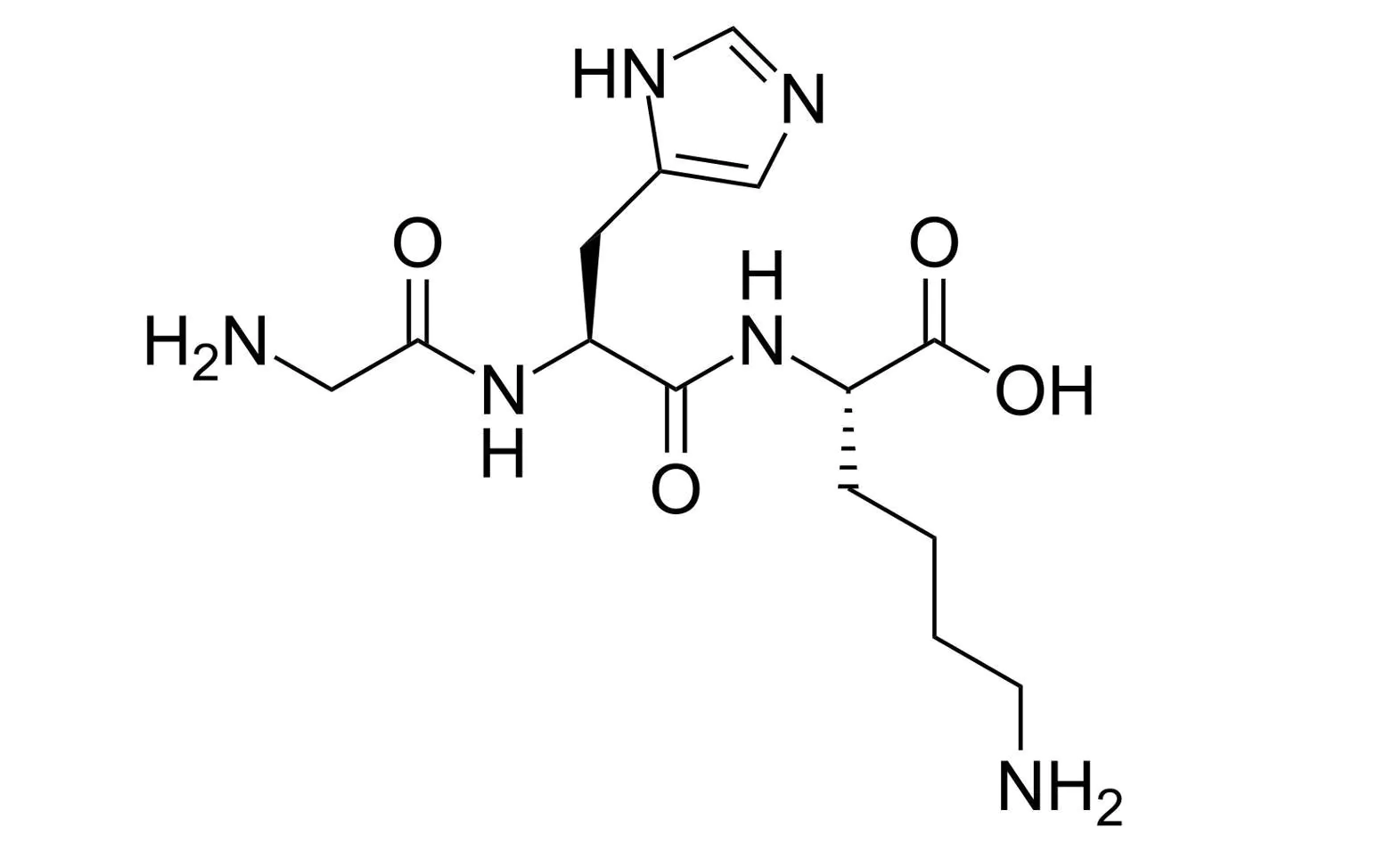
GHK with and without copper affects a large number of genes related to an organism’s response to stress and injury (tissue remodeling, anti-oxidant, anti-inflammatory, anti-pain, anti-anxiety, blood vessel growth, nerve outgrowth, anti-cancer action). GHK sequence is included in the collagen molecule, and SPARC protein and GHK is naturally released after an injury due to protein breakdown.
Copper is a transitional metal that is vital for all eukaryotic organisms from microbes to humans. Since it can be converted from oxidized Cu(II) to reduced Cu(I) form, it functions as an essential cofactor in a multitude of biochemical reactions involving electron transfer. A dozen enzymes use changes in copper oxidation states to catalyze important biochemical reactions, including cellular respiration, antioxidant defense, detoxification, blood clotting, and the connective tissue formation. Copper is required for iron metabolism, oxygenation, neurotransmission, embryonic development and many other essential biological processes.
GHK研究
1。GHKはフィブリノーゲン合成を抑制します
Fibrinogen consists of three polypeptide chains; alpha, beta, and gamma. GHK strongly suppresses the gene for the beta chain of fibrinogen. A lack of adequate FGB will effectively stop fibrinogen synthesis since equal amounts of all three polypeptide chains are needed to produce fibrinogen. GHK also suppresses the production of the inflammatory cytokine interleukin-6 (IL-6) which is a main positive regulator of fibrinogen synthesis, through its interaction with fibrinogen genes. In cell culture systems, GHK suppresses IL-6 secretion in skin fibroblasts and IL-6 gene expression in SZ95 sebocytes. In summary, the effects of GHK on the FGB gene plus its effects on IL-6 production imply a suppression of overall fibrinogen production.2。GHKはユビキチン/プロテアソームシステム(UPS)を活性化します
UPSは損傷したタンパク質を除去します。 UPSのより高い活動は、老化効果を遅らせるようです。 GHKは41のUPS遺伝子で遺伝子発現を刺激し、1つのUPS遺伝子のみを抑制しました。3。GHKはDNA修復遺伝子を活性化します
DNA損傷は、若い健康な細胞で速やかに修復されますが、年齢となると、DNA損傷が蓄積し始めます。 DNA修復遺伝子の活性をリセットすると、老化の有害な効果が低下する可能性があります。 GHKは主にDNA修復遺伝子の刺激性でした(47 UP、5ダウン)。4。GHKは抗酸化剤として機能します
脂質過酸化のフリーラジカルと毒性最終産物は、アテローム性動脈硬化症、癌、白内障、糖尿病、腎症、アルツハイマー病、およびその他の重度の病理学的症状に関連しています。 GHKは14の抗酸化遺伝子を刺激し、2つの酸化遺伝子を抑制します。5。GHKはインスリンとインスリン様遺伝子を抑制します
The insulin family has been proposed as a negative controller of longevity; higher levels of insulin and insulin-like proteins reduce lifespan. GHK stimulates 3 genes in this system and suppresses 6 genes. The insulin/IGF-1- like receptor pathway is a contributor to the biological aging process in many organisms. The gene expression data suggests that GHK suppresses this system as 6 of 9 of the affected insulin/IGF-1 genes are suppressed. Insulin/IGF-1-like signaling is conserved from worms to humans. In vitro experiments show that mutations that reduce insulin/IGF-1 signaling have been shown to decelerate the degenerative aging process and extend lifespan in many organisms, including mice and possibly humans. Reduced IGF-1 signaling is also thought to contribute to the “antiaging” effects of calorie restriction.6。GHKは、TGFスーパーファミリーによる組織を修復します
The most explored of GHK’s actions is the repair of damaged tissues (skin, hair follicles, stomach and intestinal linings, and boney tissue) either by the use of copper-peptide-containing creams or by induction of systemic healing. Campbell et al. found that GHK’s resetting of gene expression of fibroblasts from COPD patients fits into this category of tissue repair via the TGF beta superfamily. Campbell et al. also found that GHK directly increases TGF beta and other family members which activate the repair process.7。癌制御遺伝子
Caspase, growth regulatory, and DNA repair genes are important in cancer suppression. In 2010, Hong et al. identified 54 genes associated with aggressive, metastatic, human colon cancer. The Broad Institute’s Connectivity Map was used to find compounds that reverse the differential expressions of these genes. The results indicated that two wound healing and skin remodeling molecules, GHK at 1 micromolar and securinine at 18 micromolar, could significantly reverse the differential expression of these genes and suggested that they may have a therapeutic effect on the metastasis-prone patients.結論
The tripeptide GHK possesses many positive effects but declines with age. It improves wound healing and tissue regeneration (skin, hair follicles, stomach and intestinal linings, and boney tissue), increases collagen and glycosaminoglycans, stimulates synthesis of decorin, increases angiogenesis, and nerve outgrowth, possesses antioxidant and anti-inflammatory effects, and increases cellular stemness and the secretion of trophic factors by mesenchymal stem cells. Recently, GHK has even been found to reset genes of diseased cells from patients with cancer or COPD to a healthier state. GHK exhibits minimal side effects, low oral and excellent subcutaneous bioavailability in mice. Per kg dosage in mice does not scale to humans. GHK for sale at
ペプチドグル 人間の消費ではなく、教育的および科学的研究のみに限定されています。あなたが認可された研究者である場合にのみGHKを購入してください。
記事著者
The above literature was researched, edited and organized by Dr. Logan, M.D. Dr. Logan holds a doctorate degree from Case Western Reserve University School of Medicine and a B.S. in molecular biology.
Scientific Journalの著者
ローレンピカート博士 has released 109 publications and is developing patents and analyzing GHK’s effects on human gene expression of 4,192 genes. In addition to GHK’s published potential uses on 肌 inflammation, metastatic cancer and COPD, it appears to have beneficial effects on other tissue systems such as the nervous system, gastrointestinal system, and mitochondrial system. His brief but detailed autobiography dives into the motivations and background behind his dedicating to skin, anti-aging, and life-long training.
ローレンピカート博士 GHK-CUの研究開発に関与する主要な科学者の一人として参照されています。この医師/科学者は、何らかの理由でこの製品の購入、販売、または使用を承認または提唱することは決してありません。関係や関係はありません。
ペプチドグル and this doctor. The purpose of citing the doctor is to acknowledge, recognize, and credit the exhaustive research and development efforts conducted by the scientists studying this peptide. Loren Pickart, Ph.D is listed in all of the referenced citations below.
参照された引用
- ピカート、ローレン&バスケス - ソルテロ、ジェシカ&マルゴリーナ、アンナ。 (2015)。皮膚再生における複数の細胞経路の天然変調器としてのGHKペプチド。 Biomed Research International。記事ID648108。10.1155/2015/648108。
- Pickart, L., & Margolina, A. (2018). Regenerative and Protective Actions of the GHK-Cu Peptide in the Light of the New Gene Data. International journal of molecular sciences, 19(7)、1987。https://doi.org/10.3390/IJMS19071987
- Pickart L.ヒトトリペプチドGHKおよび組織リモデリング。 J Biomater Sci Polym ed。 2008; 19(8):969-88。 doi:10.1163/156856208784909435。 PMID:18644225。
- Loren Pickart, Jessica Michelle Vasquez-Soltero, Anna Margolina, “GHK and DNA: Resetting the Human Genome to Health”, BioMed Research International、Vol。 2014、記事ID 151479、10ページ、2014年。https://doi.org/10.1155/2014/151479


