Mail ons nu om je bestelling te plaatsen met 1-op-1 ondersteuning. Beperkte voorraad! Wij accepteren Zelle, CashApp, Venmo, bankoverschrijving en crypto.
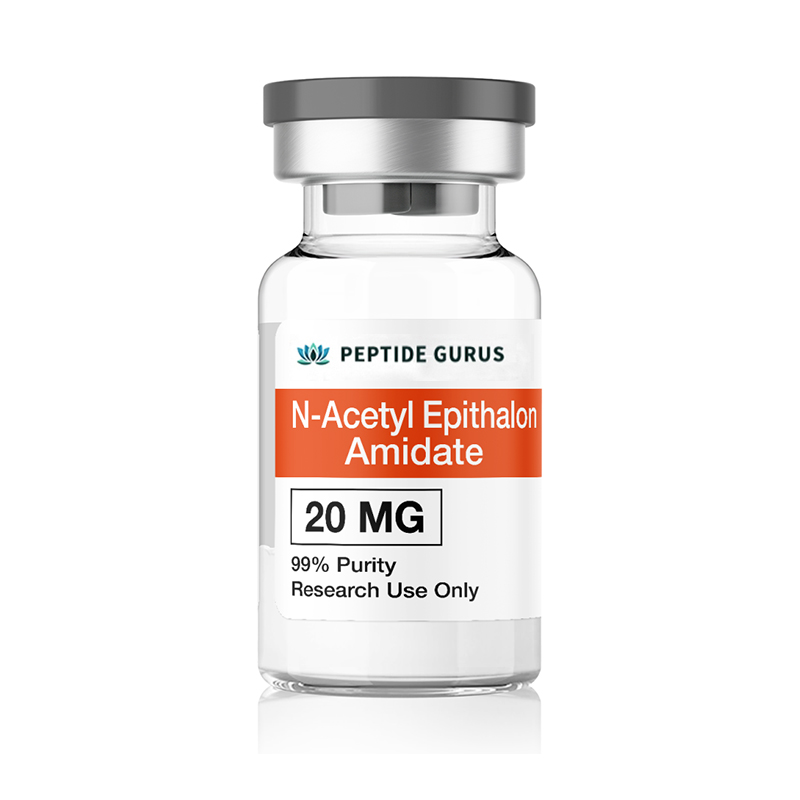
N-Acetyl Epithalon Amidate is a modified version of the synthetic peptide Epithalon (a.k.a. Epitalon). Epithalon itself is a component of naturally occurring cow pineal gland extract that is now produced synthetically. It is well known in research settings for its anti-aging properties and significant effects on cancer, infectious disease, DNA (primarily telomere) regulation, and skin health.
Even though Epithalon was discovered roughly forty years ago at the St. Petersburg Institute of Bioregulation and Gerontology, the peptide is still under active research and providing new insights. Most recently, scientists proposed potential epigenetic mechanisms to explain the influence that Epithalon has on neuronal differentiation of stem cells.
N-Acetyl Epitalon AMIDATE STRUCTUUR
Aminozuursequentie:Ala-Glu-Asp-GlyChemische formule:C14H22N4O9Moleculaire massa:390.349 g/molPubChem CID: 219042
Moleculaire massa:446.45 g/molCAS -nummer:307297-39-8Synoniem:Epitalon, Epithalon, epithalamine, epithalamineBron:PubchHier in de sequentie vertegenwoordigt "AC-" de acetylgroep bevestigd aan de N-terminus van het peptide, en "-nh2" vertegenwoordigt de geaMideerde groep aan de C-terminus. De aminozuursequentie "Agagaaga" komt overeen met het kern Epitalon -peptide. Acetyl-epitalon-amidaat is een gemodificeerde versie van Epitalon, een synthetisch peptide met potentiële anti-aging- en telomerase-activeringseigenschappen. De toevoeging van de acetyl- en geaugeerde groepen kan de stabiliteit, biologische beschikbaarheid en werkzaamheid verbeteren.
N-acetyl epithalon amidaat: wijzigingen
The modifications to Epithalon do not alter the peptide’s overall function, but they do alter the half-life, stability, and efficacy of Epithalon. Only two modifications are made to the native peptide: N-acetylation and amidation. Each has specific benefits that make Epithalon more potent and allow for lower dosing of the peptide.
Acetylation is a common, natural process that occurs to many proteins in the body. It is also a process used by the pharmaceutical industry to help a compound to reach the central nervous system. Acetylated molecules are much more capable of crossing the blood-brain barrier (BBB). Acetylation has been shown to increase the rate at which a compound crosses the BBB, thereby increasing the intensity of the compound’s effects and helping reduce the dosage of a compound required to achieve a specific outcome. Aspirin, for instance is the acetylated form of salicylic acid. Research shows that acetylation of salicylic acid increases the anti-inflammatory effects of the molecule.
Amidation is another natural protein modification that has been coopted by the pharmaceutical industry to improve the half-life of compounds. Amidated proteins are less sensitive to proteolytic degradation in the blood stream. They also tend to bind more strongly to their receptors, making amidation an excellent means of increasing potency and efficacy of a compound.
By altering Epithalon via acetylation and amidation, it is possible to increase the penetration of the peptide into the central nervous and protect it from degradation during the process. The result is increased potency of a given dose of Epithalon as well as increased efficacy of the compound due to improved receptor binding
N-acetyl epithalon amidaat en de hersenen
Research in cell culture shows that Epithalon influences gene expression in neurogenetic differentiation as well as protein synthesis. Molecular modeling suggests that occurs through epigenetic modulation of a handful of genes coding for the proteins Nestin, GAP43, β Tubulin III, and Doublecortin. Epithalon increases expression of these peptides by as much as 1.8 times via binding with specific histone proteins and allowing the genes to be accessed more easily[1]. The result of easier access to the DNA in those regions is increased expression of the genes and thus increased protein production.
The proteins being affected by Epithalon are important in the growth and development of neurons as follows.
Nestine - Dit tussenliggende filamenteiwit wordt tot expressie gebracht in zenuwcellen en speelt een belangrijke rol in de radiale groei van axonen. Het helpt ook stamcellen om te differentiëren in zenuwcellen, waardoor de groei van weefsel in het centrale zenuwstelsel (CNS) wordt gestimuleerd.
GAP43 - GAP43 wordt vaak het 'plasticiteit' -eiwit genoemd omdat een belangrijke rol speelt in neuronale groeiceksten tijdens ontwikkeling en axonale regeneratie. Het speelt een cruciale rol in het leren. Verwijdering van zelfs één allel van het GAP43 -gen leidt tot intellectuele handicap.
β tubuline III - Dit microtubule -element wordt gevonden in neuronen en testiscellen waar het betrokken is bij de vorming van microtubuli en oxidatieve stressreacties. Onderzoek suggereert dat het belangrijk is bij cellulaire aanpassing aan moleculaire stress en dat tekortkomingen in dit eiwit een sleutelrol kunnen spelen bij de agressiviteit van tumor.
Doublecortine-DoubleCortine is een microtubule-geassocieerd eiwit dat wordt aangetroffen in onrijpe neuronen. Het is van cruciaal belang voor de ontwikkeling van complexe hersenstructuren. Tekorten in doublecortine zijn gekoppeld aan dubbel cortex -syndroom waarbij een gebrek aan migratie van onrijpe neuronen leidt tot een soepele hersenen bij mannen en misplaatste neuronen bij vrouwen. Het resultaat van een tekort is een diepgaande intellectuele handicap.
Door de toegang tot de DNA-regio's die de genen bevatten die de bovenstaande eiwitten regelen, is epithalon gekoppeld aan verbeterd leren, verbeterd herstel van CNS-letsel en mogelijk tot verminderingen van de langetermijneffecten van veroudering op de hersenen. Dit laatste kenmerk is slechts een van de vele manieren waarop Epithalon is gevonden om het verouderingsproces positief te beïnvloeden. In het bijzonder is aangetoond dat epithalon de differentiatie van neuronale stamcellen beïnvloedt door de groei en ontwikkeling van neuronen uit stamcelvoorlopers te bevorderen [2]. Met een langere halfwaardetijd en verbeterde penetratie in het centraal zenuwstelsel, zullen de potentie en effecten van N-acetylepithalon-amidaat worden verbeterd in vergelijking met standaard epithalon.
N-acetyl epithalon amidate en huidgezondheid
The ability of Epithalon to regulate gene expression patterns is hardly limited to the CNS. Research in skin stem cell cultures shows that Epithalon, even at very low concentrations increases proliferation of stems cells in rats regardless of age. In particular, fibroblast proliferation rates increase by as much as 45%[3].
It isn’t just the growth of fibroblasts that is affected, however. Research shows that Epithalon (and other short polyfunctional peptides) decrease rates of apoptosis and increase functional activity of fibroblasts[4]. This leads to “normalization” of the intracellular matrix. In other words, Epithalon restores homeostasis (biological balance) to the skin and helps to shift the balance in aging skin toward more youthful production of things like collage, elastin, and other proteins[4]. The net result is improved skin health. In fact, Epithalon has opened up a new field in research, referred to as gerontocosmetology, focused on skin health in age.
It is important to note that while cosmetology has a definite component focused on appearance, the field is much deeper than that. The visual effects of cosmetology overlay the deeper components of skin health. Aging skin appears wrinkled, for instance, because of a loss of extracellular matrix proteins like collagen and elastin. Replacement of these proteins, among others, reduces the appearance of wrinkles but also improves the strength and integrity of skin. Skin is the first line of defense against infection and is often referred to as the large organ of the immune system. Healthy skin means less infection, faster wound healing, better insulation against cold, improved response to heat, and much more. Thus, the field of gerontocosmetology is focused not just on the surface, but on the holistic health of the skin and thus the human body[3].
N-acetyl epithalon amidaat en immuungezondheid
Een ander gebied waarin epithalon een actieve rol speelt in genregulatie is het immuunsysteem. Celkweekonderzoek toont aan dat epithalon de expressie verandert van immuunsignaalmoleculen zoals CD5, IL-2, arylalkylamine-N-acetyltransferase, interferon gamma en tram1. Elk van deze eiwitten beïnvloedt het immuunsysteem als volgt.
CD5 - CD5 beïnvloedt de differentiatie van cellen van het immuunsysteem en helpt stamcellen om over te stappen in functionele cellen die vechten van infectie en ontstekingsstroom bestrijden.
IL-2-IL-2 is een krachtige regulator van de productie van witte bloedcellen.
Arylalkylamine-N-acetyltransferase-Dit enzym is van cruciaal belang voor de productie van melatonine, wat niet alleen belangrijk is in de slaap, maar ook een cruciale rol speelt bij de regulatie van het immuunsysteem.
Interferon Gamma - Onderzoek bij ratten toont aan dat interferongamma belangrijk is bij het bestrijden van infectie via activering van macrofagen, natuurlijke killercellen en T -cellen. Het speelt met name een cruciale rol in de reactie van het lichaam op virale infectie [5].
De achteruitgang van de immuunrespons is een van de primaire markers en stuurprogramma's van veroudering. DYS -gereguleerde immuunfunctie leidt tot chronische ontsteking en speelt een rol bij de ontwikkeling van hart- en vaatziekten en dementie. Het vermogen van epithalon om het immuunsysteem te reguleren is een van de manieren waarop het de effecten van veroudering dwarsboomt. Nogmaals, het vermogen van N-acetylepithalon-amidaat om in het centraal zenuwstelsel te dringen, helpt ervoor te zorgen dat de immuunverbeterende effecten in de hersenen worden ervaren, waar regulering van ontsteking kan helpen de processen te temperen die leiden tot dementie.
N-acetyl epithalon amidaat en kanker
Onderzoek in rattenmodellen van verschillende tumoren heeft aangetoond dat dagelijkse toediening van epithalon de tumorgroei vermindert [6]. Het peptide wordt momenteel onderzocht als een potentieel adjuvans voor de behandeling van HER-2/NEU-positieve (hormoon positieve) borstkanker en leukemie en testiculaire kanker. Interessant is dat een van de primaire acties van epithalon bij kanker lijkt te zijn door de regulatie van Per1 -gen. Per1, dat wordt gevonden in de hypothalamus, reguleert het circadiane ritme en is vastgelegd bij kankerpatiënten [7].
N-acetyl epithalon amidaat en slaap
As noted above, Epithalon regulates the production of the protein PER1, which plays an important role in circadian rhythm. This should come as no surprise given that Epithalon was first isolated from the pineal gland of cows and the primary role of the pineal gland is to regulate the sleep-wake cycle and the response of many animals to light. Research in rats shows that Epithalon also regulates the production and release of melatonin, which is a potent regulator of sleep.
Via action at the genes for arylalkylamine-N-acetyltransferase and pCREM, Epithalon increases melatonin production and can restore normal sleep-wake cycles[8]. Melatonin and sleep patterns often become dysregulated because of age, a phenomenon that is more than likely a result of changes in DNA expression patterns. By restoring DNA expression to a more youthful state, Epithalon helps to offset age-related changes in sleep. This, in turn, as a tremendous impact on everything from cognitive function to wound healing, the immune response, growth hormone secretion, weight gain, bone structure, and cardiovascular health.
N-acetyl epithalon amidaat en veroudering
Each of the above sections has dealt with a specific feature of Epithalon function, but each has also made note of the fact that Epithalon helps to restore DNA expression patterns in aging animals to those seen in younger animals. Indeed, restoration of youthful DNA expression patterns is the overarching theme associated with Epithalon. Production of this peptide by the pineal gland appears to decline with age, resulting in many of the age-related changes that impact health and longevity. Supplementation with Epithalon in insects and rodents has shown that Epithalon can decrease mortality by more than half and prolong life by as much as 27%[9].
The above changes in DNA expression patterns, possibly through epigenetic changes that result of histone protein binding, is at least part of the reason that Epithalon has such profound effects on aging. It is not the whole story though. Research shows that Epithalon also impacts antioxidant activity and telomere health.
In rat models. Injection of Epithalon has been shown to decrease LPO production and reduce oxidative modification of proteins[10]. LPO production (lipid peroxidation products) result from lipid peroxidation, which is a normal biological process known to production free radicals. LPO is necessary for several normal biological functions, such as the destruction of invading pathogens and the recycling of damaged proteins. The production of potentially dangerous free radicals is offset by the equal production of antioxidants. With aging, however, antioxidant production wanes thus cellular and protein damage from free radical production increases. Epithalon offsets the decline in antioxidant production and thus helps to maintain the homeostatic balance that prevents damage from free radicals.
Research in human somatic cells shows that Epithalon activates an enzyme called telomerase[11]. Telomerase is important for maintain the end caps of DNA called telomeres. Telomeres are regions of the DNA that don not contain genes, but instead protect DNA during the process of replication. Replication slowly erodes DNA so having telomeres helps to prevent functional DNA from being damaged. Unfortunately, telomeres themselves degrade over time and when they get too short, cells stop functioning and eventually die. Telomerase helps to repair telomeres and thus helps to extend the lifespan of cells. By increasing activity of telomerase, Epithalon is directly impacting the health of DNA and thus how long cells live[12], [13].
Aging, in general, can be divided into several categories, but they are all interlinked. In general, DNA damage leads to protein malfunction. This, combined with direct protein damage, leads to cellular dysfunction. As cellular dysfunction accumulates, cells are either killed or become non-functional in a process known as senescence. Over time, both processes lead to tissue and organ dysfunction that eventually produces signs of aging like changes in sleep patterns, weight gain, wrinkling, greying of the hair, and increased incidence of chronic disease. The accumulation of this “macro-damage” is what eventually leads to death as the body becomes unable to sustain normal biological function. Epithalon helps to offset much of this dysfunction by regulating DNA and protein damage at a fundamental level.
N-acetyl epithalon amidaat: samenvatting
Hoewel Epithalon niet het enige antwoord is om het verouderingsproces te stoppen, geeft het wel inzicht in hoe sommige van de fundamentele processen die leiden tot DNA en eiwitschade kan helpen om het totale verouderingsproces te dwarsbomen. Volgens Dr. Vladimir Khavison, de peetvader van Epithalon Development, terwijl onderzoek naar epithalon verder gaat, krijgt de wetenschap een dieper, meer genuanceerd begrip van wat zoogdieren, in het algemeen en mensen veroorzaakt om ouder te worden en uiteindelijk te sterven. Epithalon is een belangrijke sleutel om te begrijpen hoe biochemische processen kunnen worden gewijzigd om enkele van de fundamentele oorzaken van veroudering te vertragen of zelfs te stoppen. De ontwikkeling van N-acetylepithalon-amidaat is een belangrijk onderdeel van het onderzoek van epithalon, omdat het vermogen ervan om het centraal zenuwstelsel te penetreren het voor onderzoekers gemakkelijker zal maken om de effecten van epithalon op veroudering in de hersenen te verkennen. Dit zal waarschijnlijk inzicht geven in hoe biochemische processen zoals slaap- en neurongroei het leren, geheugen, cognitieve veerkracht en nog veel meer beïnvloeden.
Artikelauteur
De bovenstaande literatuur werd onderzocht, bewerkt en georganiseerd door Dr. E. Logan, M.D. Dr. E. Logan behaalde een doctoraat vanCase Western Reserve University School of Medicineen een B.S. in moleculaire biologie.
Wetenschappelijke tijdschrift Auteur
Vladimir Khavinsonis een professor, president van de Europese regio van de International Association of Gerontology and Geriatrics; Lid van deRussische en Oekraïense academies van medische wetenschappen; Hoofd gerontoloog van de gezondheidscommissie van de regering van Saint Petersburg, Rusland; Directeur van het Saint Petersburg Institute of Bioregulation and Gerontology; Vice-president van Gerontological Society of theRussische Academie van Wetenschappen; Hoofd van de voorzitter van Gerontology and Geriatrics van de Thenorth-Western State Medical University, St-Petersburg; Kolonel van de medische dienst (USSR, Rusland), gepensioneerd. Vladimir Khavinson staat bekend om de ontdekking, experimentele en klinische studies van nieuwe klassen vanPeptideBioregulatoren en voor de ontwikkeling van bioregulerende peptidetherapie. Hij is bezig met het bestuderen van de rol van peptiden bij de regulatie van de verouderingsmechanismen. Zijn hoofdveld van acties is ontwerp, pre-klinische en klinische studies van nieuw peptidegeroprotectoren. A 40-year-long investigation resulted in a multitude of methods of application of peptide bioregulators to slow down the process of ageing and increase human life span. Six peptide-based pharmaceuticals and 64 peptide food supplements have been introduced into clinical practice by V. Khavinson. He is an author of 196 patents (Russian and international) as well as of 775 scientific publications.His major achievements are presented in two books: “Peptides and Ageing” (NEL, 2002)and “Gerontological aspects of genome peptide regulation” (Karger AG, 2005).Vladimir Khavinson introduced scientific specialty “Gerontology and Geriatrics” in the Russian Federation on the governmental level. Academic Council headed by V. Khavinson has oversighted over 200 Ph.D. and Doctorate theses from many different countries.
Prof. Vladimir Khavinson is being referenced as one of the leading scientists involved in the research and development of N-Acetyl Epithalon Amidate. In no way is this doctor/scientist endorsing or advocating the purchase, sale, or use of this product for any reason. There is no affiliation or relationship, implied or otherwise, between
Peptidegoeroesen deze dokter. Het doel van het citeren van de arts is om de uitputtende onderzoeks- en ontwikkelingsinspanningen van de wetenschappers die dit peptide bestuderen te erkennen, te erkennen en te crediteren.
Vermeld citaten
V. Khavinsonet al.,AEDG Peptide (Epitalon) Stimulates Gene Expression and Protein Synthesis during Neurogenesis: Possible Epigenetic Mechanism ,”Mol. Basel Switz., vol. 25, no. 3, p. E609, Jan. 2020, doi: 10.3390/molecules25030609.
S. Caputiet al., “Effect of short peptides on neuronal differentiation of stem cells,”Int. J. Immunopathol. Pharmacol., vol. 33, p. 2058738419828613, Feb. 2019, doi: 10.1177/2058738419828613.
N. I. Chalisova, N. S. Lin’kova, A. N. Zhekalov, A. O. Orlova, G. A. Ryzhak, and V. K. Khavinson, “[Short peptides stimulate skin cell regeneration during ageing],”Adv. Gerontol. Uspekhi Gerontol,, vol. 27, no. 4, pp. 699–703, 2014.
V. K. Khavinson, N. S. Linkova, A. S. Diatlova, E. O. Gutop, and O. A. Orlova, “[Short peptides: regulation of skin function during aging.],”Adv. Gerontol. Uspekhi Gerontol., vol. 33, no. 1, Art. no. 1, 2020.
N. Lin’kova, B. Kuznik, and V. Khavinson, “The peptide Ala-Glu-Asp-Gly and interferon gamma: Their role in immune response during aging,”Adv. Gerontol., vol. 3, Apr. 2013, doi: 10.1134/S2079057013020100.
I. A. Vinogradova, A. V. Bukalev, M. A. Zabezhinski, A. V. Semenchenko, V. K. Khavinson, and V. N. Anisimov, “Effect of Ala-Glu-Asp-Gly peptide on life span and development of spontaneous tumors in female rats exposed to different illumination regimes,”Bull. Exp. Biol. Med.,vol. 144, no. 6, pp. 825–830, Dec. 2007, doi: 10.1007/s10517-007-0441-z.
S. Gery, N. Komatsu, L. Baldjyan, A. Yu, D. Koo, and H. P. Koeffler, “The circadian gene per1 plays an important role in cell growth and DNA damage control in human cancer cells,”Mol. Cell, vol. 22, no. 3, pp. 375–382, May 2006, doi: 10.1016/j.molcel.2006.03.038.
O. Korkushkoet al., “[Normalizing effect of the pineal gland peptides on the daily melatonin rhythm in old monkeys and elderly people],”Adv. Gerontol. Uspekhi Gerontol. Ross. Akad. Nauk Gerontol. Obshchestvo, vol. 20, pp. 74–85, Feb. 2007.
V. N. Anisimov, S. V. Mylnikov, and V. K. Khavinson, “Pineal peptide preparation epithalamin increases the lifespan of fruit flies, mice and rats,”Mech. Ageing Dev., vol. 103, no. 2, pp. 123–132, Jun. 1998, doi: 10.1016/S0047-6374(98)00034-7.
L. S. Kozina, “Effects of bioactive tetrapeptides on free-radical processes,”Bull. Exp. Biol. Med., vol. 143, no. 6, Art. no. 6, Jun. 2007, doi: 10.1007/s10517-007-0230-8.
V. Kh. Khavinson, I. E. Bondarev, and A. A. Butyugov, “Epithalon Peptide Induces Telomerase Activity and Telomere Elongation in Human Somatic Cells,”Bull. Exp. Biol. Med., vol. 135, no. 6, Art. no. 6, Jun. 2003, doi: 10.1023/A:1025493705728.
T. A. Dzhokhadze, T. Z. Buadze, M. N. GaÄozishvili, M. A. Rogava, and T. A. Lazhava, “[Functional regulation of genome with peptide bioregulators by hypertrophic cardiomyopathy (by patients and relatives)],”Georgian Med. News, no. 225, Art. no. 225, Dec. 2013.
V. N. Anisimov, “Effect of Epitalon on biomarkers of aging, life span and spontaneous tumor incidence in female Swiss-derived SHR mice,”Biogerontology, vol. 4, no. 4, pp. 193–202, 2003, doi: 10.1023/a:1025114230714.Alle artikelen en productinformatie op deze website zijn alleen voor informatieve en educatieve doeleinden.De producten die op deze website worden aangeboden, zijn alleen ingericht voor in-vitro-studies. In-vitro-onderzoeken (Latijn: in glas) worden buiten het lichaam uitgevoerd. Deze producten zijn geen medicijnen of medicijnen en zijn niet goedgekeurd door de FDA om een medische aandoening, kwaal of ziekte te voorkomen, te behandelen of te genezen. Lichamelijke introductie van welke aard dan ook in mensen of dieren is ten strengste wettelijk verboden.
Peptidegurus is een toonaangevende leverancier van Amerikaanse onderzoekspeptiden en biedt producten van topkwaliteit tegen concurrerende prijzen. Met een focus op excellentie en klantenservice, zorgen ze voor een veilig en handig bestelproces met wereldwijde verzending.