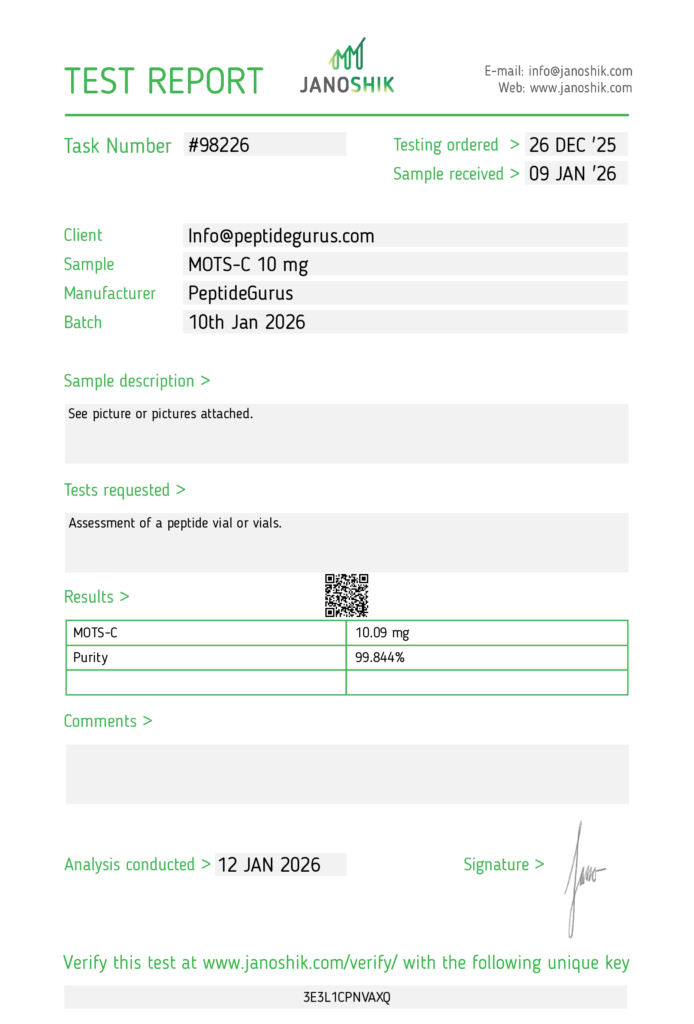
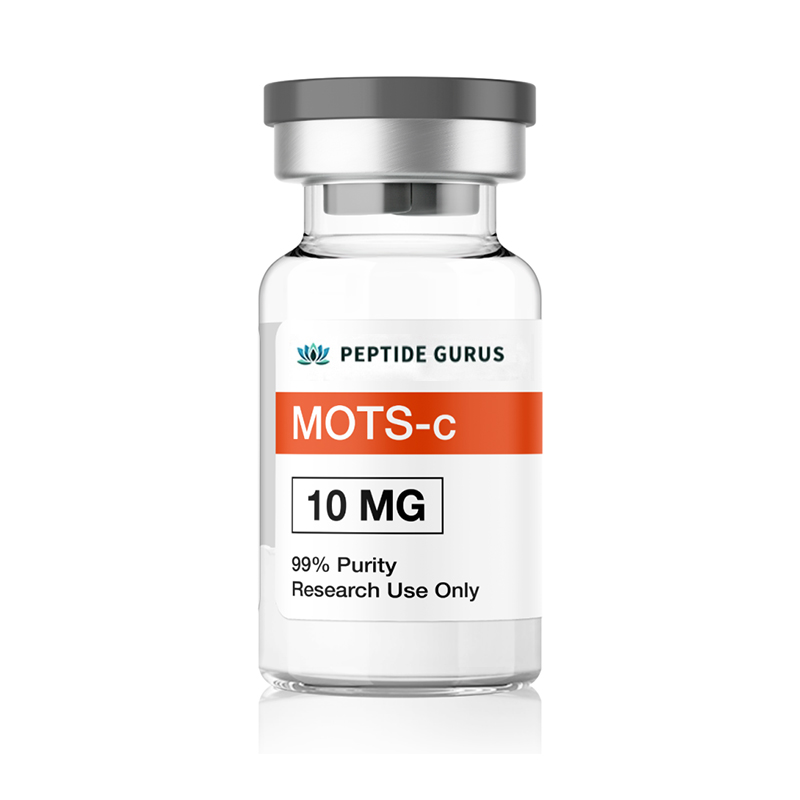
Product Usage: This PRODUCT IS INTENDED AS A RESEARCH CHEMICAL ONLY. This designation allows the use of research chemicals strictly for in vitro testing and laboratory experimentation only. All product information available on this website is for educational purposes only. Bodily introduction of any kind into humans or animals is strictly forbidden by law. This product should only be handled by licensed, qualified professionals. This product is not a drug, food, or cosmetic and may not be misbranded, misused or mislabled as a drug, food or cosmetic.
MOTS-C Structure, De BQUB17-JHolguera – Trabajo propio, CC BY-SA 4.0
Source: WikipediaSequence: Met-Arg-Trp-Gln-Glu-Met-Gly-Tyr-Ile-Phe-Tyr-Pro-Arg-Lys-Leu-Arg
Molecular Formula: C101h152n28o22s2Molecular Weight: 2174.64 g/mol
PubChem SID: 255386757
CAS Number: 1627580-64-6
Synonyms: Mitochondrial open reading frame of the 12S rRNA-c, MT-RNR1
マウスの研究により、エストロゲンのレベルが低いことが脂肪量の増加と正常な脂肪組織の機能障害につながることが示されています。このシナリオは、インスリン抵抗性を発症するリスクを高め、その後、糖尿病を発症するリスクを高めます。しかし、マウスにMOTS-Cを補充すると、茶色の脂肪機能が増加し、脂肪組織の蓄積が減少します。また、ペプチドは脂肪機能障害とインスリン抵抗性に先行する脂肪炎症を防ぐように見えます[2].
It appears that at least part of the influence that MOTS-c has on fat metabolism is mediated through activation of the AMPK pathway. This well-defined pathway is turned on when cellular energy levels are low and it drives the uptake of both glucose and fatty acids by cells for metabolism. It is also the pathway that is activated in ketogenic diets, like the Atkin’s diet, which promote fat metabolism while protecting lean body mass. MOTS-c targets the methionine-folate cycle, increases AICAR levels, and activates AMPK.
New research suggests that MOTS-c can actually leave the mitochondria and make its way to the nucleus where the peptide can affect nuclear gene expression. Following metabolic stress, MOTS-c has been shown to regulate nuclear genes involved in glucose restriction and antioxidant responses[3].
MOTS-c has effects in both the mitochondria and the nucleus.
Source: 細胞代謝
マウスからの証拠は、特に肥満の設定におけるMOTS-Cがスフィンゴ脂質、モノアシルグリセロール、およびジカルボン酸代謝の重要な調節因子であることを示しています。これらの経路をダウンレギュレーションし、ベータ酸化を増加させることにより、MOTS-Cは脂肪の蓄積を防ぐように見えます[4]。これらの効果の一部は、核内のMOTS-Cアクションを介してほぼ確実に媒介されます。 MOTS-Cに関する研究は、科学界で牽引力を獲得している脂肪沈着とインスリン抵抗性に関する新しい仮説につながり、肥満と糖尿病の病態生理に介入する新しい手段を提供する可能性があります。ミトコンドリアにおける脂肪代謝の調節不全は、脂肪酸化の欠如をもたらす可能性があるようです。これにより、循環脂肪のレベルが高くなるため、血流から脂質を取り除くために体がインスリンレベルを高めるように強制します。この作用の結果は、脂肪沈着の増加と、慢性的に高いレベルのインスリンに適応する(そして耐性になる)体の恒常性の変化です[5].
MOTS-c supplementation in rats prevents mitochondrial dysfunction and prevents the accumulation of fat even in the setting of a high-fat diet.
Source: 細胞代謝
MOTS-Cは、骨の骨芽細胞によるI型コラーゲンの合成に役割を果たすようです。骨芽細胞細胞株の研究は、MOTS-Cが骨芽細胞の健康と生存の原因となるTGFベータ/SMAD経路を調節することを示しています。骨芽細胞の生存を促進することにより、MOTS-CはタイプIコラーゲン合成の改善に役立ち、したがって骨の強度と完全性を改善するのに役立ちます[7].
Additional research in osteoporosis has revealed that MOTS-c promotes the differentiation of bone marrow stem cells via the same TGF-beta/SMAD pathway. In the study, this directly led to increased osteogenesis (formation of new bone)[8]。したがって、MOTS-Cは骨芽細胞を保護し、生存を促進するだけでなく、幹細胞からの発達も促進します。
長寿
MOTS-Cに関する研究により、日本などの特定の人口の寿命に関連するペプチドの特定の変化が特定されています。この場合、MOTS-C遺伝子の変化は、タンパク質の位置14に通常見られるリジンのグルタミン酸残基の置換につながります。この変化がタンパク質の機能的側面にどのように影響するかは明らかではありませんが、グルタミン酸はリジンと根本的に異なる特性を持っているため、MOTS-C遺伝子の構造と機能の両方を変化させるため、ほぼ確実です。この変化が機能にどのように影響するかを理解するにはさらに研究が必要ですが、北東アジアの祖先を持つ人々にのみ見られ、この集団で見られる例外的な長寿に役割を果たすと考えられています[9].
According to Dr. Changhan David Lee, a researcher at the School of Gerontology at USC Leonard Davis, mitochondrial biology holds the keep to extending both lifespan and healthspan in humans. The mitochondria, being the single most important metabolic organelle, is “strongly implicated in aging and age-related diseases.” Until now, dietary restriction offered the only reliable means of affecting mitochondrial function and thus longevity. Peptides like MOTS-c, however, may make it possible to directly impact mitochondrial function in a more profound way.
心臓の健康
冠動脈造影を受けているヒトのMOTS-Cレベルを測定する研究により、血液中のMOTS-Cのレベルが低い患者は、内皮細胞機能障害のレベルが高いことが明らかになりました。内皮細胞は血管の内側に並んでおり、血圧、血液凝固、およびプラーク層の調節に不可欠です。ラットの追加研究によると、MOTS-Cは血管応答性に直接影響しませんが、アセチルコリンのような他のシグナル伝達分子の効果に対する内皮細胞を感作することが示唆されています。ラットをMOTS-Cで補充することは、内皮機能を改善し、微小血管および心外膜血管機能を改善することが示されています。[10].
MOTS-c is not alone among mitochondria-derived peptides (MDPs) in affecting heart health. Research suggests that at least three MDPs play roles in protecting cardiac cells against stress and inflammation. There is good reason to believe that MDP dysregulation is also an important factor in the development of cardiovascular disease. The peptides may even be important factors in reperfusion injury and, as pointed out above, in endothelial function[11].
MOTS-c exhibits minimal side effects, low oral and excellent subcutaneous bioavailability in mice. Per kg dosage in mice does not scale to humans. MOTS-c for sale at ペプチドグル 人間の消費ではなく、教育的および科学的研究のみに限定されています。あなたが免許を持つ研究者である場合にのみMOTS-Cを購入してください。
記事著者
The above literature was researched, edited and organized by Dr. Logan, M.D. Dr. Logan holds a doctorate degree from Case Western Reserve University School of Medicine and a B.S. in molecular biology.
Scientific Journalの著者
Dr. Boe Boe Boe、「MOTS-C:筋肉と脂肪代謝を調節する新規ミトコンドリア由来ペプチド」および「ミトコンドリアをエンコードしたペプチドMOTS-Cへの寄与剤は、核に移行して代謝ストレスに応じて核遺伝子発現を調節します」
Cohen Pinches、MD, is the dean of the USC Leonard Davis School of Gerontology, executive director of the Ethel Percy Andrus Gerontology Center, and holder of the William and Sylvia Kugel Dean’s Chair in Gerontology. He is an expert in the study of mitochondrial peptides and their possible therapeutic benefits for diabetes, Alzheimer’s, and other diseases related to aging. Cohen’s current research focus is on the emerging science of mitochondria-derived peptides, which he discovered. These peptides include humanin, a 24-amino acid peptide encoded from the mt-16S-rRNA. It is a novel, centrally acting insulin sensitizer and metaboloprotective factor representing a new therapeutic and diagnostic target in diabetes and related disease. Other mitochondrial peptides of interest include MOTS-c, a second peptide encoded from a small ORF in the 12S region of the mitochondrial chromosome that has potent anti-diabetes and anti-obesity effect and acts as an exercise-mimetic, and SHLP2, a peptide encoded from the light strand of the mt-16S-rRNA region whose levels correlate with prostate cancer.
Dr. Changhan David Lee and Dr. Pinchas Cohen are being referenced as leading scientists involved in the research and development of Humanin. In no way are these doctors/scientists endorsing or advocating the purchase, sale, or use of this product for any reason. There is no affiliation or relationship, implied or otherwise, between
C. Lee、K。H。Kim、およびP. Cohen、「Mots-C:筋肉と脂肪代謝を調節する新規のミトコンドリア由来ペプチド」、フリーラジック。 Biol。 Med。、vol。 100、pp。182–187、2016年11月。[PMC]
H. Lu et al。、「Mots-Cペプチドは脂肪恒常性を調節して、卵巣切除誘発性代謝機能障害を防ぐ」、J。Mol。医薬品。ベル。 Ger。、vol。 97、いいえ。 4、pp。473–485、2019年4月。[PubMed]
K. H.キム、J。M。ソン、B。A。ベナヨーン、およびC.リー、「ミトコンドリアエンコードペプチドMOTS-Cは、代謝ストレスに応答して核遺伝子発現を調節するために核に移行します」、Cell Metab。、vol。 28、いいえ。 3、pp。516-524.e7、2018年9月。[PMC]
S.-J. Kim et al。、「ミトコンドリア由来のペプチドMOTS-Cは、血漿代謝物の調節因子であり、インスリン感受性を高めます」とPhysiol。 Rep。、vol。 7、いいえ。 13、p。 E14171、2019年7月。[PubMed]
R. Crescenzo、F。Bianco、A。Mazzoli、A。Giacco、G。Liverini、およびS. Iossa、「肝臓のミトコンドリア機能障害と食事誘発性インスリン抵抗性との間の可能なリンク」、Eur。 J. Nutr。、Vol。 55、いいえ。 1、pp。1–6、2016年2月。[BMJ]
L. R. Cataldo、R。Fernández-Verdejo、J。L。Santos、およびJ. E. Galgani、「Plasma Mots-Cレベルは、肥満の個人では除脂肪ではなく、リーンのインスリン感受性に関連しています」とJ.調査。 Med。、vol。 66、いいえ。 6、pp。1019–1022、2018年8月。[PubMed]
N. Che et al。、「MOTS-Cは、TGF-β/SMADシグナル伝達経路を介した骨芽細胞におけるI型コラーゲンの合成を促進することにより、骨粗鬆症を改善します」Eur。牧師ファーマコール。 Sci。、vol。 23、いいえ。 8、pp。3183–3189、2019年4月。[PubMed]
N. Fuku et al。、「ミトコンドリア由来のペプチドMOTS-C:例外的な長寿のプレーヤー?」、Aging Cell、vol。 14、2015年8月。[Research Gate]
Q. Qin et al。、「冠動脈内皮機能障害の患者における循環MOTS-Cレベルのダウンレギュレーション」、Int。 J. Cardiol。、vol。 254、pp。23–27、01 2018。[PubMed]
Y. Yang et al。、「心血管疾患におけるミトコンドリア由来のペプチドの役割:最近の更新」、Biomed。薬局。 Biomedecine Pharmacother。、Vol。 117、p。 109075、2019年6月。[PubMed]
ALL ARTICLES AND PRODUCT INFORMATION PROVIDED ON THIS WEBSITE ARE FOR INFORMATIONAL AND EDUCATIONAL PURPOSES ONLY.
このウェブサイトで提供される製品は、ビトロ内の研究のためにのみ提供されています。 in-vitro研究(ラテン語:ガラス)は体の外側で行われます。これらの製品は薬や薬ではなく、病状、病気、病気を予防、治療、治療するためにFDAによって承認されていません。あらゆる種類の人間や動物への身体導入は、法律によって厳密に禁じられています。