

การวิจัยในหนูแสดงให้เห็นว่าระดับฮอร์โมนเอสโตรเจนต่ํานําไปสู่มวลไขมันที่เพิ่มขึ้นและความผิดปกติของเนื้อเยื่อไขมันปกติ สถานการณ์นี้เพิ่มความเสี่ยงในการเกิดการดื้อต่ออินซูลินและต่อมาความเสี่ยงในการเกิดโรคเบาหวาน อย่างไรก็ตาม การเสริมหนูด้วย MOTS-c จะช่วยเพิ่มการทํางานของไขมันสีน้ําตาลและลดการสะสมของเนื้อเยื่อไขมัน นอกจากนี้ยังปรากฏว่าเปปไทด์ป้องกันความผิดปกติของไขมันและการอักเสบของไขมันที่มักนําหน้าการดื้อต่ออินซูลิน[2].
It appears that at least part of the influence that MOTS-c has on fat metabolism is mediated through activation of the AMPK pathway. This well-defined pathway is turned on when cellular energy levels are low and it drives the uptake of both glucose and fatty acids by cells for metabolism. It is also the pathway that is activated in ketogenic diets, like the Atkin’s diet, which promote fat metabolism while protecting lean body mass. MOTS-c targets the methionine-folate cycle, increases AICAR levels, and activates AMPK.
New research suggests that MOTS-c can actually leave the mitochondria and make its way to the nucleus where the peptide can affect nuclear gene expression. Following metabolic stress, MOTS-c has been shown to regulate nuclear genes involved in glucose restriction and antioxidant responses[3].
MOTS-c has effects in both the mitochondria and the nucleus.
Source:การเผาผลาญของเซลล์หลักฐานจากหนูบ่งชี้ว่า MOTS-c โดยเฉพาะอย่างยิ่งในภาวะโรคอ้วน เป็นตัวควบคุมที่สําคัญของการเผาผลาญ sphingolipid, monoacylglycerol และ dicarboxylate ด้วยการควบคุมวิถีเหล่านี้และเพิ่มเบต้าออกซิเดชัน MOTS-c ดูเหมือนจะป้องกันการสะสมของไขมัน[4]. ผลกระทบเหล่านี้บางส่วนเกือบจะแน่นอนผ่านการกระทําของ MOTS-c ในนิวเคลียส การวิจัยเกี่ยวกับ MOTS-c ได้นําไปสู่สมมติฐานใหม่เกี่ยวกับการสะสมของไขมันและการดื้อต่ออินซูลินที่กําลังได้รับความสนใจในชุมชนวิทยาศาสตร์ และอาจเสนอวิธีการใหม่ในการแทรกแซงพยาธิสรีรวิทยาของโรคอ้วนและโรคเบาหวาน ดูเหมือนว่าความผิดปกติของการเผาผลาญไขมันในไมโทคอนเดรียอาจส่งผลให้ขาดการเกิดออกซิเดชันของไขมัน สิ่งนี้นําไปสู่ระดับไขมันหมุนเวียนที่สูงขึ้นและบังคับให้ร่างกายเพิ่มระดับอินซูลินเพื่อพยายามล้างไขมันออกจากกระแสเลือด ผลที่ตามมาของการกระทํานี้คือการสะสมของไขมันที่เพิ่มขึ้นและการเปลี่ยนแปลงสภาวะสมดุลในร่างกายเมื่อปรับตัวเข้ากับ (และดื้อต่อ) ระดับอินซูลินที่สูงขึ้นเรื้อรัง[5].
MOTS-c supplementation in rats prevents mitochondrial dysfunction and prevents the accumulation of fat even in the setting of a high-fat diet.
Source:การเผาผลาญของเซลล์
MOTS-c ดูเหมือนจะมีบทบาทในการสังเคราะห์คอลลาเจนชนิดที่ 1 โดยเซลล์กระดูกในกระดูก การวิจัยในสายเซลล์ osteoblast แสดงให้เห็นว่า MOTS-c ควบคุมวิถี TGF-beta/SMAD ที่รับผิดชอบต่อสุขภาพและการอยู่รอดของเซลล์กระดูก ด้วยการส่งเสริมการรอดชีวิตของเซลล์กระดูก MOTS-c ช่วยปรับปรุงการสังเคราะห์คอลลาเจนชนิดที่ 1 และด้วยเหตุนี้จึงทําให้ความแข็งแรงและความสมบูรณ์ของกระดูก[7].
Additional research in osteoporosis has revealed that MOTS-c promotes the differentiation of bone marrow stem cells via the same TGF-beta/SMAD pathway. In the study, this directly led to increased osteogenesis (formation of new bone)[8]. ดังนั้น MOTS-c ไม่เพียงแต่ปกป้อง osteoblasts และส่งเสริมการอยู่รอด แต่ยังส่งเสริมการพัฒนาจากสเต็มเซลล์อีกด้วย
อายุยืน
การวิจัยเกี่ยวกับ MOTS-c ได้ระบุการเปลี่ยนแปลงเฉพาะของเปปไทด์ที่เกี่ยวข้องกับอายุยืนยาวในประชากรมนุษย์บางกลุ่ม เช่น ชาวญี่ปุ่น การเปลี่ยนแปลงของยีน MOTS-c ในกรณีนี้นําไปสู่การทดแทนสารตกค้างของกลูตาเมตสําหรับไลซีนที่ปกติจะพบในตําแหน่ง 14 ของโปรตีน ไม่ชัดเจนว่าการเปลี่ยนแปลงนี้ส่งผลต่อด้านการทํางานของโปรตีนอย่างไร แต่เกือบจะแน่นอนว่ากลูตาเมตมีคุณสมบัติที่แตกต่างจากไลซีนอย่างสิ้นเชิง และจะเปลี่ยนทั้งโครงสร้างและการทํางานของยีน MOTS-c จําเป็นต้องมีการวิจัยเพิ่มเติมเพื่อทําความเข้าใจว่าการเปลี่ยนแปลงนี้ส่งผลต่อการทํางานอย่างไร แต่พบเฉพาะในผู้ที่มีบรรพบุรุษในเอเชียตะวันออกเฉียงเหนือเท่านั้น และคิดว่ามีบทบาทในการมีอายุยืนยาวเป็นพิเศษที่เห็นในประชากรกลุ่มนี้[9].
According to Dr. Changhan David Lee, a researcher at the School of Gerontology at USC Leonard Davis, mitochondrial biology holds the keep to extending both lifespan and healthspan in humans. The mitochondria, being the single most important metabolic organelle, is “strongly implicated in aging and age-related diseases.” Until now, dietary restriction offered the only reliable means of affecting mitochondrial function and thus longevity. Peptides like MOTS-c, however, may make it possible to directly impact mitochondrial function in a more profound way.
สุขภาพหัวใจ
การวิจัยที่วัดระดับ MOTS-c ในมนุษย์ที่ได้รับการตรวจหลอดเลือดหัวใจพบว่าผู้ป่วยที่มีระดับ MOTS-c ในเลือดต่ํากว่ามีระดับความผิดปกติของเซลล์เยื่อบุผนังหลอดเลือดสูงกว่า เซลล์เยื่อบุผนังหลอดเลือดเรียงรายอยู่ภายในหลอดเลือดและเป็นส่วนสําคัญในการควบคุมความดันโลหิตการแข็งตัวของเลือดและการก่อตัวของคราบจุลินทรีย์ การวิจัยเพิ่มเติมในหนูชี้ให้เห็นว่าแม้ว่า MOTS-c จะไม่ส่งผลโดยตรงต่อการตอบสนองของหลอดเลือด แต่ก็ทําให้เซลล์เยื่อบุผนังหลอดเลือดไวต่อผลกระทบของโมเลกุลส่งสัญญาณอื่นๆ เช่น อะซิทิลโคลีน การเสริม MOTS-c ในหนูช่วยปรับปรุงการทํางานของเยื่อบุผนังหลอดเลือดและปรับปรุงการทํางานของหลอดเลือดขนาดเล็กและเยื่อหุ้มหัวใจ[10].
MOTS-c is not alone among mitochondria-derived peptides (MDPs) in affecting heart health. Research suggests that at least three MDPs play roles in protecting cardiac cells against stress and inflammation. There is good reason to believe that MDP dysregulation is also an important factor in the development of cardiovascular disease. The peptides may even be important factors in reperfusion injury and, as pointed out above, in endothelial function[11].
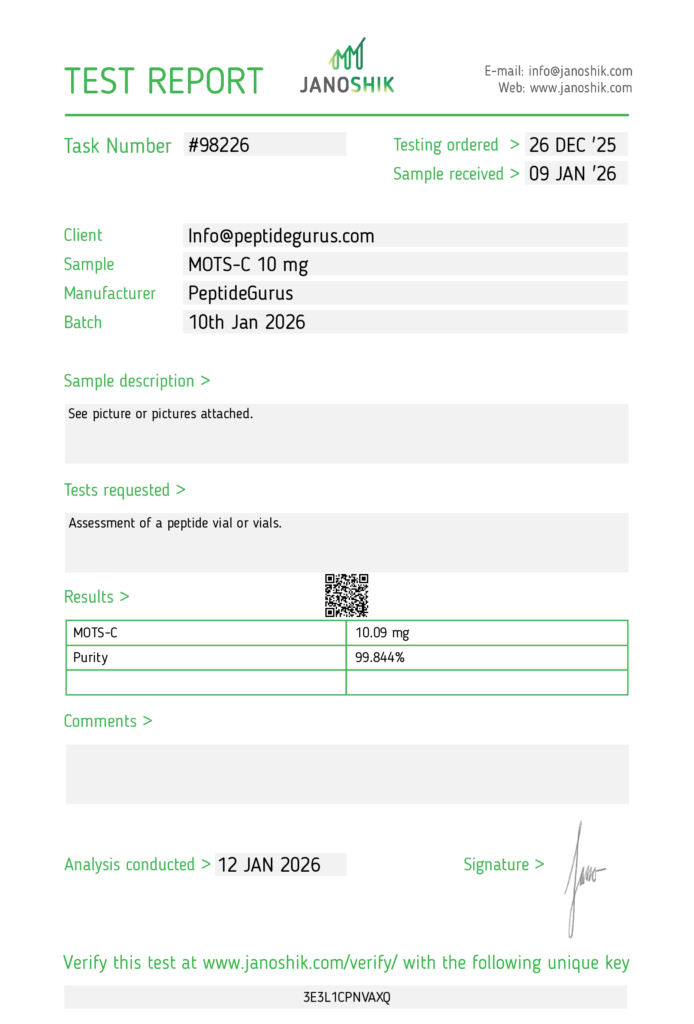
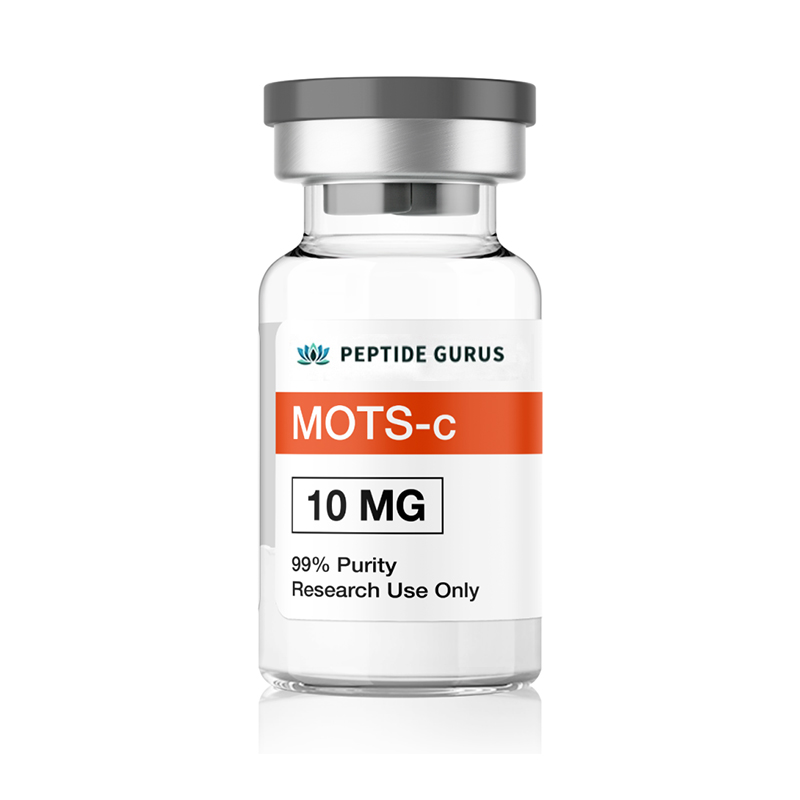
MOTS-c exhibits minimal side effects, low oral and excellent subcutaneous bioavailability in mice. Per kg dosage in mice does not scale to humans. MOTS-c for sale atกูรูเปปไทด์จํากัดเฉพาะการวิจัยทางการศึกษาและวิทยาศาสตร์เท่านั้น ไม่ใช่เพื่อการบริโภคของมนุษย์ ซื้อ MOTS-c เฉพาะเมื่อคุณเป็นนักวิจัยที่มีใบอนุญาต
ผู้เขียนบทความ
วรรณกรรมข้างต้นได้รับการวิจัย แก้ไข และจัดระเบียบโดย Dr. Logan, MD Dr. Logan สําเร็จการศึกษาระดับปริญญาเอกจากคณะแพทยศาสตร์มหาวิทยาลัย Case Western Reserveและปริญญาตรีสาขาชีววิทยาโมเลกุล
ผู้เขียนวารสารวิทยาศาสตร์
ดร. ชางฮัน เดวิด ลี, contributor to “MOTS-c: A novel mitochondrial-derived peptide regulating muscle and fat metabolism,” and “The Mitochondrial-Encoded Peptide MOTS-c Translocates to the Nucleus to Regulate Nuclear Gene Expression in Response to Metabolic Stress,” is a researcher at the School of Gerontology at USC Leonard Davis.Pinchas Cohen, MD, is the dean of the USC Leonard Davis School of Gerontology, executive director of the Ethel Percy Andrus Gerontology Center, and holder of the William and Sylvia Kugel Dean’s Chair in Gerontology. He is an expert in the study of mitochondrial peptides and their possible therapeutic benefits for diabetes, Alzheimer’s, and other diseases related to aging.Cohen’s current research focus is on the emerging science of mitochondria-derived peptides, which he discovered. These peptides include humanin, a 24-amino acid peptide encoded from the mt-16S-rRNA. It is a novel, centrally acting insulin sensitizer and metaboloprotective factor representing a new therapeutic and diagnostic target in diabetes and related disease. Other mitochondrial peptides of interest include MOTS-c, a second peptide encoded from a small ORF in the 12S region of the mitochondrial chromosome that has potent anti-diabetes and anti-obesity effect and acts as an exercise-mimetic, and SHLP2, a peptide encoded from the light strand of the mt-16S-rRNA region whose levels correlate with prostate cancer.
Dr. Changhan David Lee and Dr. Pinchas Cohen are being referenced as leading scientists involved in the research and development of Humanin. In no way are these doctors/scientists endorsing or advocating the purchase, sale, or use of this product for any reason. There is no affiliation or relationship, implied or otherwise, between
กูรูเปปไทด์and these doctors. The purpose of citing the doctors is to acknowledge, recognize, and credit the exhaustive research and development efforts conducted by the scientists studying this peptide. Dr. Changhan David Lee is listed in [1] [3] Dr. Pinchas Cohen is listed in [9] under the referenced citations.
การอ้างอิงอ้างอิง
C. Lee, K. H. Kim, and P. Cohen, “MOTS-c: A novel mitochondrial-derived peptide regulating muscle and fat metabolism,” Free Radic. Biol. Med., vol. 100, pp. 182–187, Nov. 2016. [PMC]
H. Lu et al., “MOTS-c peptide regulates adipose homeostasis to prevent ovariectomy-induced metabolic dysfunction,” J. Mol. Med. Berl. Ger., vol. 97, no. 4, pp. 473–485, Apr. 2019. [PubMed]
K. H. Kim, J. M. Son, B. A. Benayoun, and C. Lee, “The Mitochondrial-Encoded Peptide MOTS-c Translocates to the Nucleus to Regulate Nuclear Gene Expression in Response to Metabolic Stress,” Cell Metab., vol. 28, no. 3, pp. 516-524.e7, Sep. 2018. [PMC]
S.-J. Kim et al., “The mitochondrial-derived peptide MOTS-c is a regulator of plasma metabolites and enhances insulin sensitivity,” Physiol. Rep., vol. 7, no. 13, p. e14171, Jul. 2019. [PubMed]
R. Crescenzo, F. Bianco, A. Mazzoli, A. Giacco, G. Liverini, and S. Iossa, “A possible link between hepatic mitochondrial dysfunction and diet-induced insulin resistance,” Eur. J. Nutr., vol. 55, no. 1, pp. 1–6, Feb. 2016. [BMJ]
L. R. Cataldo, R. Fernández-Verdejo, J. L. Santos, and J. E. Galgani, “Plasma MOTS-c levels are associated with insulin sensitivity in lean but not in obese individuals,” J. Investig. Med., vol. 66, no. 6, pp. 1019–1022, Aug. 2018. [PubMed]
N. Che et al., “MOTS-c improves osteoporosis by promoting the synthesis of type I collagen in osteoblasts via TGF-β/SMAD signaling pathway,” Eur. Rev. Med. Pharmacol. Sci., vol. 23, no. 8, pp. 3183–3189, Apr. 2019. [PubMed]
B.-T. Hu and W.-Z. Chen, “MOTS-c improves osteoporosis by promoting osteogenic differentiation of bone marrow mesenchymal stem cells via TGF-β/Smad pathway,” Eur. Rev. Med. Pharmacol. Sci., vol. 22, no. 21, pp. 7156–7163, Nov. 2018. [PubMed]
N. Fuku et al., “The mitochondrial-derived peptide MOTS-c: A player in exceptional longevity?,” Aging Cell, vol. 14, Aug. 2015. [Research Gate]
Q. Qin et al., “Downregulation of circulating MOTS-c levels in patients with coronary endothelial dysfunction,” Int. J. Cardiol., vol. 254, pp. 23–27, 01 2018. [PubMed]
Y. Yang et al., “The role of mitochondria-derived peptides in cardiovascular disease: Recent updates,” Biomed. Pharmacother. Biomedecine Pharmacother., vol. 117, p. 109075, Jun. 2019. [PubMed]บทความและข้อมูลผลิตภัณฑ์ทั้งหมดที่ให้ไว้บนเว็บไซต์นี้มีวัตถุประสงค์เพื่อให้ข้อมูลและการศึกษาเท่านั้นผลิตภัณฑ์ที่นําเสนอบนเว็บไซต์นี้ได้รับการตกแต่งสําหรับการศึกษาในหลอดทดลองเท่านั้น การศึกษาในหลอดทดลอง (ละติน: ในแก้ว) จะดําเนินการนอกร่างกาย ผลิตภัณฑ์เหล่านี้ไม่ใช่ยาหรือยาและไม่ได้รับการอนุมัติจากองค์การอาหารและยาเพื่อป้องกันรักษาหรือรักษาอาการป่วยโรคหรือโรคใด ๆ กฎหมายห้ามการนําร่างกายใด ๆ เข้าสู่มนุษย์หรือสัตว์โดยเด็ดขาด