
• FOXO4-DRI peptide in aging research
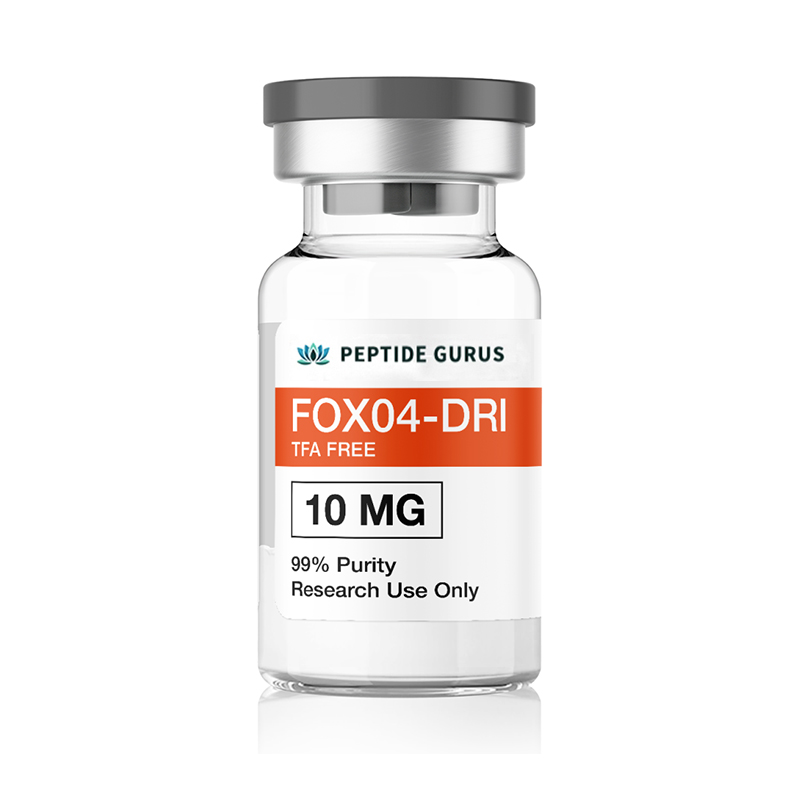
FOX04-Dri 10mg (ProxOfIM)
X
FOX04-Dri 10mg (ProxOfIM)

FOX04-Dri 10mg (ProxOfIM)

Categorieën: ,

Contact om te bestellen
Mail ons nu om je bestelling te plaatsen met 1-op-1 ondersteuning. Beperkte voorraad! Wij accepteren Zelle, CashApp, Venmo, bankoverschrijving en crypto.

Gratis (1) 30 ml Bacteriostatisch Water
with qualified orders over $500 USD. (excludes capsule products, cosmetic peptides, promo codes and shipping)
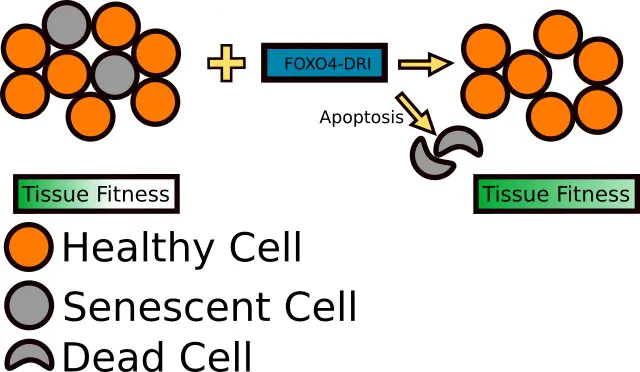
FOX04-DRI (Retro-Inverso) is a synthetic, slightly modified version of the standard FOXO4 protein. The modification prolongs half-life of the protein and allows it to interfere with normal FOXO4 function. FOXO4-DRI has been shown in research to prevent normal FOXO4 binding to p53, thereby allowing for elimination of senescent cells, improved organ function, and younger tissue “biological age.” FOXO4-DRI impacts insulin signaling, cell cycle regulation, and oxidative stress signaling pathways. FOXO4-DRI is a cell penetrating peptide shown to selectively induce apoptosis of senescent cells thereby reversing effects of aging in animal studies.
Product Usage: This PRODUCT IS INTENDED AS A RESEARCH CHEMICAL ONLY. This designation allows the use of research chemicals strictly for in vitro testing and laboratory experimentation only. All product information available on this website is for educational purposes only. Bodily introduction of any kind into humans or animals is strictly forbidden by law. This product should only be handled by licensed, qualified professionals. This product is not a drug, food, or cosmetic and may not be misbranded, misused or mislabled as a drug, food or cosmetic.

Wat is FOXO4-D-Retro-Inverso (DRI)?

FOXO4 D-Retro-Inverso is identical to the protein product of the FOXO4 gene, but the normal L amino acids have been exchanged for D amino acids. The result is that FOXO4-DRI has reduced susceptibility to normal physiologic clearance mechanisms and thus remains in the body for longer periods of time. The modified protein is still capable, however, of affecting transcription and cellular pathways. In general, the FOXO4-DRI protein interferes with normal FOXO4 function. Of greatest interest in terms of aging and senescence is the ability of FOXO4-DRI to interfere with normal FOXO4 signaling in the cell cycle by preventing the binding of FOXO4 to p53. The p53 protein is an important regulator of progression through the cell cycle as well as programmed cell death (apoptosis). When FOXO4-DRI binds to p53, it prevents FOXO4 from binding and allows p53 to bind to DNA. This, in turn, allows the cell to continue through the process of apoptosis and die. Interestingly, FOXO4-DRI appears to only have this effect in senescent cells, cells that are no longer functional or are dysfunctional as a result of aging[2]. Door zich te richten op deze disfunctionele cellen, helpt Foxo4-Dri om weefsel van cellen te bevrijden die niets anders zijn dan dood gewicht. Dit zorgt op zijn beurt, zorgt voor een beter werking van weefsel en helpt de groei en differentiatie van jongere, gezondere cellen te stimuleren. Het netto resultaat is een betere biologische functie en dus een afname van "biologische leeftijd".

"DRI" Retro InverSo Peptiden legden uit

DRI-Retro Inverso Peptides Explained Retro-inverso peptides are linear peptides whose amino acid sequence is reversed and the α-center chirality of the amino acid subunits is inverted as well. Usually, these types of peptides are designed by including D-amino acids in the reverse sequence to help maintain side chain topology similar to that of the original L-amino acid peptide and make them more resistant to proteolytic degradation. Other reported synonyms for these peptides in the scientific literature are: Retro-Inverso Peptides, All-D-Retro Peptides, Retro-Enantio Peptides, Retro-Inverso Analogs, Retro-Inverso Analogues, Retro-Inverso Derivatives, and Retro-Inverso Isomers. D-amino acids represent conformational mirror images of natural L-amino acids occurring in natural proteins present in biological systems. Peptides that contain D-amino acids have advantages over peptides that just contain L-amino acids. In general, these types of peptides are less susceptible to proteolytic degradation and have a longer effective time when used as pharmaceuticals. Furthermore, the insertion of D-amino acids in selected sequence regions as sequence blocks containing only D-amino acids or in-between L-amino acids allows the design of peptide-based drugs that are bioactive and possess increased bioavailability in addition to being resistant to proteolysis. Furthermore, if properly designed, retro-inverso peptides can have binding characteristics similar to L-peptides. Retro-inverso peptides are useful candidates for the study of protein-protein interactions by designing peptidomimetics that mimic the shape of peptide epitopes, protein-protein, or protein-peptide interfases. Retro-inverso-peptides are attractive alternatives to L-peptides used as pharmaceuticals. These of peptide have been reported to elicit lower immunogenic responses compared to L-peptides.
FOXO4-DRI brengt p53 uit van fysiologische sekwestratie. Het p53 -eiwit richt zich vervolgens op senescente cellen voor apoptose. Het netto resultaat is een toename van de totale weefselfitness en dus een verbeterde functie op weefsel- en orgelniveau. Verbeterde weefselfunctie wordt verminderd biologische leeftijd genoemd.

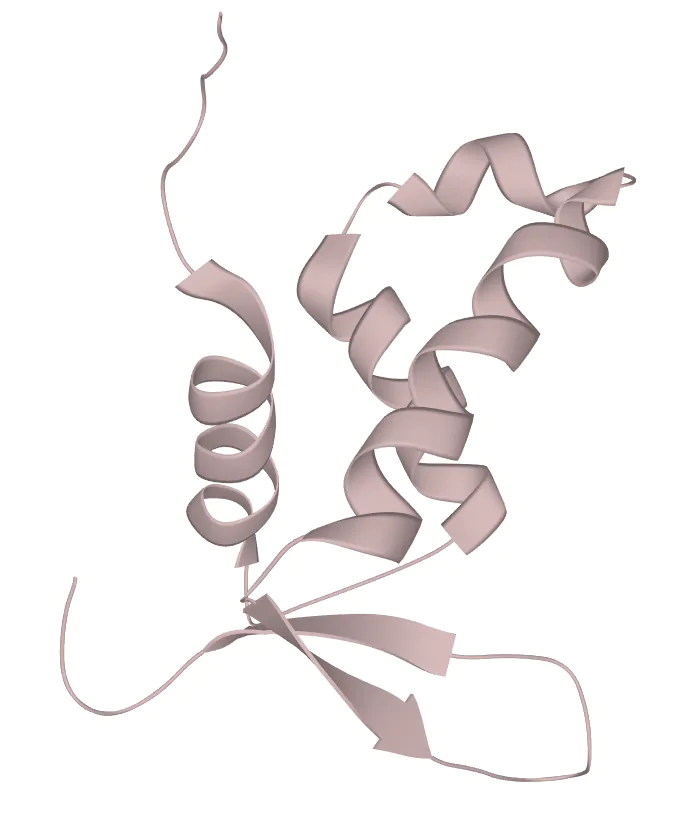
Foxo4-dri peptidestructuur

Source: Uniprot Sequence: H-D-Leu-D-Thr-D-Leu-D-Arg-D-Lys-D-Glu-D-Pro-D-Ala-D-Ser-D-Glu-D-Ile-D-Ala-D-Gln-D-Ser-D-Ile-D-Leu-D-Glu-D-Ala-D-Tyr-D-Ser-D-Gln-D-Asn-D-Gly-D-Trp-D-Ala-D-Asn-D-Arg-D-Arg-D-Ser-D-Gly-D-Gly-D-Lys-D-Arg-D-Pro-D-Pro-D-Pro-D-Arg-D-Arg-D-Arg-D-Gln-D-Arg-D-Arg-D-Lys-D-Lys-D-Arg-D-Gly-OH Molecular Formula: C228H388N86O64 Molecular Weight: 5358.05 Synonyms: Forkhead box protein O4, Proxofim, FOXO4a, AFX, AFX1, MLLT7

FOXO4-DRI veroudering en senescentie

The relationship between FOXO4 and aging is complex and still not fully understood. There is, however, good evidence that helps to elucidate the mechanisms by which the protein has its effects. Research in the well-studied nematode C. elegans shows that FOXO4 affects insulin-like growth factor receptor signaling and thus cellular lifespan control, stress resistance, and gene regulation[3]. It also appears that FOXO4 interacts with the p53 protein to regulate the cell cycle.

Natural FOXO4 actually protects senescent cells by keeping p53, a regulator of the cell cycle, sequestered and unable to induce apoptosis. FOXO4-DRI disrupts the normal FOXO4/p53 mechanism and allows the latter protein to induce apoptosis in senescent cells. The result is an amelioration of senescence-associated loss of tissue homeostasis[4][5]. Wetenschappers noemen dit verjonging door therapeutische eliminatie van senescente cellen. Het proces is niet zo anders dan het snoeien van een fruitboom. Door dode en beschadigde takken (senescente cellen) te verwijderen, wordt energie omgeleid naar gezondere delen van de boom en dus naar fruitproductie en groei. Ditzelfde proces gebeurt op orgel- en weefselniveau wanneer cellen die bijdragen aan de algehele ongezonde functie worden verwijderd, waardoor middelen kunnen worden gericht op gezonde cellen.
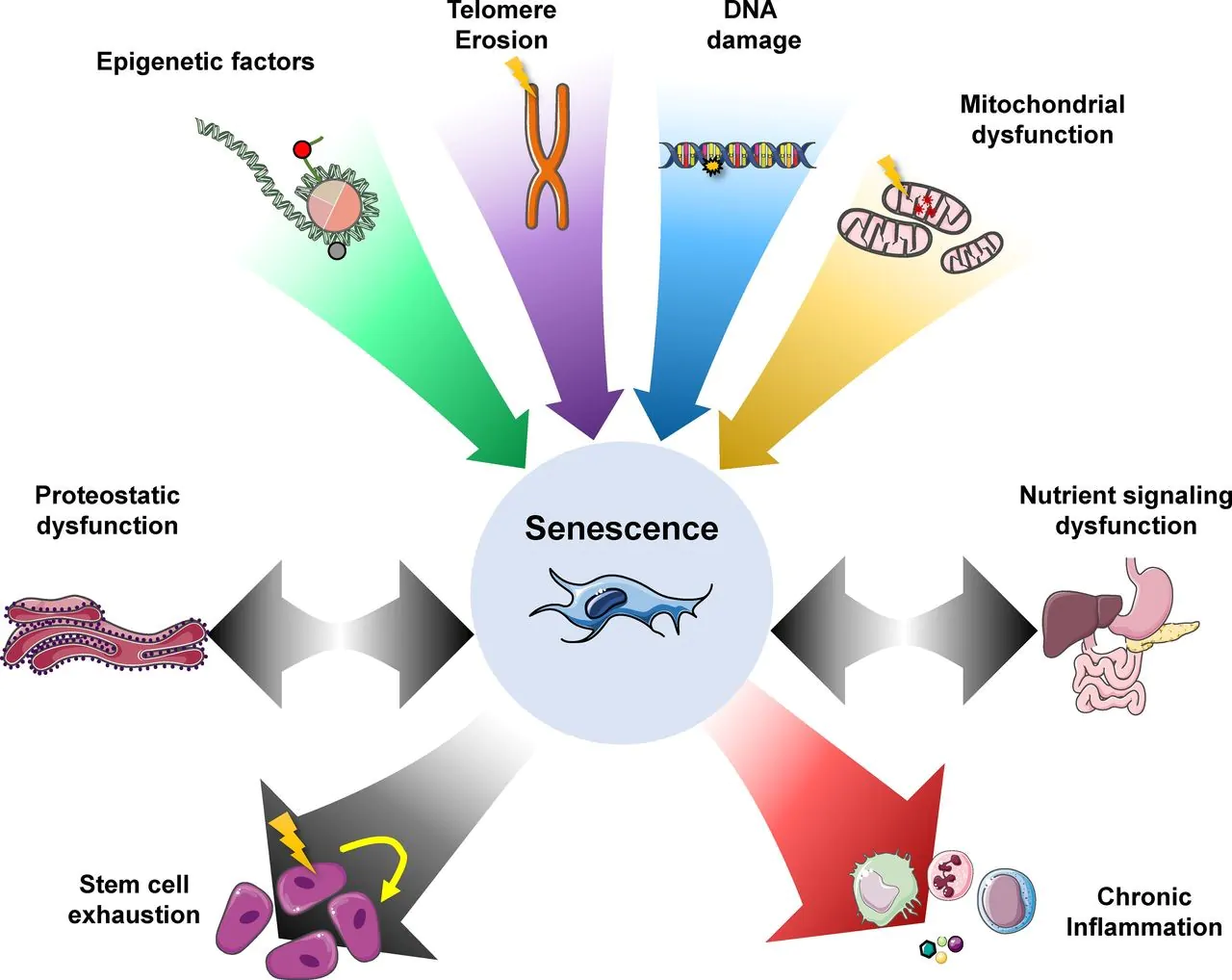
Source: Journal of Cell Biology

Deze afbeelding toont welke factoren bijdragen aan senescentie en wat de resultaten zijn senescentie zijn. Merk op dat het elimineren van een senescente cel stamceluitputting niet verlicht, maar deze kan vertragen. Het helpt echter om chronische ontsteking te verminderen, een gevestigde motor van een aantal aandoeningen zoals hartziekten, beroerte, enz.

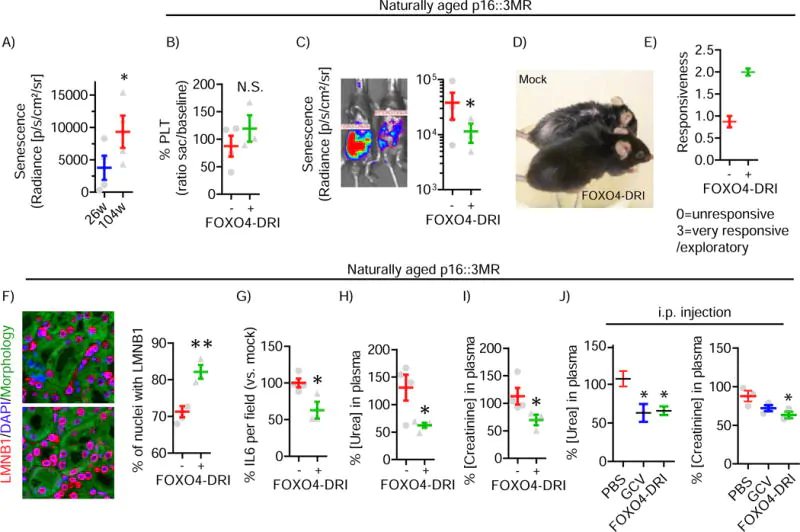
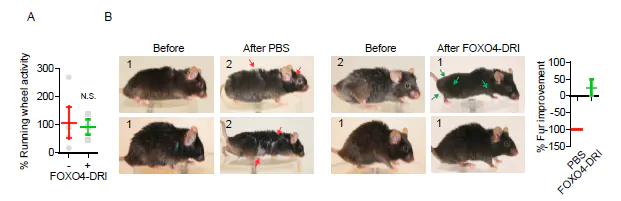
Onherstelbare schade, dat wil zeggen cellulaire schade die het vermogen van het lichaam om te repareren te boven gaat, is een van de primaire beperkingen voor de gezondheid van de gezondheid. Gezondheidsspanne, de tijdsduur waarin een organisme gezond blijft en optimaal functioneert, is over het algemeen korter dan de levensduur. Een daling van de gezondheidspan manifesteert zich als veroudering. Het vermogen om de gezondheidsspanne te verlengen, kan niet leiden tot meer geleefde jaren, maar het kan ertoe leiden dat de jaren aan ons zijn toegewezen in een grotere gezondheid en met een beter functioneren. In muismodellen is aangetoond dat FOXO4 de gezondheidsspanne bij oude muizen verbetert, wat leidt tot een toename van fitness, bontdichtheid en nierfunctioneren. De muizen leven niet noodzakelijkerwijs langer, maar ze hebben een grotere gezondheid, zelfs in ouderdom, wat zich vertaalt in minder handicap en minder leeftijdsgerelateerde aandoeningen zoals hartaandoeningen, musculoskeletale disfunctie, enz[2].
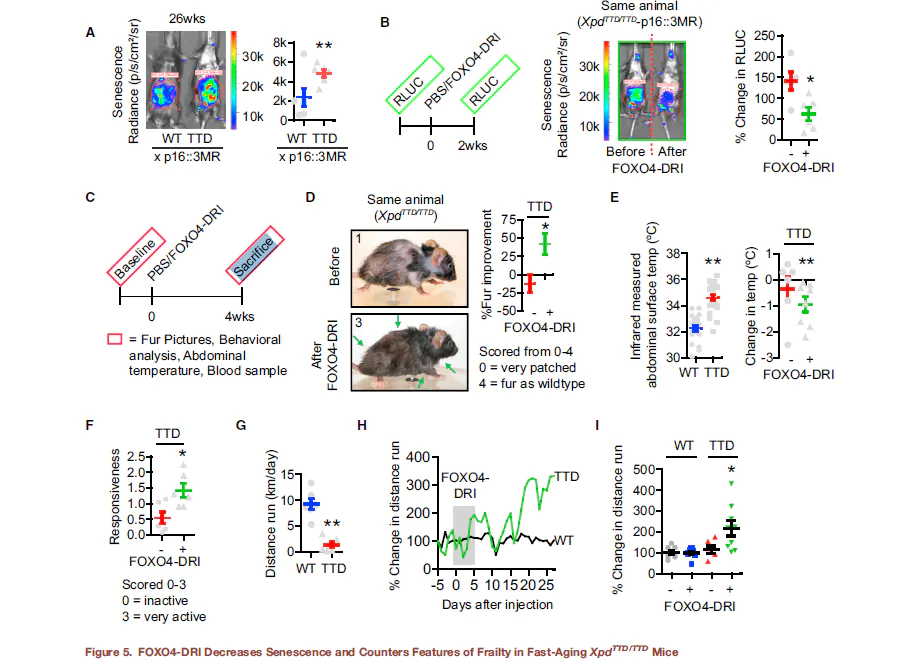
Afbeeldingen die verbeterde fitness tonen, zoals aangegeven door bontdichtheid, in een muis behandeld met FOXO4-Dri na onderworpen aan chemotoxische middelen die werden gebruikt om veroudering te modelleren:
Source: Pubmed.

FOXO4-DRI-onderzoek

1. Insulinesignalering

Het is al lang begrepen dat FOXO-eiwitten belangrijke regulatoren zijn van insulinesignalering, maar dat ze stroomafwaarts van de insuline zelf werken, evenals insulineachtige groeifactoren. Onderzoek in diermodellen geeft aan dat FOXO gemedieert dat remmereffecten van insuline en insuline-achtige groeifactor op celmetabolisme, groei, differentiatie, oxidatieve stress en meer. Mutaties in FOXO zijn verbonden met pathologische veranderingen in insulinesignalering en de ontwikkeling van metabole ziekten en kanker. Bij diabetici leidt veranderingen van Foxo -signalering tot nuchtere hyperglykemie en hyperlipidemie[6]. Dit laatste is een van de meest zorgen over aspecten van diabetes, omdat het leidt tot veel van de complicaties van de ziekte, zoals nierschade, beroerte, hartaanval, verminderde wondgenezing en meer. Het vermogen om FOXO -signalering bij diabetes te reguleren, kan zorgen voor meer gerichte, effectievere methoden om een ​​deel van de ernstige complicaties van de ziekte te voorkomen. Het is onduidelijk hoe FOXO4-DRI de insulinesignalering beïnvloedt, maar er wordt gedacht dat het eiwit de stroomafwaartse effecten van insuline kan verbeteren door de nuchtere bloedsuikerspiegel te verminderen.

2. Hartziekte

Leeftijd is een risicofactor voor hart- en vaatziekten. Dit risico lijkt te worden gemedieerd door dalingen van proteasome activiteit in het hart. Proteasomen zijn verantwoordelijk voor het verwijderen van geoxideerde eiwitten en andere eiwitten die de cel is gemarkeerd als "beschadigd" of disfunctioneel. Onderzoek bij ratten toont aan dat leeftijd omgekeerd wordt gecorreleerd met proteasoomactiviteit en dus toeneemt in niveaus van beschadigde eiwitten in het hart[7].

FOXO -eiwitten bemiddelen autofagie en proteasoomactiviteit. Verhogingen van FOXO4 -niveaus leiden tot toename van proteasoomactiviteit en verlaagde dus verminderde niveaus van oxidatie en eiwitschade binnen specifiek weefsel. Het kan mogelijk zijn dat FOXO4-Dri of een variant ervan kan worden gebruikt om de natuurlijke huishoudfuncties van het hart te stimuleren en dus leeftijdsgebonden veranderingen in de cardiovasculaire functie te verminderen[8].

3. Neurodegeneratieve ziekte

Age-related changes in cognitive function have a complex etiology. Even relatively common diseases, like Alzheimer’s disease, are not fully understood by the medical community. There is some evidence, however, to support the notion that changes in proteasome activity can lead to or exacerbate underlying neurodegenerative conditions. It isn’t clear if impaired proteasome activity is a primary cause or secondary contributor to diseases like Alzheimer’s disease, but impairment of the systems has been found in Parkinson’s, Alzheimer’s, Huntington’s, and Prion disease. There is also impairment of proteasome function in amyotrophic lateral sclerosis (ALS or Lou Gehrig’s disease) [9].

It appears that FOXO proteins are modified in the central nervous system, a finding that has led researchers to explore the idea that exogenous FOXO protein may be useful in treating or preventing neurodegenerative disorders. At the very least, there is hope that FOXO4-DRI and other modified FOXO proteins may be useful in slowing the relentless progression of neurodegenerative disorders [10].

Samenvatting

FOXO4-Dri is duidelijk aangetoond dat het de apoptose stimuleert in cellen die senescent zijn geworden, wat leidt tot een verbeterde weefselfunctie en een betere algehele gezondheid in diermodellen. Het valt nog te bezien hoe uitgebreid de effecten van Foxo4-Dri zijn, maar er is hoop dat het eiwit inzicht kan ontsluiten in leeftijdsgebonden aandoeningen zoals dementie, hartaandoeningen en algemeen functieverlies veroorzaakt door celsescentie.

FOXO4-DRI exhibits minimal side effects, low oral and excellent subcutaneous bioavailability in mice. Per kg dosage in mice does not scale to humans. FOXO4-DRI for sale at Peptide Gurus is limited to educational and scientific research only, not for human consumption. Only buy FOXO4-DRI if you are a licensed researcher.

Artikelauteur

The above literature was researched, edited and organized by Dr. Logan, M.D. Dr. Logan holds a doctorate degree from Case Western Reserve University School of Medicine and a B.S. in molecular biology.

Wetenschappelijke tijdschrift Auteur

The aim of Dr. Peter de Keizer’s group is to unravel the molecular mechanisms that cause cells to become senescent and to identify how these cells drive aging and age-related diseases. The role of senescence in late-stage therapy-resistant cancer is a major component of this research. The research has a strong translational component and a spearpoint of the group is to develop methods to target the deleterious effects of senescent and senescent-like cancer cells, for instance by eliminating them altogether. In 2004, Peter obtained his MSc in Biomolecular Science form Utrecht University. The final part of his training was performed at Harvard Medical School / Massachusetts General Hospital in Boston, USA. Here, he focused on therapy-resistant Glioblastoma, the most lethal form of brain cancer, something which is now on of the focus areas of the group. In 2009, Peter obtained his PhD from UMC Utrecht on the regulation of FOXO proteins under conditions of stress and their role in tumor suppression. Dr. Peter de Keizer is being referenced as one of the leading scientists involved in the research and development of FOXO4-DRI. In no way is this doctor/scientist endorsing or advocating the purchase, sale, or use of this product for any reason. There is no affiliation or relationship, implied or otherwise, between Peptide Gurus and this doctor. The purpose of citing the doctor is to acknowledge, recognize, and credit the exhaustive research and development efforts conducted by the scientists studying this peptide. Dr. Peter de Keizer is listed in [2] under the referenced citations.

Vermeld citaten

  1.     W. Liu, Y. Song, J. Wang, H. Xiao, Y. Zhang, and B. Luo, “Dysregulation of FOXO transcription factors in Epstein-Barr virus-associated gastric carcinoma,” Virus Res., P. 197808, november 2019.
  2.     Baar, Marjolein P, et al. “Targeted Apoptosis of Senescent Cells Restores Tissue Homeostasis in Response to Chemotoxicity and Aging.” Cell, vol. 169, no. 1, 2017, pp. 132-147.e16, www.ncbi.nlm.nih.gov/pubmed/28340339, 10.1016/j.cell.2017.02.031. 
  3.     A. T.-Y. Chen et al., “Longevity Genes Revealed by Integrative Analysis of Isoform-Specific daf-16/FoxO Mutants of Caenorhabditis elegans,” Genetics, Vol. 201, nee. 2, pp. 613–629, oktober 2015.
  4.     P. Krimpenfort and A. Berns, “Rejuvenation by Therapeutic Elimination of Senescent Cells,” Cell, Vol. 169, nee. 1, pp. 3–5, 23 2017.
  5. "Senescentie en veroudering: oorzaken, gevolgen en therapeutische wegen | JCB." [Online]. Beschikbaar: http://jcb.rupress.org/content/217/1/65. [Toegang: 17-NOV-2019].
  6.     S. Lee and H. H. Dong, “FoxO integration of insulin signaling with glucose and lipid metabolism,” J. Endocrinol., Vol. 233, nee. 2, pp. R67 - R79, 2017.
  7.     A.-L. Bulteau, L. I. Szweda, and B. Friguet, “Age-dependent declines in proteasome activity in the heart,” Arch. Biochem. Biophys., Vol. 397, nee. 2, pp. 298–304, januari 2002.
  8.     G. Murtaza, A. K. Khan, R. Rashid, S. Muneer, S. M. F. Hasan, and J. Chen, “FOXO Transcriptional Factors and Long-Term Living,” Oxid. Med. Cell. Longev., Vol. 2017, 2017.
  9.     A. Ciechanover and P. Brundin, “The ubiquitin proteasome system in neurodegenerative diseases: sometimes the chicken, sometimes the egg,” Neuron, Vol. 40, nee. 2, pp. 427–446, oktober 2003.
  10.   W. Hu et al., “Roles of forkhead box O (FoxO) transcription factors in neurodegenerative diseases: A panoramic view,” Prog. Neurobiol., Vol. 181, p. 101645, oktober 2019.
ALL ARTICLES AND PRODUCT INFORMATION PROVIDED ON THIS WEBSITE ARE FOR INFORMATIONAL AND EDUCATIONAL PURPOSES ONLY. De producten die op deze website worden aangeboden, zijn alleen ingericht voor in-vitro-studies. In-vitro-onderzoeken (Latijn: in glas) worden buiten het lichaam uitgevoerd. Deze producten zijn geen medicijnen of medicijnen en zijn niet goedgekeurd door de FDA om een ​​medische aandoening, kwaal of ziekte te voorkomen, te behandelen of te genezen. Lichamelijke introductie van welke aard dan ook in mensen of dieren is ten strengste wettelijk verboden.

Aanvraag aanvragen

ABOUT US

Peptidegurus is een toonaangevende leverancier van Amerikaanse onderzoekspeptiden en biedt producten van topkwaliteit tegen concurrerende prijzen. Met een focus op excellentie en klantenservice, zorgen ze voor een veilig en handig bestelproces met wereldwijde verzending.

Vraag een citaat aan

  • Peptidegoeroes
  • info@peptidegurus.com
  • Glendale, het is, VS
  • CONTACT

    Aanvraag aanvragen