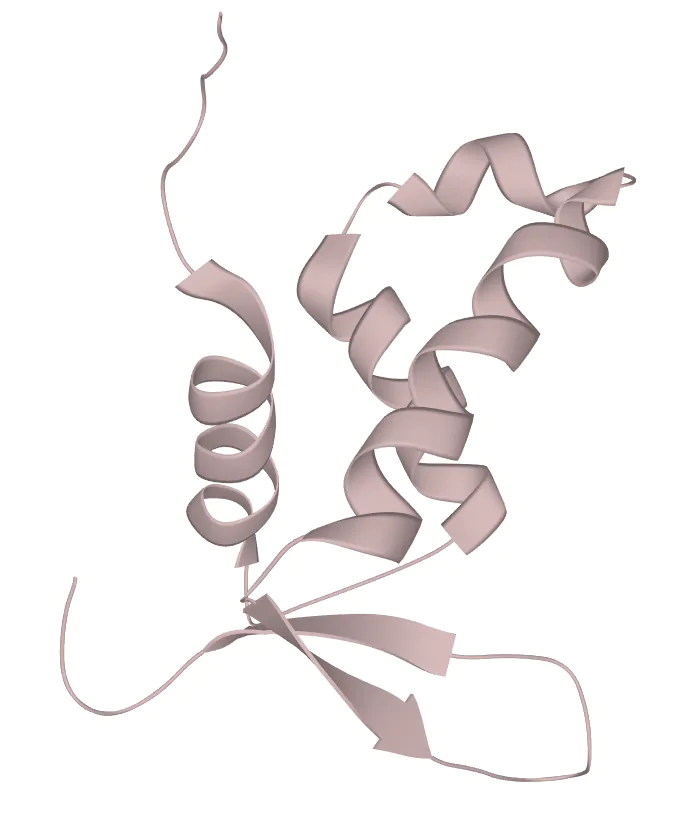

• FOXO4-DRI peptide in aging research
FOX04-DRI 10 мг (Проксофим)
Икс
FOX04-DRI 10 мг (Проксофим)

FOX04-DRI 10 мг (Проксофим)

Категории: ,

Контакт для заказа
Напишите нам прямо сейчас, чтобы оформить заказ у индивидуальной поддержки. Ограниченный ассортимент! Мы принимаем Zelle, CashApp, Venmo, банковские переводы и криптовалюту.

Бесплатно (1) 30 мл бактериостатической воды
с квалифицированными заказами более $500 USD. (excludes capsule products, cosmetic peptides, promo codes and shipping)
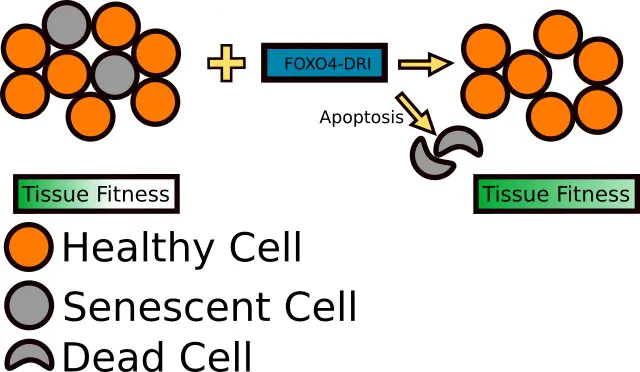
FOX04-DRI (Retro-Inverso) is a synthetic, slightly modified version of the standard FOXO4 protein. The modification prolongs half-life of the protein and allows it to interfere with normal FOXO4 function. FOXO4-DRI has been shown in research to prevent normal FOXO4 binding to p53, thereby allowing for elimination of senescent cells, improved organ function, and younger tissue “biological age.” FOXO4-DRI impacts insulin signaling, cell cycle regulation, and oxidative stress signaling pathways. FOXO4-DRI is a cell penetrating peptide shown to selectively induce apoptosis of senescent cells thereby reversing effects of aging in animal studies.
Product Usage: This PRODUCT IS INTENDED AS A RESEARCH CHEMICAL ONLY. This designation allows the use of research chemicals strictly for in vitro testing and laboratory experimentation only. All product information available on this website is for educational purposes only. Bodily introduction of any kind into humans or animals is strictly forbidden by law. This product should only be handled by licensed, qualified professionals. This product is not a drug, food, or cosmetic and may not be misbranded, misused or mislabled as a drug, food or cosmetic.

Что такое FOXO4-D-ретро-инверсо (DRI)?

FOXO4 D-Retro-Inverso is identical to the protein product of the FOXO4 gene, but the normal L amino acids have been exchanged for D amino acids. The result is that FOXO4-DRI has reduced susceptibility to normal physiologic clearance mechanisms and thus remains in the body for longer periods of time. The modified protein is still capable, however, of affecting transcription and cellular pathways. In general, the FOXO4-DRI protein interferes with normal FOXO4 function. Of greatest interest in terms of aging and senescence is the ability of FOXO4-DRI to interfere with normal FOXO4 signaling in the cell cycle by preventing the binding of FOXO4 to p53. The p53 protein is an important regulator of progression through the cell cycle as well as programmed cell death (apoptosis). When FOXO4-DRI binds to p53, it prevents FOXO4 from binding and allows p53 to bind to DNA. This, in turn, allows the cell to continue through the process of apoptosis and die. Interestingly, FOXO4-DRI appears to only have this effect in senescent cells, cells that are no longer functional or are dysfunctional as a result of aging[2]. Воздействуя на эти дисфункциональные клетки, FOXO4-DRI помогает избавить ткани от клеток, которые представляют собой не что иное, как мертвый груз. Это, в свою очередь, способствует лучшему функционированию тканей и помогает стимулировать рост и дифференцировку более молодых и здоровых клеток. Конечным результатом является улучшение биологической функции и, следовательно, снижение «биологического возраста».

Объяснение ретро-инверсо-пептидов «DRI»

DRI-Retro Inverso Peptides Explained Retro-inverso peptides are linear peptides whose amino acid sequence is reversed and the α-center chirality of the amino acid subunits is inverted as well. Usually, these types of peptides are designed by including D-amino acids in the reverse sequence to help maintain side chain topology similar to that of the original L-amino acid peptide and make them more resistant to proteolytic degradation. Other reported synonyms for these peptides in the scientific literature are: Retro-Inverso Peptides, All-D-Retro Peptides, Retro-Enantio Peptides, Retro-Inverso Analogs, Retro-Inverso Analogues, Retro-Inverso Derivatives, and Retro-Inverso Isomers. D-amino acids represent conformational mirror images of natural L-amino acids occurring in natural proteins present in biological systems. Peptides that contain D-amino acids have advantages over peptides that just contain L-amino acids. In general, these types of peptides are less susceptible to proteolytic degradation and have a longer effective time when used as pharmaceuticals. Furthermore, the insertion of D-amino acids in selected sequence regions as sequence blocks containing only D-amino acids or in-between L-amino acids allows the design of peptide-based drugs that are bioactive and possess increased bioavailability in addition to being resistant to proteolysis. Furthermore, if properly designed, retro-inverso peptides can have binding characteristics similar to L-peptides. Retro-inverso peptides are useful candidates for the study of protein-protein interactions by designing peptidomimetics that mimic the shape of peptide epitopes, protein-protein, or protein-peptide interfases. Retro-inverso-peptides are attractive alternatives to L-peptides used as pharmaceuticals. These of peptide have been reported to elicit lower immunogenic responses compared to L-peptides.
FOXO4-DRI высвобождает p53 в результате физиологической секвестрации. Затем белок p53 нацеливается на стареющие клетки для апоптоза. Конечным результатом является повышение общей работоспособности тканей и, следовательно, улучшение функций на уровне тканей и органов. Улучшение функции тканей называется снижением биологического возраста.

Структура пептида FOXO4-DRI

Source: Uniprot Sequence: H-D-Leu-D-Thr-D-Leu-D-Arg-D-Lys-D-Glu-D-Pro-D-Ala-D-Ser-D-Glu-D-Ile-D-Ala-D- Глн-Д-Сер-Д-Иль-Д-Лей-Д-Глу-Д-Ала-Д-Тир-Д-Сер-Д-Глн-Д-Асн-Д-Гли-Д-Трп-Д-Ала- D-Asn-D-Arg-D-Arg-D-Ser-D-Gly-D-Gly-D-Lys-D-Arg-D-Pro-D-Pro-D-Pro-D-Arg-D- Arg-D-Arg-D-Gln-D-Arg-D-Arg-D-Lys-D-Lys-D-Arg-D-Gly-OH Molecular Formula: C228H388N86O64 Molecular Weight: 5358.05 Synonyms: Forkhead box protein O4, Proxofim, FOXO4a, AFX, AFX1, MLLT7

FOXO4-DRI Старение и старение

The relationship between FOXO4 and aging is complex and still not fully understood. There is, however, good evidence that helps to elucidate the mechanisms by which the protein has its effects. Research in the well-studied nematode C. elegans shows that FOXO4 affects insulin-like growth factor receptor signaling and thus cellular lifespan control, stress resistance, and gene regulation[3]. It also appears that FOXO4 interacts with the p53 protein to regulate the cell cycle.

Natural FOXO4 actually protects senescent cells by keeping p53, a regulator of the cell cycle, sequestered and unable to induce apoptosis. FOXO4-DRI disrupts the normal FOXO4/p53 mechanism and allows the latter protein to induce apoptosis in senescent cells. The result is an amelioration of senescence-associated loss of tissue homeostasis[4][5]. Ученые называют это омоложением путем терапевтического устранения стареющих клеток. Этот процесс мало чем отличается от обрезки фруктового дерева. Путем удаления мертвых и поврежденных ветвей (стареющих клеток) энергия перенаправляется на более здоровые части дерева и, таким образом, на производство и рост плодов. Тот же процесс происходит на уровне органов и тканей, когда клетки, которые способствуют общему нездоровому функционированию, удаляются, что позволяет сосредоточить ресурсы на здоровых клетках.
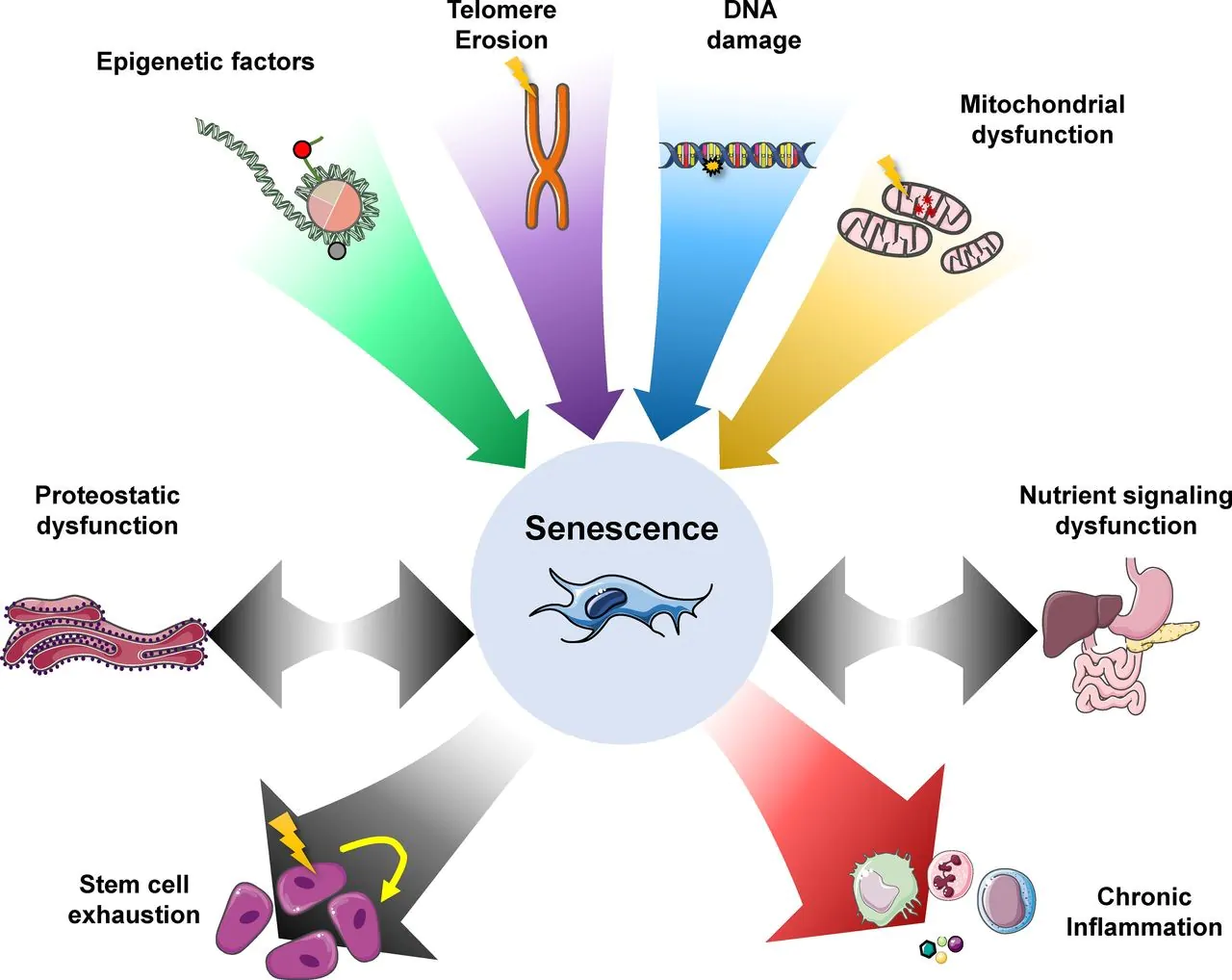
Source: Журнал клеточной биологии

На этом изображении показано, какие факторы способствуют старению и каковы последствия старения. Обратите внимание, что устранение стареющих клеток не облегчает истощение стволовых клеток, но может замедлить его. Однако он помогает уменьшить хроническое воспаление, которое является общепризнанной причиной ряда заболеваний, таких как болезни сердца, инсульт и т. д.

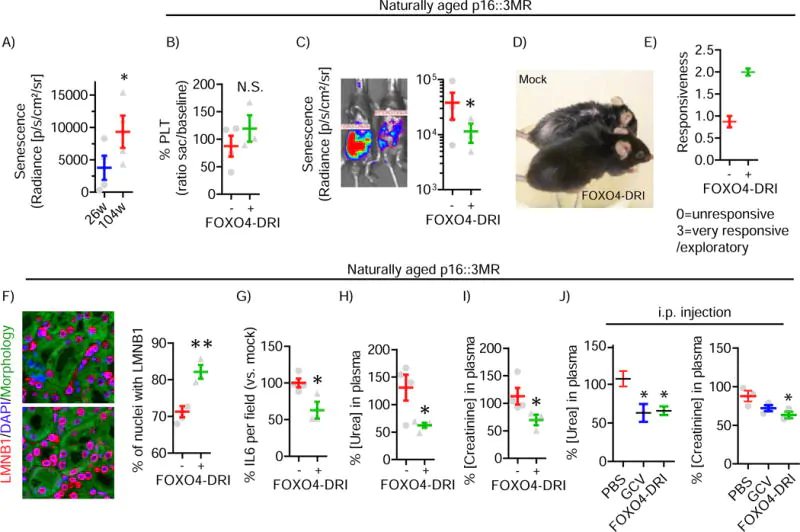
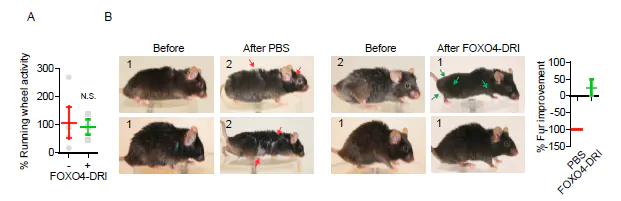
Непоправимый ущерб, то есть повреждение клеток, которое организм не в состоянии исправить, является одним из основных ограничений продолжительности жизни. Продолжительность здоровья, то есть период времени, в течение которого организм остается здоровым и оптимально функционирует, обычно короче продолжительности жизни. Снижение продолжительности здоровья проявляется как старение. Возможность продлить продолжительность жизни, возможно, не приведет к увеличению прожитых лет, но она может привести к тому, что мы проживем отведенные нам годы с лучшим здоровьем и лучшим функционированием. На моделях мышей было показано, что FOXO4 улучшает продолжительность жизни пожилых мышей, что приводит к улучшению физической формы, плотности шерсти и функционирования почек. Мыши не обязательно живут дольше, но у них лучшее здоровье, даже в пожилом возрасте, что приводит к меньшей инвалидности и возрастным заболеваниям, таким как болезни сердца, скелетно-мышечная дисфункция и т. д.[2].
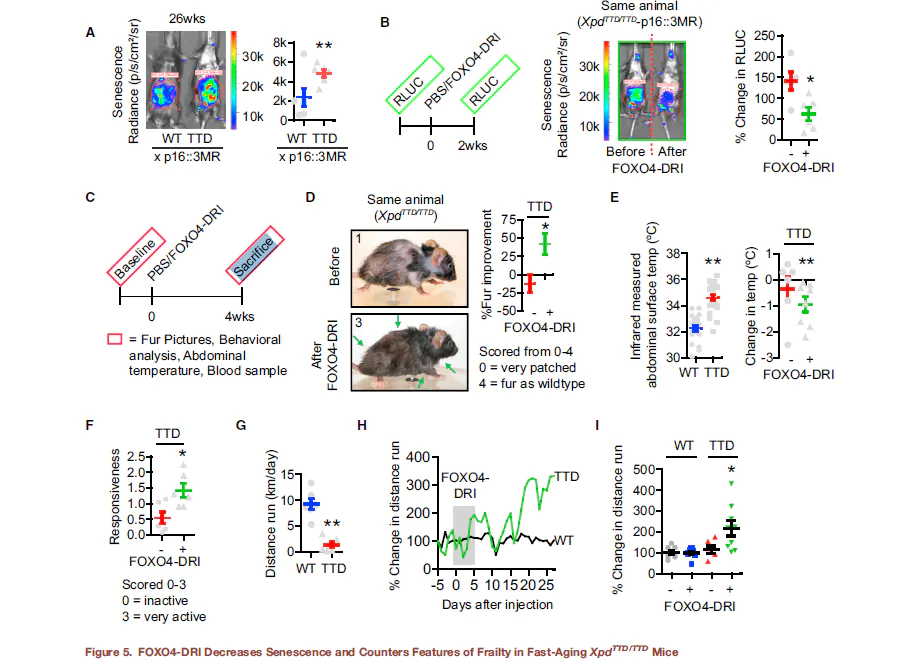
Изображения, демонстрирующие улучшение физической формы, о чем свидетельствует плотность шерсти, у мышей, обработанных FOXO4-DRI, после воздействия химиотоксических агентов, используемых для моделирования старения:
Source: Pubmed.

FOXO4-DRI Исследования

1. Передача сигналов инсулина

Уже давно стало понятно, что белки FOXO являются важными регуляторами передачи сигналов инсулина, но действуют после самого инсулина, а также инсулиноподобных факторов роста. Исследования на животных моделях показывают, что FOXO опосредует ингибирующее действие инсулина и инсулиноподобного фактора роста на клеточный метаболизм, рост, дифференцировку, окислительный стресс и многое другое. Мутации в FOXO связаны с патологическими изменениями в передаче сигналов инсулина и развитием метаболических заболеваний, а также рака. У диабетиков изменения передачи сигналов FOXO приводят к гипергликемии и гиперлипидемии натощак.[6]. Последнее является одним из наиболее тревожных аспектов диабета, поскольку оно приводит ко многим осложнениям заболевания, таким как повреждение почек, инсульт, сердечный приступ, нарушение заживления ран и многое другое. Способность регулировать передачу сигналов FOXO при диабете может обеспечить более целенаправленные и эффективные методы предотвращения некоторых серьезных осложнений заболевания. Неясно, как FOXO4-DRI влияет на передачу сигналов инсулина, но считается, что этот белок может улучшить последующие эффекты инсулина за счет снижения уровня сахара в крови натощак.

2. Болезни сердца

Возраст является фактором риска сердечно-сосудистых заболеваний. Этот риск, по-видимому, опосредован снижением активности протеасом в сердце. Протеасомы отвечают за удаление окисленных белков и других белков, которые клетка пометила как «поврежденные» или дисфункциональные. Исследования на крысах показывают, что возраст обратно коррелирует с активностью протеасом и, следовательно, увеличивает уровень поврежденных белков в сердце.[7].

Белки FOXO опосредуют аутофагию и активность протеасом. Увеличение уровней FOXO4 приводит к увеличению активности протеасом и, следовательно, к снижению уровня окисления и повреждения белков в конкретной ткани. Вполне возможно, что FOXO4-DRI или его вариант можно использовать для усиления естественных домашних функций сердца и, таким образом, уменьшения возрастных изменений сердечно-сосудистой функции.[8].

3. Нейродегенеративные заболевания.

Age-related changes in cognitive function have a complex etiology. Even relatively common diseases, like Alzheimer’s disease, are not fully understood by the medical community. There is some evidence, however, to support the notion that changes in proteasome activity can lead to or exacerbate underlying neurodegenerative conditions. It isn’t clear if impaired proteasome activity is a primary cause or secondary contributor to diseases like Alzheimer’s disease, but impairment of the systems has been found in Parkinson’s, Alzheimer’s, Huntington’s, and Prion disease. There is also impairment of proteasome function in amyotrophic lateral sclerosis (ALS or Lou Gehrig’s disease) [9].

It appears that FOXO proteins are modified in the central nervous system, a finding that has led researchers to explore the idea that exogenous FOXO protein may be useful in treating or preventing neurodegenerative disorders. At the very least, there is hope that FOXO4-DRI and other modified FOXO proteins may be useful in slowing the relentless progression of neurodegenerative disorders [10].

Краткое содержание

Было четко продемонстрировано, что FOXO4-DRI усиливает апоптоз в стареющих клетках, что приводит к улучшению функции тканей и улучшению общего состояния здоровья на животных моделях. Еще неизвестно, насколько обширны эффекты FOXO4-DRI, но есть надежда, что этот белок сможет раскрыть понимание возрастных состояний, таких как деменция, болезни сердца и общая потеря функций, вызванная старением клеток.

FOXO4-DRI демонстрирует минимальные побочные эффекты, низкую биодоступность при пероральном приеме и отличную подкожную биодоступность у мышей. Дозировка на кг для мышей не распространяется на людей. FOXO4-DRI продается по адресу Peptide Gurus ограничивается только образовательными и научными исследованиями, а не для потребления человеком. Покупайте FOXO4-DRI только в том случае, если вы являетесь лицензированным исследователем.

Автор статьи

The above literature was researched, edited and organized by Dr. Logan, M.D. Dr. Logan holds a doctorate degree from Case Western Reserve University School of Medicine and a B.S. in molecular biology.

Автор научного журнала

Цель Dr. Peter de Keizer’s group is to unravel the molecular mechanisms that cause cells to become senescent and to identify how these cells drive aging and age-related diseases. The role of senescence in late-stage therapy-resistant cancer is a major component of this research. The research has a strong translational component and a spearpoint of the group is to develop methods to target the deleterious effects of senescent and senescent-like cancer cells, for instance by eliminating them altogether. In 2004, Peter obtained his MSc in Biomolecular Science form Utrecht University. The final part of his training was performed at Harvard Medical School / Massachusetts General Hospital in Boston, USA. Here, he focused on therapy-resistant Glioblastoma, the most lethal form of brain cancer, something which is now on of the focus areas of the group. In 2009, Peter obtained his PhD from UMC Utrecht on the regulation of FOXO proteins under conditions of stress and their role in tumor suppression. Dr. Peter de Keizer is being referenced as one of the leading scientists involved in the research and development of FOXO4-DRI. In no way is this doctor/scientist endorsing or advocating the purchase, sale, or use of this product for any reason. There is no affiliation or relationship, implied or otherwise, between Peptide Gurus and this doctor. The purpose of citing the doctor is to acknowledge, recognize, and credit the exhaustive research and development efforts conducted by the scientists studying this peptide. Dr. Peter de Keizer is listed in [2] under the referenced citations.

Ссылочные цитаты

  1.     W. Liu, Y. Song, J. Wang, H. Xiao, Y. Zhang, and B. Luo, “Dysregulation of FOXO transcription factors in Epstein-Barr virus-associated gastric carcinoma,” Virus Res., с. 197808, ноябрь. 2019.
  2.     Baar, Marjolein P, et al. “Targeted Apoptosis of Senescent Cells Restores Tissue Homeostasis in Response to Chemotoxicity and Aging.” Cell, vol. 169, no. 1, 2017, pp. 132-147.e16, www.ncbi.nlm.nih.gov/pubmed/28340339, 10.1016/j.cell.2017.02.031. 
  3.     A. T.-Y. Chen et al., “Longevity Genes Revealed by Integrative Analysis of Isoform-Specific daf-16/FoxO Mutants of Caenorhabditis elegans,” Genetics, том. 201, нет. 2, стр. 613–629, октябрь 2015 г.
  4.     P. Krimpenfort and A. Berns, “Rejuvenation by Therapeutic Elimination of Senescent Cells,” Cell, том. 169, нет. 1, стр. 3–5, 23 2017 г.
  5. «Старение и старение: причины, последствия и пути лечения | Джей СиБи». [Онлайн]. Доступно: http://jcb.rupress.org/content/217/1/65. [Доступ: 17 ноября 2019 г.].
  6.     S. Lee and H. H. Dong, “FoxO integration of insulin signaling with glucose and lipid metabolism,” J. Endocrinol., том. 233, нет. 2, стр. R67–R79, 2017.
  7.     A.-L. Bulteau, L. I. Szweda, and B. Friguet, “Age-dependent declines in proteasome activity in the heart,” Arch. Biochem. Biophys., том. 397, нет. 2, стр. 298–304, январь 2002 г.
  8.     G. Murtaza, A. K. Khan, R. Rashid, S. Muneer, S. M. F. Hasan, and J. Chen, “FOXO Transcriptional Factors and Long-Term Living,” Oxid. Med. Cell. Longev., том. 2017, 2017.
  9.     A. Ciechanover and P. Brundin, “The ubiquitin proteasome system in neurodegenerative diseases: sometimes the chicken, sometimes the egg,” Neuron, том. 40, нет. 2, стр. 427–446, октябрь 2003 г.
  10.   W. Hu et al., “Roles of forkhead box O (FoxO) transcription factors in neurodegenerative diseases: A panoramic view,” Prog. Neurobiol., том. 181, с. 101645, октябрь 2019 г.
ALL ARTICLES AND PRODUCT INFORMATION PROVIDED ON THIS WEBSITE ARE FOR INFORMATIONAL AND EDUCATIONAL PURPOSES ONLY. Продукты, предлагаемые на этом сайте, предназначены только для исследований in vitro. Исследования in vitro (лат. «в стекле») проводятся вне организма. Эти продукты не являются лекарствами или лекарствами и не были одобрены FDA для профилактики, лечения или лечения каких-либо заболеваний, недугов или заболеваний. Любое телесное введение людям или животным строго запрещено законом.

Запросить запрос

ABOUT US

PeptideGurus — ведущий поставщик исследовательских пептидов американского производства, предлагающий продукцию высочайшего качества по конкурентоспособным ценам. Уделяя особое внимание качеству и обслуживанию клиентов, они обеспечивают безопасный и удобный процесс заказа с доставкой по всему миру.

Запрос цитаты

  • Пептидные гуру
  • info@peptidegurus.com
  • Глендейл, Аризона, США
  • КОНТАКТ

    Запросить запрос