
• FOXO4-DRI peptide in aging research
fox04-dri 10mg(proxofim)
X
fox04-dri 10mg(proxofim)

fox04-dri 10mg(proxofim)

カテゴリ: ,

注文するには連絡先
今すぐメールでご注文をし、1対1のサポートでご注文いたします。在庫が限られています!Zelle、CashApp、Venmo、銀行振込、暗号通貨もご利用いただけます。

遊離(1)30 mlの細菌性水
with qualified orders over $500 USD. (excludes capsule products, cosmetic peptides, promo codes and shipping)
FOX04-DRI (Retro-Inverso) is a synthetic, slightly modified version of the standard FOXO4 protein. The modification prolongs half-life of the protein and allows it to interfere with normal FOXO4 function. FOXO4-DRI has been shown in research to prevent normal FOXO4 binding to p53, thereby allowing for elimination of senescent cells, improved organ function, and younger tissue “biological age.” FOXO4-DRI impacts insulin signaling, cell cycle regulation, and oxidative stress signaling pathways. FOXO4-DRI is a cell penetrating peptide shown to selectively induce apoptosis of senescent cells thereby reversing effects of aging in animal studies.
Product Usage: This PRODUCT IS INTENDED AS A RESEARCH CHEMICAL ONLY. This designation allows the use of research chemicals strictly for in vitro testing and laboratory experimentation only. All product information available on this website is for educational purposes only. Bodily introduction of any kind into humans or animals is strictly forbidden by law. This product should only be handled by licensed, qualified professionals. This product is not a drug, food, or cosmetic and may not be misbranded, misused or mislabled as a drug, food or cosmetic.

FOXO4-D-RETRO-INVERSO(DRI)とは何ですか?

FOXO4 D-Retro-Inverso is identical to the protein product of the FOXO4 gene, but the normal L amino acids have been exchanged for D amino acids. The result is that FOXO4-DRI has reduced susceptibility to normal physiologic clearance mechanisms and thus remains in the body for longer periods of time. The modified protein is still capable, however, of affecting transcription and cellular pathways. In general, the FOXO4-DRI protein interferes with normal FOXO4 function. Of greatest interest in terms of aging and senescence is the ability of FOXO4-DRI to interfere with normal FOXO4 signaling in the cell cycle by preventing the binding of FOXO4 to p53. The p53 protein is an important regulator of progression through the cell cycle as well as programmed cell death (apoptosis). When FOXO4-DRI binds to p53, it prevents FOXO4 from binding and allows p53 to bind to DNA. This, in turn, allows the cell to continue through the process of apoptosis and die. Interestingly, FOXO4-DRI appears to only have this effect in senescent cells, cells that are no longer functional or are dysfunctional as a result of aging[2]。これらの機能不全の細胞を標的とすることにより、FOXO4-DRIは、死んだ体重に過ぎない細胞の組織を吸収するのに役立ちます。これにより、組織の機能が改善され、若い健康な細胞の成長と分化を刺激するのに役立ちます。正味の結果はより良い生物学的機能であり、したがって「生物学的年齢」の減少です。

「DRI」レトロなインバーソペプチドが説明しました

DRI-Retro Inverso Peptides Explained Retro-inverso peptides are linear peptides whose amino acid sequence is reversed and the α-center chirality of the amino acid subunits is inverted as well. Usually, these types of peptides are designed by including D-amino acids in the reverse sequence to help maintain side chain topology similar to that of the original L-amino acid peptide and make them more resistant to proteolytic degradation. Other reported synonyms for these peptides in the scientific literature are: Retro-Inverso Peptides, All-D-Retro Peptides, Retro-Enantio Peptides, Retro-Inverso Analogs, Retro-Inverso Analogues, Retro-Inverso Derivatives, and Retro-Inverso Isomers. D-amino acids represent conformational mirror images of natural L-amino acids occurring in natural proteins present in biological systems. Peptides that contain D-amino acids have advantages over peptides that just contain L-amino acids. In general, these types of peptides are less susceptible to proteolytic degradation and have a longer effective time when used as pharmaceuticals. Furthermore, the insertion of D-amino acids in selected sequence regions as sequence blocks containing only D-amino acids or in-between L-amino acids allows the design of peptide-based drugs that are bioactive and possess increased bioavailability in addition to being resistant to proteolysis. Furthermore, if properly designed, retro-inverso peptides can have binding characteristics similar to L-peptides. Retro-inverso peptides are useful candidates for the study of protein-protein interactions by designing peptidomimetics that mimic the shape of peptide epitopes, protein-protein, or protein-peptide interfases. Retro-inverso-peptides are attractive alternatives to L-peptides used as pharmaceuticals. These of peptide have been reported to elicit lower immunogenic responses compared to L-peptides.
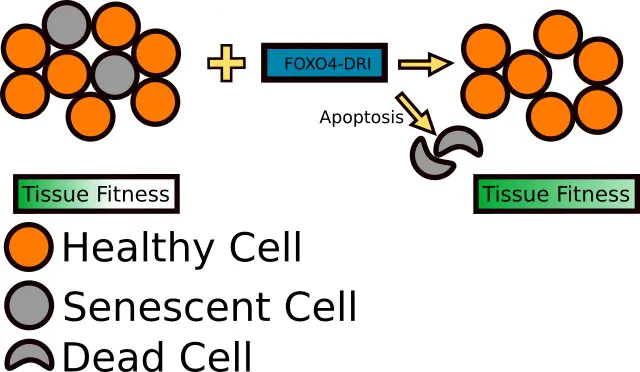
FOXO4-DRIは、生理学的隔離からP53を放出します。 P53タンパク質は、アポトーシスの老化細胞を標的とします。最終的な結果は、組織全体のフィットネスの増加であり、したがって組織および臓器レベルでの機能が改善されました。改善された組織機能は、生物学的年齢の低下と呼ばれます。

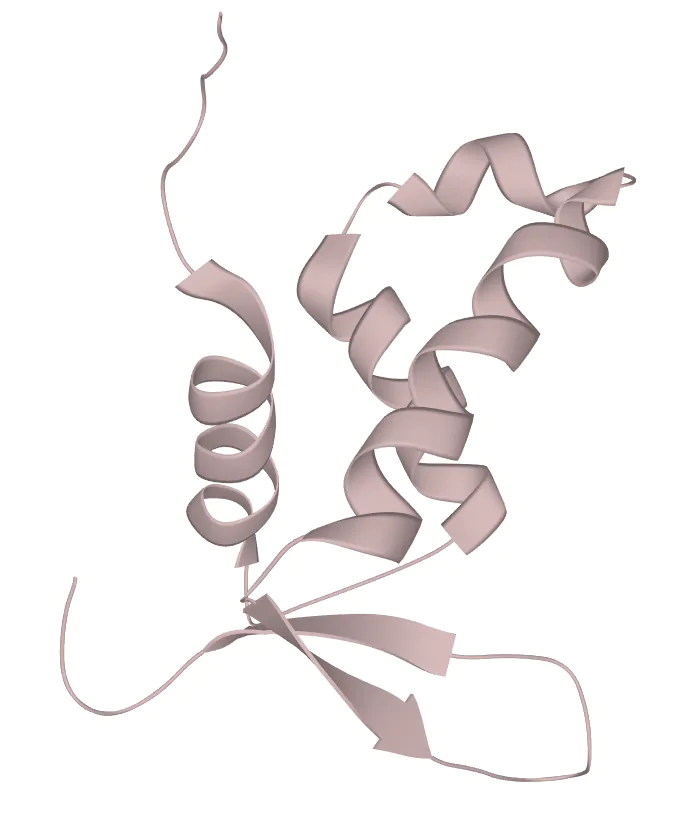
FOXO4-DRIペプチド構造

Source: Uniprot Sequence: H-D-Leu-D-Thr-D-Leu-D-Arg-D-Lys-D-Glu-D-Pro-D-Ala-D-Ser-D-Glu-D-Ile-D-Ala-D-Gln-D-Ser-D-Ile-D-Leu-D-Glu-D-Ala-D-Tyr-D-Ser-D-Gln-D-Asn-D-Gly-D-Trp-D-Ala-D-Asn-D-Arg-D-Arg-D-Ser-D-Gly-D-Gly-D-Lys-D-Arg-D-Pro-D-Pro-D-Pro-D-Arg-D-Arg-D-Arg-D-Gln-D-Arg-D-Arg-D-Lys-D-Lys-D-Arg-D-Gly-OH Molecular Formula: C228H388N86O64 Molecular Weight: 5358.05 Synonyms: Forkhead box protein O4, Proxofim, FOXO4a, AFX, AFX1, MLLT7

Foxo4-driの老化と老化

The relationship between FOXO4 and aging is complex and still not fully understood. There is, however, good evidence that helps to elucidate the mechanisms by which the protein has its effects. Research in the well-studied nematode C. elegans shows that FOXO4 affects insulin-like growth factor receptor signaling and thus cellular lifespan control, stress resistance, and gene regulation[3]. It also appears that FOXO4 interacts with the p53 protein to regulate the cell cycle.

Natural FOXO4 actually protects senescent cells by keeping p53, a regulator of the cell cycle, sequestered and unable to induce apoptosis. FOXO4-DRI disrupts the normal FOXO4/p53 mechanism and allows the latter protein to induce apoptosis in senescent cells. The result is an amelioration of senescence-associated loss of tissue homeostasis[4][5]。科学者は、これを老化細胞の治療的除去による若返りと呼んでいます。プロセスは、果樹を剪定することとそれほど違いはありません。死んだ枝と損傷した枝(老化細胞)を除去することにより、エネルギーは木のより健康的な部分にリダイレクトされ、したがって果物の生産と成長に向けられます。全体的な不健康な機能に寄与している細胞が除去されている場合、この同じプロセスが臓器と組織レベルで発生し、健康な細胞にリソースを焦点を合わせます。
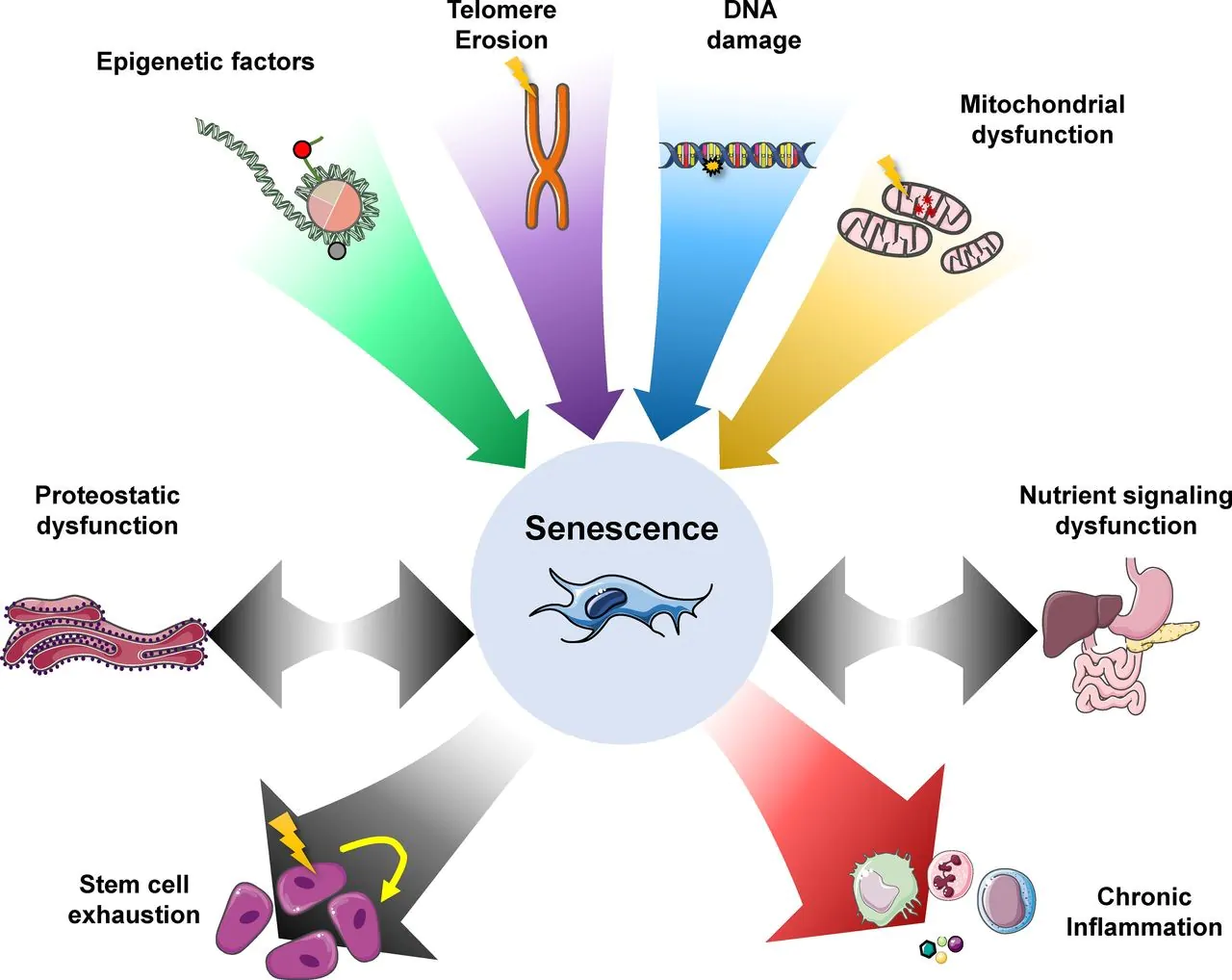
Source: Journal of Cell Biology

この画像は、どの要因が老化に貢献するか、そして老化とは何かを示しています。老化細胞を排除しても、幹細胞の疲労は軽減されないが、それを遅くする可能性があることに注意してください。ただし、心臓病、脳卒中などの多くの状態の確立されたドライバーである慢性炎症を軽減するのに役立ちます。

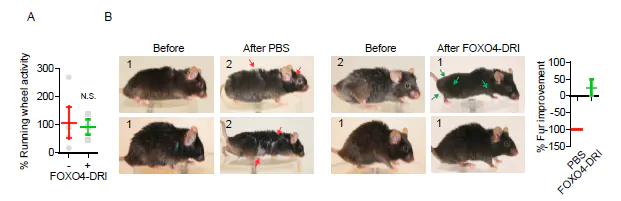
回復不可能な損傷は、体が修正する能力を超えた細胞損傷となるということですが、健康範囲への主要な制限の1つです。健康スパン、生物が健康で最適に機能する時間の長さは、一般に寿命よりも短いです。 HealthSpanの減少は老化として現れます。健康スパンを拡張する能力は、より多くの年に暮らすことはないかもしれませんが、それはより大きな健康と機能を備えた私たちに割り当てられた年に暮らすことにつながる可能性があります。マウスモデルでは、FOXO4は高齢マウスの健康スパンを改善し、フィットネス、毛皮密度、腎機能の増加につながることが示されています。マウスは必ずしも長生きするわけではありませんが、老年期までも健康が高く、障害が少なく、心臓病、筋骨格機能障害などの年齢に関連した状態が少なくなります。[2].
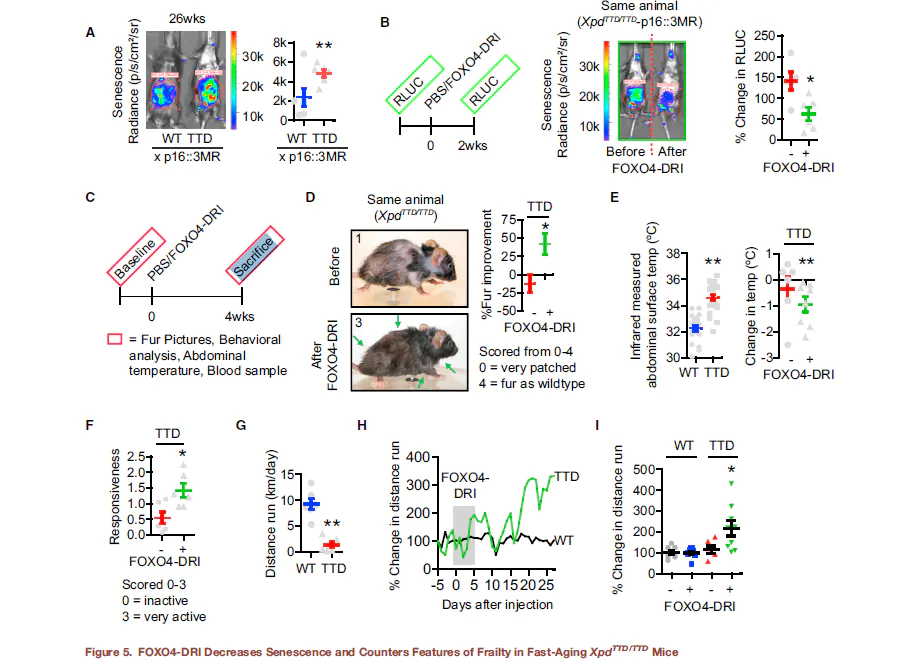
毛皮の密度で示されるように、フィットネスが改善された画像は、老化をモデル化するために使用される酸素毒性剤を受けた後にFOXO4-DRIで処理されたマウスでのマウスを示しています。
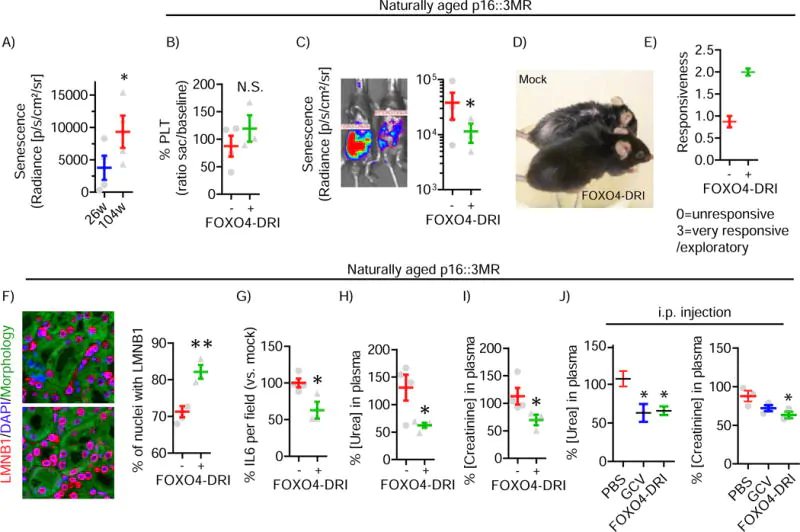
Source: Pubmed.

FOXO4-DRI研究

1。インスリンシグナル伝達

Foxoタンパク質はインスリンシグナル伝達の重要な調節因子であるが、インスリン自体とインスリン様成長因子の下流に作用することが長い間理解されてきました。動物モデルの研究は、Foxoが細胞代謝、成長、分化、酸化ストレスなどに対するインスリンとインスリン様成長因子の阻害剤効果を媒介することを示しています。 FOXOの変異は、インスリンシグナル伝達の病理学的変化と、癌と同様に代謝疾患の発症に関連しています。糖尿病患者では、FOXOシグナル伝達の変化は、断食高血糖と高脂血症につながります[6]。後者は、腎臓の損傷、脳卒中、心臓発作、創傷治癒障害など、疾患の合併症の多くにつながるため、糖尿病の最も懸念される側面の1つです。糖尿病におけるFOXOシグナル伝達を調節する能力は、病気の深刻な合併症の一部を予防する、より標的、より効果的な方法を提供する可能性があります。 FOXO4-DRIがインスリンシグナル伝達にどのように影響するかは不明ですが、タンパク質は空腹時血糖レベルを低下させることによりインスリンの下流効果を改善できると考えられています。

2。心臓病

年齢は心血管疾患の危険因子です。このリスクは、心臓のプロテアソーム活性の減少によって媒介されるようです。プロテアソームは、細胞が「損傷」または機能不全としてマークした酸化タンパク質およびその他のタンパク質を除去する原因です。ラットの研究は、年齢がプロテアソーム活性と逆相関しているため、心臓内の損傷したタンパク質のレベルが増加することを示しています。[7].

FOXOタンパク質は、オートファジーとプロテアソーム活性を媒介します。 FOXO4レベルの増加は、プロテアソーム活性の増加につながり、したがって特定の組織内の酸化とタンパク質損傷のレベルが低下しました。 FOXO4-DRIまたはそのバリアントを使用して、心臓の自然な家政施設を高め、心血管機能の年齢に関連した変化を減らすことができる可能性があります。[8].

3。神経変性疾患

Age-related changes in cognitive function have a complex etiology. Even relatively common diseases, like Alzheimer’s disease, are not fully understood by the medical community. There is some evidence, however, to support the notion that changes in proteasome activity can lead to or exacerbate underlying neurodegenerative conditions. It isn’t clear if impaired proteasome activity is a primary cause or secondary contributor to diseases like Alzheimer’s disease, but impairment of the systems has been found in Parkinson’s, Alzheimer’s, Huntington’s, and Prion disease. There is also impairment of proteasome function in amyotrophic lateral sclerosis (ALS or Lou Gehrig’s disease) [9].

It appears that FOXO proteins are modified in the central nervous system, a finding that has led researchers to explore the idea that exogenous FOXO protein may be useful in treating or preventing neurodegenerative disorders. At the very least, there is hope that FOXO4-DRI and other modified FOXO proteins may be useful in slowing the relentless progression of neurodegenerative disorders [10].

まとめ

FOXO4-DRIは、老化した細胞のアポトーシスを高めることが明確に実証されており、動物モデルの組織機能の改善と全体的な健康の改善につながります。 FOXO4-driの影響がどれほど広範囲であるかはまだわかりませんが、タンパク質が認知症、心臓病、細胞老化によって引き起こされる機能の一般的な機能の喪失などの年齢に関連する状態に対する洞察を解き放つことができるという希望があります。

FOXO4-DRI exhibits minimal side effects, low oral and excellent subcutaneous bioavailability in mice. Per kg dosage in mice does not scale to humans. FOXO4-DRI for sale at Peptide Gurus is limited to educational and scientific research only, not for human consumption. Only buy FOXO4-DRI if you are a licensed researcher.

記事著者

The above literature was researched, edited and organized by Dr. Logan, M.D. Dr. Logan holds a doctorate degree from Case Western Reserve University School of Medicine and a B.S. in molecular biology.

Scientific Journalの著者

The aim of Dr. Peter de Keizer’s group is to unravel the molecular mechanisms that cause cells to become senescent and to identify how these cells drive aging and age-related diseases. The role of senescence in late-stage therapy-resistant cancer is a major component of this research. The research has a strong translational component and a spearpoint of the group is to develop methods to target the deleterious effects of senescent and senescent-like cancer cells, for instance by eliminating them altogether. In 2004, Peter obtained his MSc in Biomolecular Science form Utrecht University. The final part of his training was performed at Harvard Medical School / Massachusetts General Hospital in Boston, USA. Here, he focused on therapy-resistant Glioblastoma, the most lethal form of brain cancer, something which is now on of the focus areas of the group. In 2009, Peter obtained his PhD from UMC Utrecht on the regulation of FOXO proteins under conditions of stress and their role in tumor suppression. Dr. Peter de Keizer is being referenced as one of the leading scientists involved in the research and development of FOXO4-DRI. In no way is this doctor/scientist endorsing or advocating the purchase, sale, or use of this product for any reason. There is no affiliation or relationship, implied or otherwise, between Peptide Gurus and this doctor. The purpose of citing the doctor is to acknowledge, recognize, and credit the exhaustive research and development efforts conducted by the scientists studying this peptide. Dr. Peter de Keizer is listed in [2] under the referenced citations.

参照された引用

  1.     W. Liu, Y. Song, J. Wang, H. Xiao, Y. Zhang, and B. Luo, “Dysregulation of FOXO transcription factors in Epstein-Barr virus-associated gastric carcinoma,” Virus Res.、p。 197808、2019年11月。
  2.     Baar, Marjolein P, et al. “Targeted Apoptosis of Senescent Cells Restores Tissue Homeostasis in Response to Chemotoxicity and Aging.” Cell, vol. 169, no. 1, 2017, pp. 132-147.e16, www.ncbi.nlm.nih.gov/pubmed/28340339, 10.1016/j.cell.2017.02.031. 
  3.     A. T.-Y. Chen et al., “Longevity Genes Revealed by Integrative Analysis of Isoform-Specific daf-16/FoxO Mutants of Caenorhabditis elegans,” Genetics、Vol。 201、no。 2、pp。613–629、2015年10月。
  4.     P. Krimpenfort and A. Berns, “Rejuvenation by Therapeutic Elimination of Senescent Cells,” Cell、Vol。 169、いいえ。 1、pp。3–5、23 2017。
  5. 「老化と老化:原因、結果、および治療的手段| jcb。」 [オンライン]。利用可能:http://jcb.rupress.org/content/217/1/65。 [アクセス:2019年11月17日]。
  6.     S. Lee and H. H. Dong, “FoxO integration of insulin signaling with glucose and lipid metabolism,” J. Endocrinol.、Vol。 233、いいえ。 2、pp。R67– R79、2017。
  7.     A.-L. Bulteau, L. I. Szweda, and B. Friguet, “Age-dependent declines in proteasome activity in the heart,” Arch. Biochem. Biophys.、Vol。 397、いいえ。 2、pp。298–304、2002年1月。
  8.     G. Murtaza, A. K. Khan, R. Rashid, S. Muneer, S. M. F. Hasan, and J. Chen, “FOXO Transcriptional Factors and Long-Term Living,” Oxid. Med. Cell. Longev.、Vol。 2017、2017。
  9.     A. Ciechanover and P. Brundin, “The ubiquitin proteasome system in neurodegenerative diseases: sometimes the chicken, sometimes the egg,” Neuron、Vol。 40、いいえ。 2、pp。427–446、2003年10月。
  10.   W. Hu et al., “Roles of forkhead box O (FoxO) transcription factors in neurodegenerative diseases: A panoramic view,” Prog. Neurobiol.、Vol。 181、p。 101645、2019年10月。
ALL ARTICLES AND PRODUCT INFORMATION PROVIDED ON THIS WEBSITE ARE FOR INFORMATIONAL AND EDUCATIONAL PURPOSES ONLY. このウェブサイトで提供される製品は、ビトロ内の研究のためにのみ提供されています。 in-vitro研究(ラテン語:ガラス)は体の外側で行われます。これらの製品は薬や薬ではなく、病状、病気、病気を予防、治療、治療するためにFDAによって承認されていません。あらゆる種類の人間や動物への身体導入は、法律によって厳密に禁じられています。

お問い合わせをリクエストしてください

ABOUT US

Peptidegurusは、アメリカ製の研究ペプチドの大手サプライヤーであり、競争力のある価格で最高品質の製品を提供しています。卓越性と顧客サービスに重点を置いて、彼らはグローバルな配送で安全で便利な注文プロセスを保証します。

見積もりをリクエストしてください

  • ペプチドグル
  • info@peptidegurus.com
  • グレンデール、それは、アメリカ
  • 接触

    お問い合わせをリクエストしてください